 Add to Chrome
 Add to Firefox
 Add to Edge
MindGap: A Conversational AI Framework for Upstream Neuroplastic Intervention in Post-Traumatic Stress Disorder
May 14, 2026
Post-Traumatic Stress Disorder (PTSD) is fundamentally a neuroplastic problem traumatic contact events encode over-reactive neural pathways through Hebbian long-term potentiation, producing hair-triggered amygdala-HPA stress cascades that fire before conscious awareness can intercept them. Existing therapeutic approaches, prolonged exposure, EMDR, cognitive behavioural therapy, operate predominantly downstream of the reactive cascade, teaching patients to tolerate or reframe distress after it has arisen. While clinically valuable, these suppression-based approaches do not produce the upstream pathway dissolution that constitutes lasting structural neural reorganisation. This paper proposes MindGap, a privacy-preserving on-device conversational AI framework that delivers structured neuroplastic rehabilitation for PTSD through the practice of dependent origination, a Buddhist psychological framework that identifies the precise moment between the pre-cognitive affective signal and the reactive elaboration that follows as the site of therapeutic intervention. MindGap guides patients through three progressive layers of observation at this feeling tone gap: noticing the bare affective signal before reactive elaboration, recognising it as self-arising rather than caused by the stimulus, and recognising the conditioned implicit belief beneath the feeling. Each layer corresponds to progressively deeper prefrontal regulatory engagement and progressively deeper long-term depression-mediated weakening of the reactive pathway, producing genuine upstream dissolution rather than downstream suppression. Running entirely on-device with no data egress, MindGap delivers daily calibrated exposure sessions through a fine-tuned lightweight large language model, making it deployable in sensitive clinical and military contexts where cloud-based solutions are not permitted.

Standardization of Neuromuscular Reflex Analysis -- Role of Fine-Tuned Vision-Language Model Consortium and OpenAI gpt-oss Reasoning LLM Enabled Decision Support System
Aug 17, 2025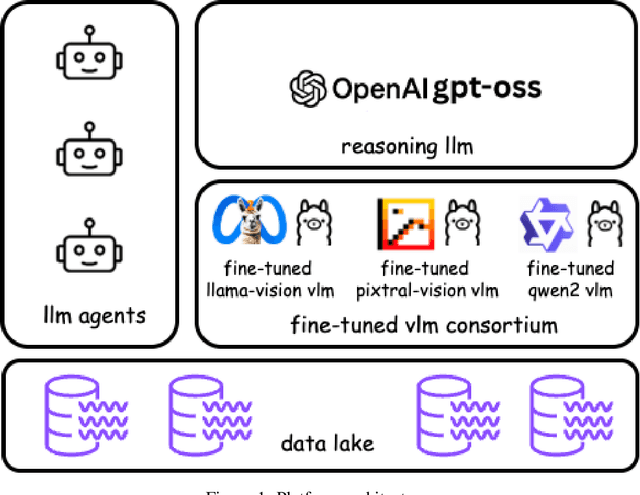

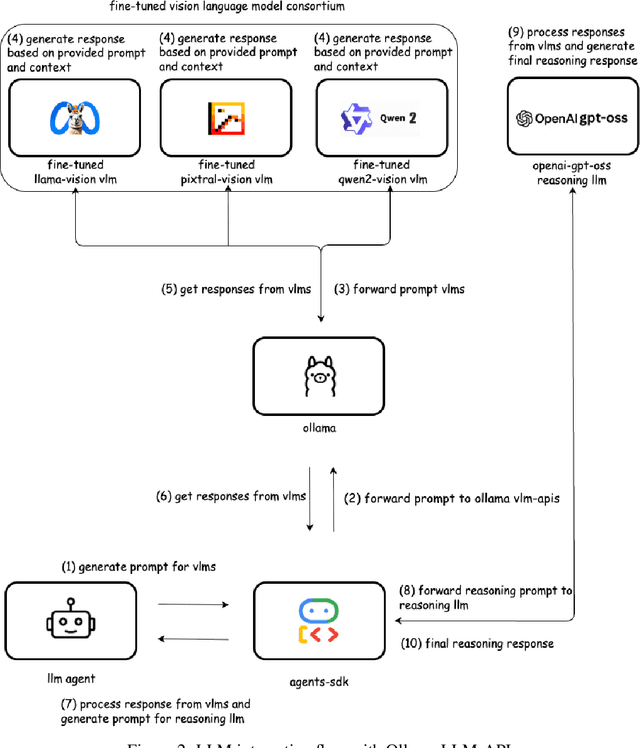
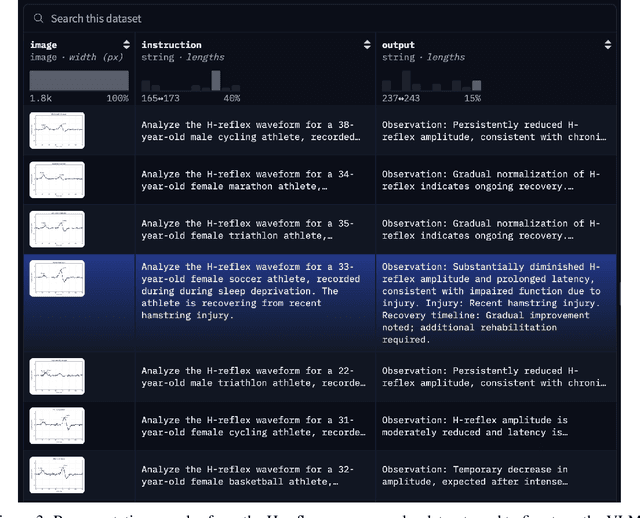
Accurate assessment of neuromuscular reflexes, such as the H-reflex, plays a critical role in sports science, rehabilitation, and clinical neurology. Traditional analysis of H-reflex EMG waveforms is subject to variability and interpretation bias among clinicians and researchers, limiting reliability and standardization. To address these challenges, we propose a Fine-Tuned Vision-Language Model (VLM) Consortium and a reasoning Large-Language Model (LLM)-enabled Decision Support System for automated H-reflex waveform interpretation and diagnosis. Our approach leverages multiple VLMs, each fine-tuned on curated datasets of H-reflex EMG waveform images annotated with clinical observations, recovery timelines, and athlete metadata. These models are capable of extracting key electrophysiological features and predicting neuromuscular states, including fatigue, injury, and recovery, directly from EMG images and contextual metadata. Diagnostic outputs from the VLM consortium are aggregated using a consensus-based method and refined by a specialized reasoning LLM, which ensures robust, transparent, and explainable decision support for clinicians and sports scientists. The end-to-end platform orchestrates seamless communication between the VLM ensemble and the reasoning LLM, integrating prompt engineering strategies and automated reasoning workflows using LLM Agents. Experimental results demonstrate that this hybrid system delivers highly accurate, consistent, and interpretable H-reflex assessments, significantly advancing the automation and standardization of neuromuscular diagnostics. To our knowledge, this work represents the first integration of a fine-tuned VLM consortium with a reasoning LLM for image-based H-reflex analysis, laying the foundation for next-generation AI-assisted neuromuscular assessment and athlete monitoring platforms.