 Add to Chrome
 Add to Firefox
 Add to Edge
MiST: Understanding the Role of Mid-Stage Scientific Training in Developing Chemical Reasoning Models
Dec 24, 2025
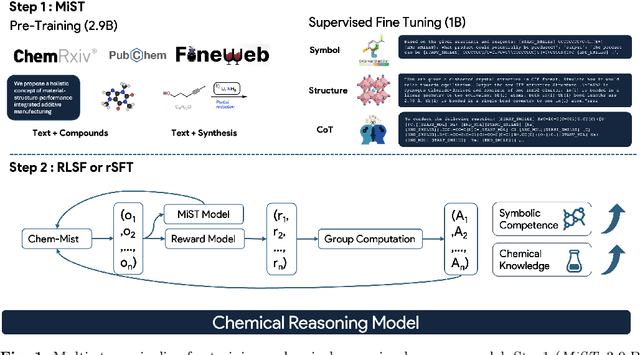
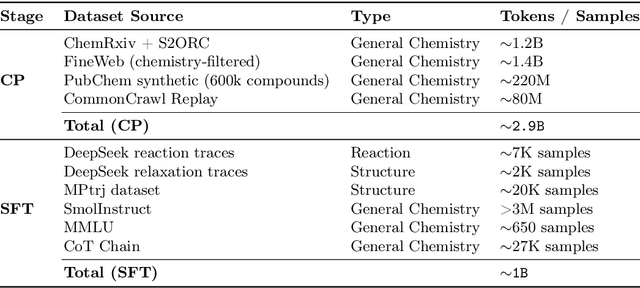
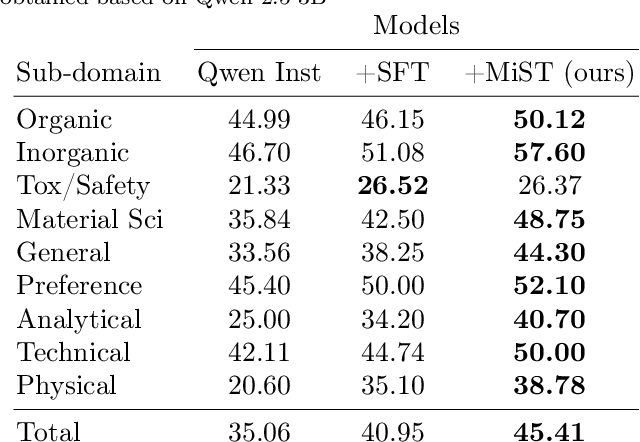
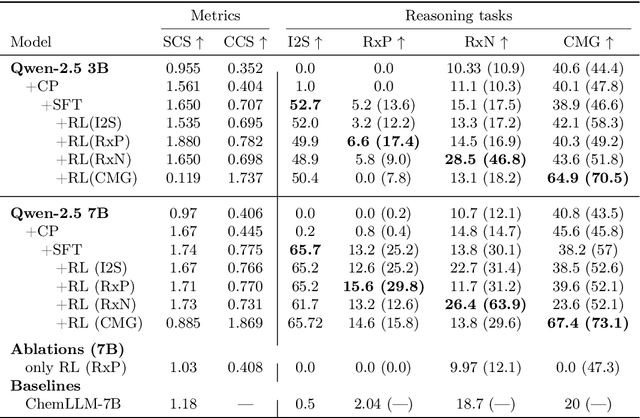
Large Language Models can develop reasoning capabilities through online fine-tuning with rule-based rewards. However, recent studies reveal a critical constraint: reinforcement learning succeeds only when the base model already assigns non-negligible probability to correct answers -- a property we term 'latent solvability'. This work investigates the emergence of chemical reasoning capabilities and what these prerequisites mean for chemistry. We identify two necessary conditions for RL-based chemical reasoning: 1) Symbolic competence, and 2) Latent chemical knowledge. We propose mid-stage scientific training (MiST): a set of mid-stage training techniques to satisfy these, including data-mixing with SMILES/CIF-aware pre-processing, continued pre-training on 2.9B tokens, and supervised fine-tuning on 1B tokens. These steps raise the latent-solvability score on 3B and 7B models by up to 1.8x, and enable RL to lift top-1 accuracy from 10.9 to 63.9% on organic reaction naming, and from 40.6 to 67.4% on inorganic material generation. Similar results are observed for other challenging chemical tasks, while producing interpretable reasoning traces. Our results define clear prerequisites for chemical reasoning training and highlight the broader role of mid-stage training in unlocking reasoning capabilities.

Open-Source Fermionic Neural Networks with Ionic Charge Initialization
Jan 16, 2024Finding accurate solutions to the electronic Schr\"odinger equation plays an important role in discovering important molecular and material energies and characteristics. Consequently, solving systems with large numbers of electrons has become increasingly important. Variational Monte Carlo (VMC) methods, especially those approximated through deep neural networks, are promising in this regard. In this paper, we aim to integrate one such model called the FermiNet, a post-Hartree-Fock (HF) Deep Neural Network (DNN) model, into a standard and widely used open source library, DeepChem. We also propose novel initialization techniques to overcome the difficulties associated with the assignment of excess or lack of electrons for ions.