 Add to Chrome
 Add to Firefox
 Add to Edge
AdsMind: A Physics-Grounded Multi-Agent System for Self-Correcting Discovery of Adsorption Configurations on Heterogeneous Catalyst Surfaces
Jun 17, 2026
Identifying the lowest-energy surface-adsorbate configuration is critical for modeling heterogeneous catalysis, yet exhaustive exploration with ab initio calculations is computationally prohibitive. Machine-learning force fields (MLFFs) accelerate structural relaxation but leave the search over the vast configurational space a major bottleneck, and open-loop large language model (LLM) agents lack a physics-grounded feedback mechanism to correct erroneous initial guesses. We propose AdsMind (Adsorption configuration discovery with Machine intelligence and relaxation feedback), a closed-loop multi-agent framework that enables autonomous error correction through MLFF relaxation feedback. Across four LLM backends, AdsMind achieves consistently high search reliability, with success rates of 100% and 98.8% on the benchmarks AA20 and OCD-GMAE62. Relative to its single-pass (1-Shot) ablation it reduces cross-backend energy dispersion, and it uses only 4.11 and 4.67 MLFF relaxations per case, respectively -- an approximately 14-fold reduction over heuristic enumeration baselines. Density functional theory (DFT) validation using VASP/PBE on six representative AA20 systems shows that the reported open-loop Adsorb-Agent outputs exhibit qualitative adsorption-energy sign errors for molecular adsorbates, whereas AdsMind preserves the correct sign in all tested cases with closer quantitative agreement. AdsMind thus delivers reliability, self-reflection, and interpretability simultaneously, supporting more DFT-informed autonomous chemistry workflows.

MiST: Understanding the Role of Mid-Stage Scientific Training in Developing Chemical Reasoning Models
Dec 24, 2025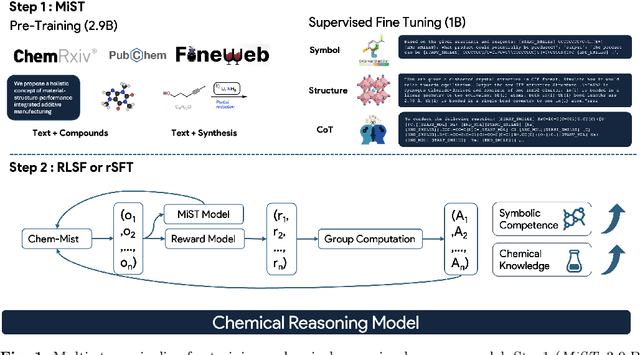
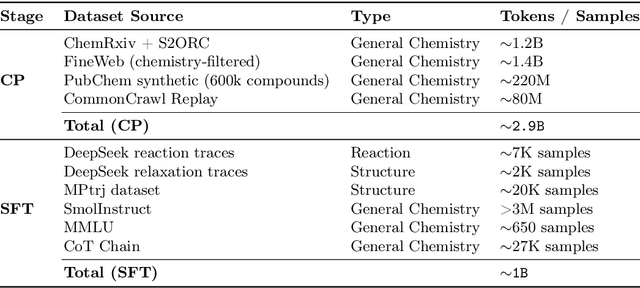
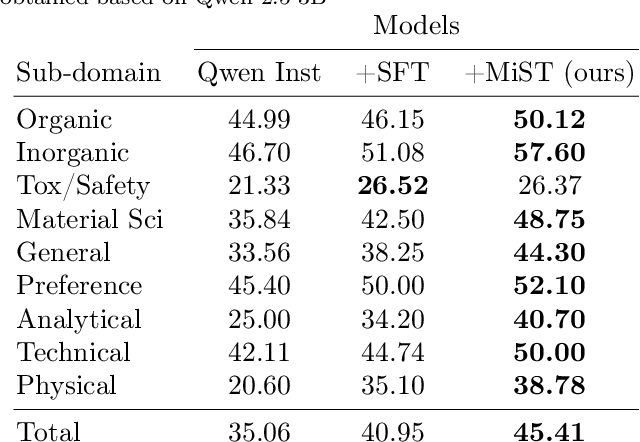
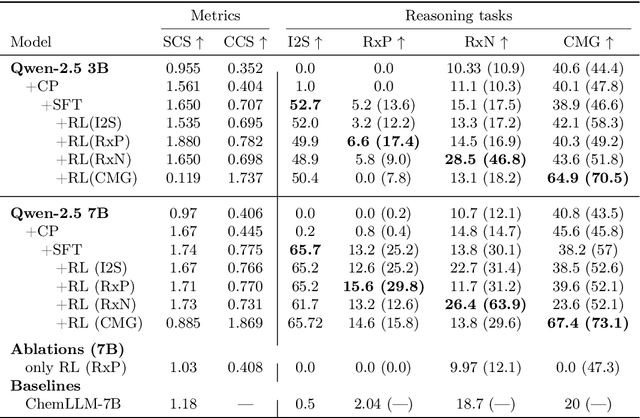
Large Language Models can develop reasoning capabilities through online fine-tuning with rule-based rewards. However, recent studies reveal a critical constraint: reinforcement learning succeeds only when the base model already assigns non-negligible probability to correct answers -- a property we term 'latent solvability'. This work investigates the emergence of chemical reasoning capabilities and what these prerequisites mean for chemistry. We identify two necessary conditions for RL-based chemical reasoning: 1) Symbolic competence, and 2) Latent chemical knowledge. We propose mid-stage scientific training (MiST): a set of mid-stage training techniques to satisfy these, including data-mixing with SMILES/CIF-aware pre-processing, continued pre-training on 2.9B tokens, and supervised fine-tuning on 1B tokens. These steps raise the latent-solvability score on 3B and 7B models by up to 1.8x, and enable RL to lift top-1 accuracy from 10.9 to 63.9% on organic reaction naming, and from 40.6 to 67.4% on inorganic material generation. Similar results are observed for other challenging chemical tasks, while producing interpretable reasoning traces. Our results define clear prerequisites for chemical reasoning training and highlight the broader role of mid-stage training in unlocking reasoning capabilities.
Reflections from the 2024 Large Language Model (LLM) Hackathon for Applications in Materials Science and Chemistry
Nov 20, 2024


Here, we present the outcomes from the second Large Language Model (LLM) Hackathon for Applications in Materials Science and Chemistry, which engaged participants across global hybrid locations, resulting in 34 team submissions. The submissions spanned seven key application areas and demonstrated the diverse utility of LLMs for applications in (1) molecular and material property prediction; (2) molecular and material design; (3) automation and novel interfaces; (4) scientific communication and education; (5) research data management and automation; (6) hypothesis generation and evaluation; and (7) knowledge extraction and reasoning from scientific literature. Each team submission is presented in a summary table with links to the code and as brief papers in the appendix. Beyond team results, we discuss the hackathon event and its hybrid format, which included physical hubs in Toronto, Montreal, San Francisco, Berlin, Lausanne, and Tokyo, alongside a global online hub to enable local and virtual collaboration. Overall, the event highlighted significant improvements in LLM capabilities since the previous year's hackathon, suggesting continued expansion of LLMs for applications in materials science and chemistry research. These outcomes demonstrate the dual utility of LLMs as both multipurpose models for diverse machine learning tasks and platforms for rapid prototyping custom applications in scientific research.