 Add to Chrome
 Add to Firefox
 Add to Edge
From Knowledge to Action: Outcomes of the 2025 Large Language Model (LLM) Hackathon for Applications in Materials Science and Chemistry
May 04, 2026
Large language models (LLMs) are rapidly changing how researchers in materials science and chemistry discover, organize, and act on scientific knowledge. This paper analyzes a broad set of community-developed LLM applications in an effort to identify emerging patterns in how these systems can be used across the scientific research lifecycle. We organize the projects into two complementary categories: Knowledge Infrastructure, systems that structure, retrieve, synthesize, and validate scientific information; and Action Systems, systems that execute, coordinate, or automate scientific work across computational and experimental environments. The submissions reveal a shift from single-purpose LLM tools toward integrated, multi-agent workflows that combine retrieval, reasoning, tool use, and domain-specific validation. Prominent themes include retrieval-augmented generation as grounding infrastructure, persistent structured knowledge representations, multimodal and multilingual scientific inputs, and early progress toward laboratory-integrated closed-loop systems. Together, these results suggest that LLMs are evolving from general-purpose assistants into composable infrastructure for scientific reasoning and action. This work provides a community snapshot of that transition and a practical taxonomy for understanding emerging LLM-enabled workflows in materials science and chemistry.

MiST: Understanding the Role of Mid-Stage Scientific Training in Developing Chemical Reasoning Models
Dec 24, 2025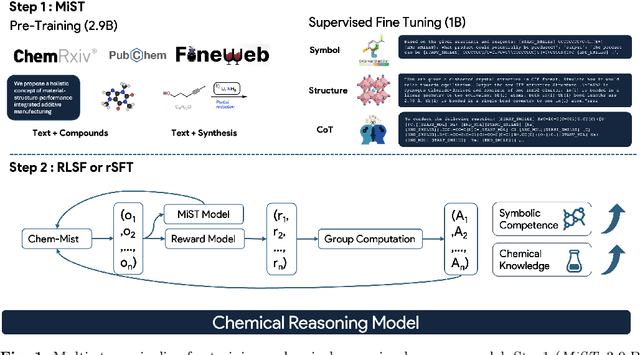
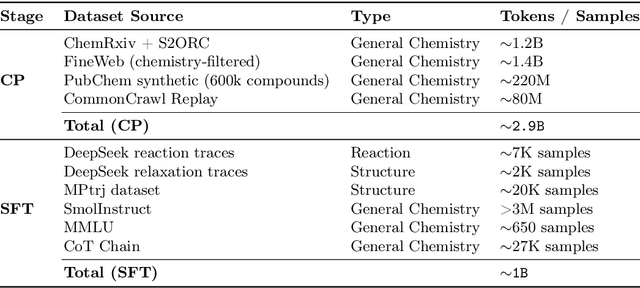
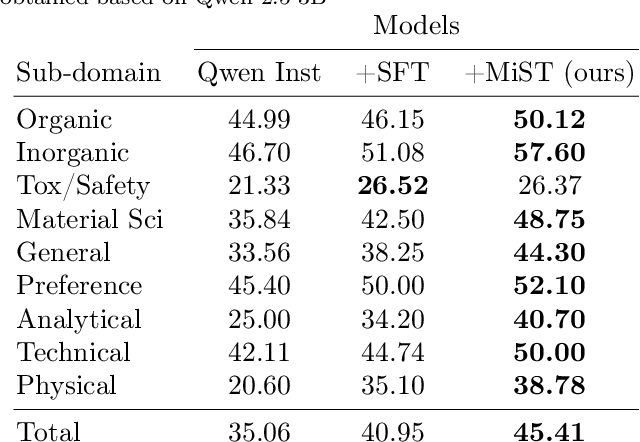
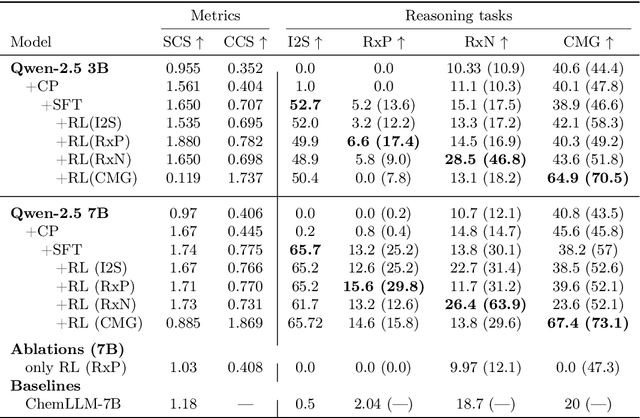
Large Language Models can develop reasoning capabilities through online fine-tuning with rule-based rewards. However, recent studies reveal a critical constraint: reinforcement learning succeeds only when the base model already assigns non-negligible probability to correct answers -- a property we term 'latent solvability'. This work investigates the emergence of chemical reasoning capabilities and what these prerequisites mean for chemistry. We identify two necessary conditions for RL-based chemical reasoning: 1) Symbolic competence, and 2) Latent chemical knowledge. We propose mid-stage scientific training (MiST): a set of mid-stage training techniques to satisfy these, including data-mixing with SMILES/CIF-aware pre-processing, continued pre-training on 2.9B tokens, and supervised fine-tuning on 1B tokens. These steps raise the latent-solvability score on 3B and 7B models by up to 1.8x, and enable RL to lift top-1 accuracy from 10.9 to 63.9% on organic reaction naming, and from 40.6 to 67.4% on inorganic material generation. Similar results are observed for other challenging chemical tasks, while producing interpretable reasoning traces. Our results define clear prerequisites for chemical reasoning training and highlight the broader role of mid-stage training in unlocking reasoning capabilities.
AtomWorld: A Benchmark for Evaluating Spatial Reasoning in Large Language Models on Crystalline Materials
Oct 06, 2025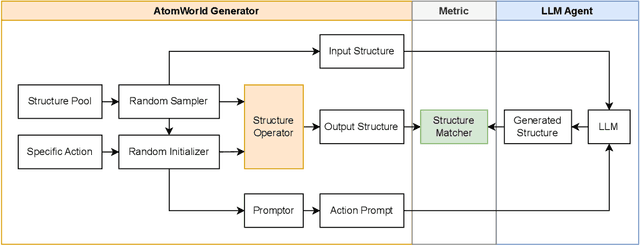
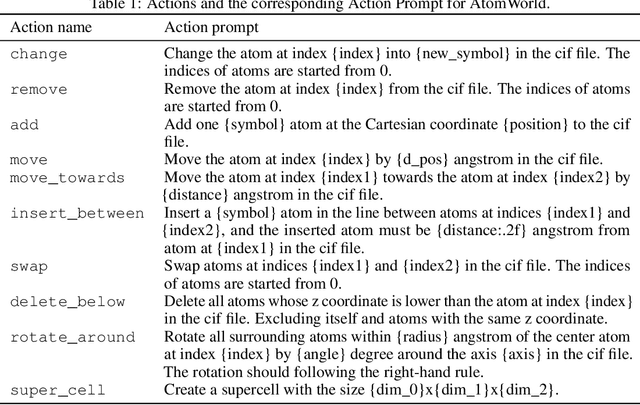
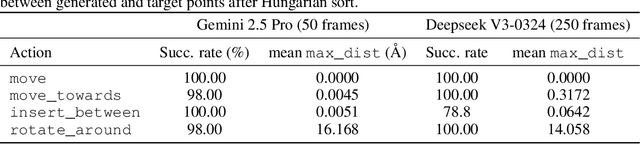
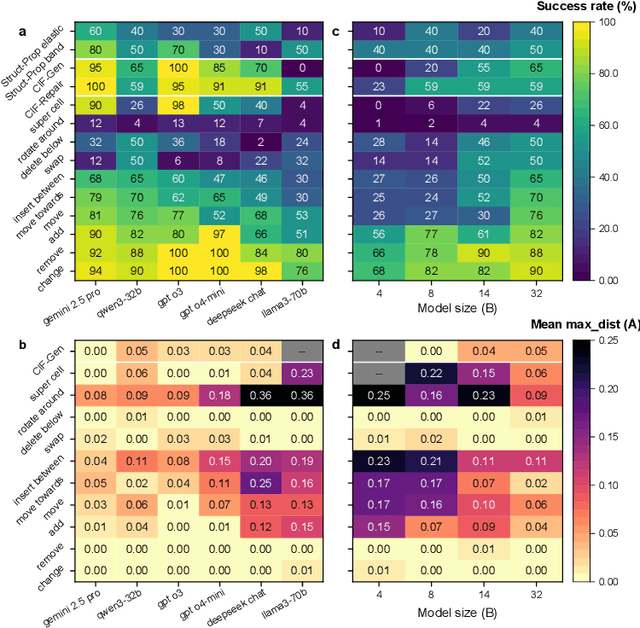
Large Language Models (LLMs) excel at textual reasoning and are beginning to develop spatial understanding, prompting the question of whether these abilities can be combined for complex, domain-specific tasks. This question is essential in fields like materials science, where deep understanding of 3D atomic structures is fundamental. While initial studies have successfully applied LLMs to tasks involving pure crystal generation or coordinate understandings, a standardized benchmark to systematically evaluate their core reasoning abilities across diverse atomic structures has been notably absent. To address this gap, we introduce the AtomWorld benchmark to evaluate LLMs on tasks based in Crystallographic Information Files (CIFs), a standard structure representation format. These tasks, including structural editing, CIF perception, and property-guided modeling, reveal a critical limitation: current models, despite establishing promising baselines, consistently fail in structural understanding and spatial reasoning. Our experiments show that these models make frequent errors on structure modification tasks, and even in the basic CIF format understandings, potentially leading to cumulative errors in subsequent analysis and materials insights. By defining these standardized tasks, AtomWorld lays the ground for advancing LLMs toward robust atomic-scale modeling, crucial for accelerating materials research and automating scientific workflows.