 Add to Chrome
 Add to Firefox
 Add to Edge
GCNO: Gramian Chebyshev Neural Operator for Physics-Based Compression of Wireless Channels
Aug 19, 2026
Large antenna arrays allow wireless systems to serve more users and achieve higher data rates, but they also make channel feedback expensive: the receiving device must repeatedly report a large complex-valued channel matrix to the base station. Most neural compressors treat this matrix like an image and replace it with a fixed-length code that only a matched neural decoder can interpret. The message therefore does not adapt to channel complexity, and changing the antenna count typically requires retraining. We ask whether a device can instead report only the few dominant propagation paths underlying each channel. We introduce the Gramian Chebyshev Neural Operator (GCNO), a physics-based, variable-rate compressor that identifies a sample-dependent set of path directions. GCNO uses receive-transmit channel structure to locate paths, a first-order Taylor correction to refine directions that fall between grid points, and least squares to recover their complex strengths. It is trained without path labels, and the base station reconstructs the channel analytically from the transmitted path tuples rather than through a learned decoder. Across three ray-traced environments, GCNO achieves better reconstruction accuracy at the same payload - or lower payload at the same accuracy - than neural feedback baselines, and transfers to unseen antenna counts without retraining.

Unlocking Realism and Interpretability in Wireless Channel Synthesis: A Physics-Guided Generative Approach
Jun 22, 2026In recent years, machine learning (ML) methods have become increasingly popular for wireless communication systems. These require large amounts of data reflecting the behavior of realistic channels with high fidelity. However, sampling over-the-air (OTA) channel data is an extremely resource-intensive process which cannot accurately represent the variety of real world channels. This results in the need for realistic training data for ML systems. To this end, generative models have been proposed to synthesize channel data. However,(i) the outputs produced by such methods may not correspond to physically viable channels, (ii) the outputs may not provide insights into the associated environment, and (iii) training the generative model may need labeled data, requiring resource intensive data annotation. Through this work, we address these issues by integrating a parametric, physics-based geometric channel (PPGC) modeling framework derived from planar wave propagation equations, with generative methods to produce realistic channel matrices with interpretable representations in the parameter domain. To overcome the limitations of the resulting non-convex optimization landscape, we propose a linearized reformulation of the PPGC model to ensure smooth gradient flow during training, while also providing insights into the underlying physical environment. We incorporate a tensor decomposition framework into the linearized reformulation to allow for flexibility in the number of wireless channel parameters. We also show the compatibility of this reformulation with parameter extraction tasks. We evaluate our model against prior baselines by comparing generated, scenario-specific samples to true channels in terms of their similarity and through their utility in downstream compression tasks.
LWM-CDE: A Representation Space for Wireless Data Reasoning and Transferability
May 22, 2026Machine learning deployments in real-world wireless communication tasks face significant generalization challenges due to location and environment-specific signal structure, high diversity in data across different deployments, and limited availability of real-world data. Current approaches for assessing data similarity between training and inference (deployment) distributions, as well as evaluating model transferability, suffer from high computational costs and inconsistent performance, leaving critical model deployment and model life cycle management decisions without a principled foundation. To address this, we introduce a dataset similarity framework built upon the feature space of a pretrained wireless foundation model. Our method, LWM-CDE (Contrastive learning of Dataset Embedding), fine-tunes the dataset embeddings of the foundation model using a combination of contrastive and geometry-shaping losses, creating a structured manifold where distance reliably indicates transferability. Extensive experiments on wireless benchmarks show that LWM-CDE achieves stronger correlation with empirical transfer performance than existing metrics while being more computationally efficient. The learned representation space supports more effective and data-efficient decision-making for tasks like source dataset selection, label-aware augmentation, and budgeted pretraining, demonstrating its broader utility across different wireless communication applications.
From Fewer Samples to Fewer Bits: Reframing Dataset Distillation as Joint Optimization of Precision and Compactness
Mar 02, 2026Dataset Distillation (DD) compresses large datasets into compact synthetic ones that maintain training performance. However, current methods mainly target sample reduction, with limited consideration of data precision and its impact on efficiency. We propose Quantization-aware Dataset Distillation (QuADD), a unified framework that jointly optimizes dataset compactness and precision under fixed bit budgets. QuADD integrates a differentiable quantization module within the distillation loop, enabling end-to-end co-optimization of synthetic samples and quantization parameters. Guided by the rate-distortion perspective, we empirically analyze how bit allocation between sample count and precision influences learning performance. Our framework supports both uniform and adaptive non-uniform quantization, where the latter learns quantization levels from data to represent information-dense regions better. Experiments on image classification and 3GPP beam management tasks show that QuADD surpasses existing DD and post-quantized baselines in accuracy per bit, establishing a new standard for information-efficient dataset distillation.
Wireless Dataset Similarity: Measuring Distances in Supervised and Unsupervised Machine Learning
Jan 03, 2026This paper introduces a task- and model-aware framework for measuring similarity between wireless datasets, enabling applications such as dataset selection/augmentation, simulation-to-real (sim2real) comparison, task-specific synthetic data generation, and informing decisions on model training/adaptation to new deployments. We evaluate candidate dataset distance metrics by how well they predict cross-dataset transferability: if two datasets have a small distance, a model trained on one should perform well on the other. We apply the framework on an unsupervised task, channel state information (CSI) compression, using autoencoders. Using metrics based on UMAP embeddings, combined with Wasserstein and Euclidean distances, we achieve Pearson correlations exceeding 0.85 between dataset distances and train-on-one/test-on-another task performance. We also apply the framework to a supervised beam prediction in the downlink using convolutional neural networks. For this task, we derive a label-aware distance by integrating supervised UMAP and penalties for dataset imbalance. Across both tasks, the resulting distances outperform traditional baselines and consistently exhibit stronger correlations with model transferability, supporting task-relevant comparisons between wireless datasets.
Comparing Stochastic and Ray-tracing Datasets in Machine Learning for Wireless Applications
Dec 13, 2025Machine learning for wireless systems is commonly studied using standardized stochastic channel models (e.g., TDL/CDL/UMa) because of their legacy in wireless communication standardization and their ability to generate data at scale. However, some of their structural assumptions may diverge from real-world propagation. This paper asks when these models are sufficient and when ray-traced (RT) data - a proxy for the real world - provides tangible benefits. To answer these questions, we conduct an empirical study on two representative tasks: CSI compression and temporal channel prediction. Models are trained and evaluated using in-domain, cross-domain, and small-data fine-tuning protocols. Across settings, we observe that stochastic-only evaluation may over- or under-estimate performance relative to RT. These findings support a task-aware recipe where stochastic models can be leveraged for scalable pre-training and for tasks that do not rely on strong spatiotemporal coupling. When that coupling matters, pre-training and evaluation should be grounded in spatially consistent or geometrically similar RT scenarios. This study provides initial guidance to inform future discussions on benchmarking and standardization.
Physics-Informed Generative Approaches for Wireless Channel Modeling
Mar 11, 2025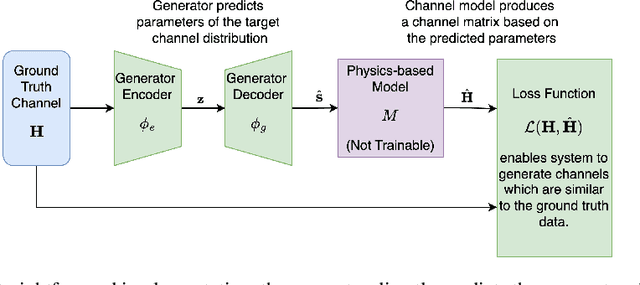
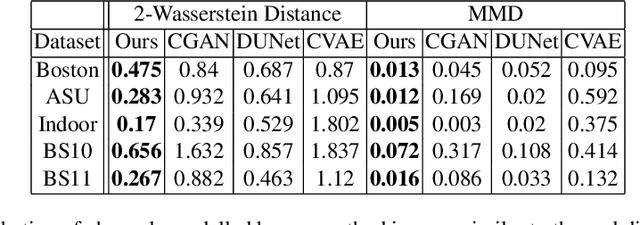
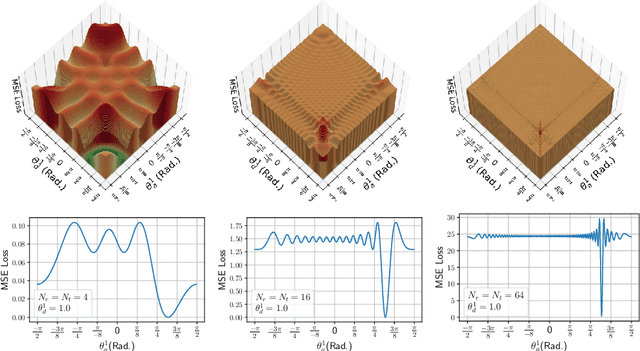

In recent years, machine learning (ML) methods have become increasingly popular in wireless communication systems for several applications. A critical bottleneck for designing ML systems for wireless communications is the availability of realistic wireless channel datasets, which are extremely resource intensive to produce. To this end, the generation of realistic wireless channels plays a key role in the subsequent design of effective ML algorithms for wireless communication systems. Generative models have been proposed to synthesize channel matrices, but outputs produced by such methods may not correspond to geometrically viable channels and do not provide any insight into the scenario of interest. In this work, we aim to address both these issues by integrating a parametric, physics-based geometric channel (PBGC) modeling framework with generative methods. To address limitations with gradient flow through the PBGC model, a linearized reformulation is presented, which ensures smooth gradient flow during generative model training, while also capturing insights about the underlying physical environment. We evaluate our model against prior baselines by comparing the generated samples in terms of the 2-Wasserstein distance and through the utility of generated data when used for downstream compression tasks.
A Dataset Similarity Evaluation Framework for Wireless Communications and Sensing
Dec 07, 2024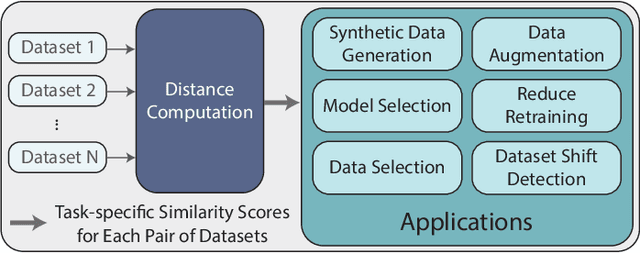
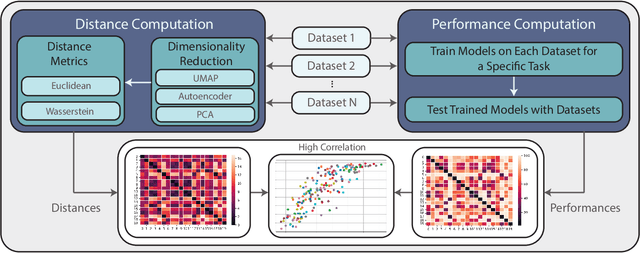
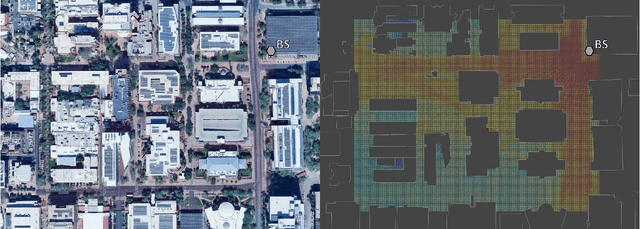
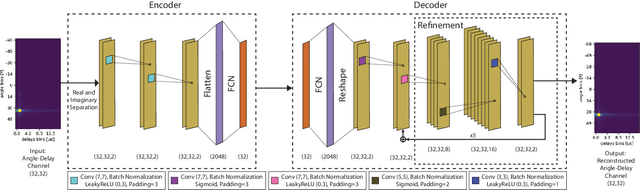
This paper introduces a task-specific, model-agnostic framework for evaluating dataset similarity, providing a means to assess and compare dataset realism and quality. Such a framework is crucial for augmenting real-world data, improving benchmarking, and making informed retraining decisions when adapting to new deployment settings, such as different sites or frequency bands. The proposed framework is employed to design metrics based on UMAP topology-preserving dimensionality reduction, leveraging Wasserstein and Euclidean distances on latent space KNN clusters. The designed metrics show correlations above 0.85 between dataset distances and model performances on a channel state information compression unsupervised machine learning task leveraging autoencoder architectures. The results show that the designed metrics outperform traditional methods.
Deep OFDM Channel Estimation: Capturing Frequency Recurrence
Jan 07, 2024In this paper, we propose a deep-learning-based channel estimation scheme in an orthogonal frequency division multiplexing (OFDM) system. Our proposed method, named Single Slot Recurrence Along Frequency Network (SisRafNet), is based on a novel study of recurrent models for exploiting sequential behavior of channels across frequencies. Utilizing the fact that wireless channels have a high degree of correlation across frequencies, we employ recurrent neural network techniques within a single OFDM slot, thus overcoming the latency and memory constraints typically associated with recurrence based methods. The proposed SisRafNet delivers superior estimation performance compared to existing deep-learning-based channel estimation techniques and the performance has been validated on a wide range of 3rd Generation Partnership Project (3GPP) compliant channel scenarios at multiple signal-to-noise ratios.
Frequency-aware Learned Image Compression for Quality Scalability
Jan 03, 2023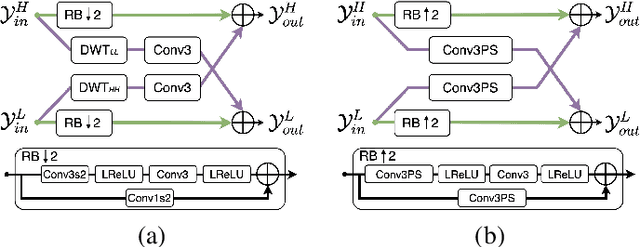
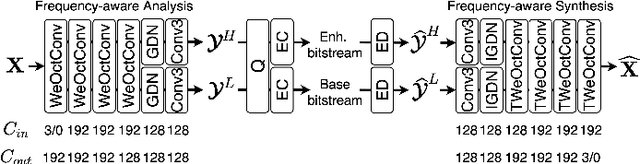
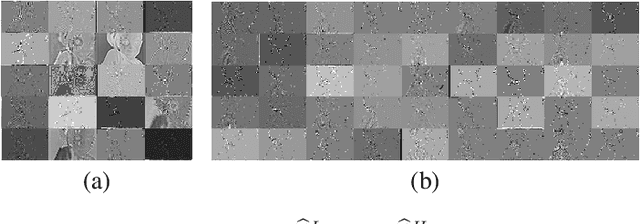
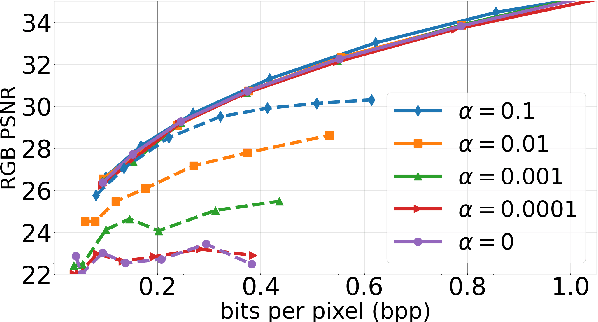
Spatial frequency analysis and transforms serve a central role in most engineered image and video lossy codecs, but are rarely employed in neural network (NN)-based approaches. We propose a novel NN-based image coding framework that utilizes forward wavelet transforms to decompose the input signal by spatial frequency. Our encoder generates separate bitstreams for each latent representation of low and high frequencies. This enables our decoder to selectively decode bitstreams in a quality-scalable manner. Hence, the decoder can produce an enhanced image by using an enhancement bitstream in addition to the base bitstream. Furthermore, our method is able to enhance only a specific region of interest (ROI) by using a corresponding part of the enhancement latent representation. Our experiments demonstrate that the proposed method shows competitive rate-distortion performance compared to several non-scalable image codecs. We also showcase the effectiveness of our two-level quality scalability, as well as its practicality in ROI quality enhancement.