 Add to Chrome
 Add to Firefox
 Add to Edge
Beyond Global Editing: Per-Instance Disentangled Subspaces for Training-Free Hallucination Mitigation in LVLMs
Aug 10, 2026
Recent advances in large vision-language models (LVLMs) have enabled powerful multimodal reasoning by integrating visual encoders with large language models (LLMs). However, their reliability is frequently undermined by hallucinations, where generated text inaccurately describes the visual input. Although fine-tuning can mitigate this problem, it is computationally expensive and requires large, curated datasets, making training-free alternatives attractive. Among these, model editing is more promising than decoding-based approaches: decoding methods adapt outputs per input but introduce computational overhead and instability, whereas model editing modifies internal representations offline, providing a more efficient and stable solution. However, existing model-editing techniques typically rely on a single global subspace to correct hallucinations, treating all test samples identically and failing to capture diverse hallucination modes across inputs. To address this limitation, we propose a training-free hallucination mitigation framework for dynamic, per-instance suppression at test time. Our method first constructs a set of Disentangled Hallucination Subspaces, each isolating a distinct hallucination mode. During inference, the model adaptively calculates weights reflecting each input's relationship to these subspaces, guiding a dynamically combined projection that selectively suppresses the most probable hallucination directions while preserving image-grounded semantics. Extensive experiments across multiple vision-language benchmarks and LVLM families demonstrate consistent improvements, highlighting the robustness, generalizability, and efficiency of our approach.

The Gate Always Closes: On Injecting Auxiliary Signals into Frozen Vision-Language Models
Jul 25, 2026Auxiliary signal pathways in VLMs are routinely fitted with learnable gates so the optimiser can decide how much of the signal to admit. We find that the optimiser almost always decides on zero: across five injection designs, every gated pathway becomes behaviourally closed, with accuracy invariant to ablating the pathway at inference even when the gate parameter would nominally pass 30-45% of the signal. We attribute this suppression phenomenon to two regimes, a dead-gradient regime formalised through the caption-invariance of image-derived signals, and a negative-utility regime in which the auxiliary signal actively hurts the loss. Rather than fight suppression, we exploit it: we regularise LoRA fine-tuning with geometric auxiliary losses from hyperbolic visual relational graphs (IoA-driven entailment cones and angular repulsion on the Lorentz manifold), coupled only through the forward pass at training time and dropped at inference. Disaggregating GQA by question type exposes a clean dissociation. Three configurations without geometric losses at inference lose 2.85-3.39pp on relational questions while gaining ~1pp on attribute questions; a fourth that trains with the losses but infers through a soft prompt loses 5.14pp on rel for only +0.23pp on attr, so training-time regularisation alone does not protect relational accuracy without a geometric inference pathway. Configurations that keep the geometric pathway at inference preserve vanilla-level relational accuracy and match the attribute gain. Out of distribution on VSR, the RMS-prefix recipe preserves the spatial signal; stripping the geometric losses (G2) collapses VSR by 4.6pp, isolating them as the OOD source. A secondary result: embedding-norm alignment is necessary for generation-safe prefix injection, and learnable gates should be replaced with fixed, non-optional injection at matched scales.
CARNet Cycle-Conditioned Core Aggregation and Redistribution for Multivariate Time Series Forecasting
Jul 23, 2026Accurately modeling cross-variate dependencies remains a key challenge in multivariate time series forecasting, particularly in the presence of strong periodic patterns. Many existing approaches rely on attention-based mechanisms that incur quadratic complexity and scale poorly with increasing numbers of variates. Recent attention-free aggregation models address this issue through linear-complexity core-based interactions, but they do not explicitly leverage the global periodic structure present in the data. To overcome this limitation, we propose CARNet, a Cycle-Conditioned Core Aggregation and Redistribution framework that integrates global recurrent cycle information into efficient core based interaction modeling via Multihead Core Aggregation. Extensive experiments on multiple real-world multivariate forecasting benchmarks demonstrate that CARNet consistently outperforms strong transformer and non-attention baselines across diverse prediction horizons while preserving linear-complexity modeling of cross-variate dependencies.
A Point Cloud Transformer for Remote Monitoring and Automated Assessment of Physical Rehabilitation Exercises
Jun 29, 2026Rehabilitation exercises are essential in restoring lost physical functions of patients suffering from various diseases (e.g., Parkinson's, back pain). Carrying out these rehabilitation exercises, often prescribed by health experts, is costly, unavailable, and requires expert supervision. The availability of RGBD images and movement/position data of joints along with expert annotation of exercise data has prompted the use of automatic assessment of the quality of rehabilitation exercises, which is cost-effective and can be carried out at home. However, existing approaches do not extract relevant features, lack practical application, require expensive pre-processing, or overlook crucial features. This study proposes a transformer-based framework for point clouds to extract features and assess rehabilitation exercises by analyzing joint positions collected through RGBD data. We adapt and utilize a curve-based point-cloud feature aggregation technique to augment point-cloud information that aids model output. The transformer architecture also uses axial self-attention, recognizing important joints and their roles to assist users in performing the exercise better. The guided system outperforms existing approaches and is also practically relevant due to its small size, fast inference, and generalization on specific joints in similar exercises. We conduct our experiments on three crucial baseline datasets for rehabilitation exercises: Kimore, UI-PRMD, and IRDS.
One Step Closer to Ground Truth: A Multi-Scale Residual-Aware Representation Learning Pipeline for Predicting Time Series Data
Jun 09, 2026Transformer-based models have emerged as leading paradigms in time-series forecasting in recent years, employing self-attention mechanisms to capture long-range dependencies. Despite their success, these single-stage forecasting architectures exhibit persistent systematic residual biases arising from structural discrepancies, unmodeled stochastic components, or inadequate multi-scale temporal representations. This limitation persists when residuals are treated as irreducible noise, precluding adaptive correction of structured error patterns. To address this limitation, we introduce a two-stage, model-agnostic framework that explicitly decouples forecasting and residual learning into distinct stages of representation learning. A base transformer first generates the initial predictions. Subsequently, a dedicated meta-corrector dynamically models structured error patterns across multivariate channels, preserves cross-variable dependencies, and iteratively refines the residual bias of the base transformer. By formalizing this pipeline as a hypothesis space expansion, our framework addresses approximation limitations inherent in single-stage architectures, removes reliance on restrictive assumptions, and enables end-to-end learning of complex error dynamics. Evaluated on eight popular benchmark datasets using established protocols, our approach achieves state-of-the-art performance, with significant improvements in standard metrics (MSE, MAE). The results demonstrate the framework's ability to mitigate systematic biases and enhance robustness to complex temporal dynamics, advancing the practical applicability of transformer-based forecasting models.
HyperVis: Continuous Latent Visual Relational Graphs on the Lorentz Hyperboloid for Compositional Reasoning
Jun 04, 2026Vision-Language Models (VLMs) struggle with compositional reasoning that requires understanding inter-object relationships. A natural remedy is to inject explicit scene graph triplets $\langle s, p, o \rangle$ from an off-the-shelf scene graph generator (SGG), but we show this backfires: discrete text labels collide with the continuous visual modality, degrading GQA accuracy from 60.38\% to 58.86\%. We propose \textbf{HyperVis}, which bypasses the SGG semantic bottleneck entirely. From $N$ class-agnostic region proposals, we compute a dense $O(N^2)$ visual relation tensor via spatially-biased cross-attention, project it onto a Lorentz hyperboloid, and enforce hierarchy through spatial physics, namely IoA-driven entailment cones and exterior-angle repulsion. We discover that HyperVis contributes in two complementary ways: (1) as a \emph{training-time regularizer}, the hyperbolic relational losses shape LoRA representations that improve generative VQA (GQA 61.03\% vs.\ 57.21\% for LoRA fine-tuning without relational losses, recovering and surpassing the baseline); and (2) as an \emph{inference-time relational encoder}, hyperbolic prefix tokens boost discriminative compositional scoring (SugarCrepe 79.94\%, $+$6.25pp over baseline). The learned curvature stabilises at $κ{=}4.0$, an order of magnitude above prior hyperbolic VLMs where $κ$ typically collapses toward zero, indicating that continuous visual features genuinely require the exponential volume of strongly curved space. A controlled Euclidean ablation confirms this decomposition: the relational pipeline regularises LoRA comparably in flat space (GQA 60.81\%), but the compositionality gain is specifically hyperbolic (SugarCrepe $+$4.58pp over Euclidean), with entailment loss ${\sim}6{\times}$ higher in Euclidean training. Codes are available at TBA.
Beyond Real Weights: Hypercomplex Representations for Stable Quantization
Dec 09, 2025Multimodal language models (MLLMs) require large parameter capacity to align high-dimensional visual features with linguistic representations, making them computationally heavy and difficult to deploy efficiently. We introduce a progressive reparameterization strategy that compresses these models by gradually replacing dense feed-forward network blocks with compact Parameterized Hypercomplex Multiplication (PHM) layers. A residual interpolation schedule, together with lightweight reconstruction and knowledge distillation losses, ensures that the PHM modules inherit the functional behavior of their dense counterparts during training. This transition yields substantial parameter and FLOP reductions while preserving strong multimodal alignment, enabling faster inference without degrading output quality. We evaluate the approach on multiple vision-language models (VLMs). Our method maintains performance comparable to the base models while delivering significant reductions in model size and inference latency. Progressive PHM substitution thus offers an architecture-compatible path toward more efficient multimodal reasoning and complements existing low-bit quantization techniques.
LAET: A Layer-wise Adaptive Ensemble Tuning Framework for Pretrained Language Models
Nov 14, 2025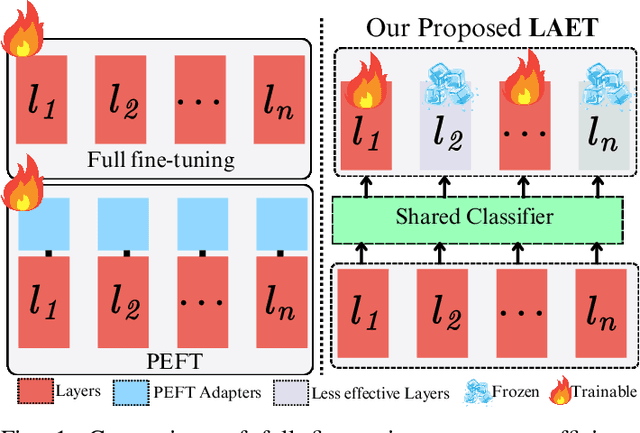
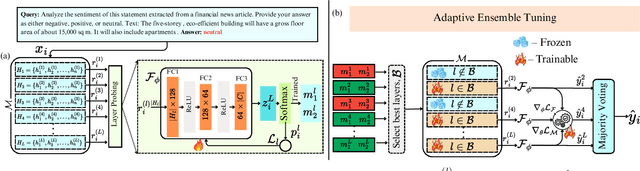

Natural Language Processing (NLP) has transformed the financial industry, enabling advancements in areas such as textual analysis, risk management, and forecasting. Large language models (LLMs) like BloombergGPT and FinMA have set new benchmarks across various financial NLP tasks, including sentiment analysis, stock movement prediction, and credit risk assessment. Furthermore, FinMA-ES, a bilingual financial LLM, has also demonstrated strong performance using the FLARE and FLARE-ES benchmarks. However, the high computational demands of these models limit the accessibility of many organizations. To address this, we propose Layer-wise Adaptive Ensemble Tuning (LAET), a novel strategy that selectively fine-tunes the most effective layers of pre-trained LLMs by analyzing hidden state representations while freezing less critical layers. LAET significantly reduces computational overhead while enhancing task-specific performance. Our approach shows strong results in financial NLP tasks, outperforming existing benchmarks and state-of-the-art LLMs such as GPT-4, even with smaller LLMs ($\sim$3B parameters). This work bridges cutting-edge financial NLP research and real-world deployment with efficient and scalable models for financial applications.
Dynamic Temperature Scheduler for Knowledge Distillation
Nov 14, 2025Knowledge Distillation (KD) trains a smaller student model using a large, pre-trained teacher model, with temperature as a key hyperparameter controlling the softness of output probabilities. Traditional methods use a fixed temperature throughout training, which is suboptimal. Moreover, architectural differences between teacher and student often result in mismatched logit magnitudes. We demonstrate that students benefit from softer probabilities early in training but require sharper probabilities in later stages. We introduce Dynamic Temperature Scheduler (DTS), which adjusts temperature dynamically based on the cross-entropy loss gap between teacher and student. To our knowledge, this is the first temperature scheduling method that adapts based on the divergence between teacher and student distributions. Our method integrates seamlessly with existing KD frameworks. We validate DTS across multiple KD strategies on vision (CIFAR-100, Tiny-ImageNet) and NLP tasks (GLUE, Dolly, SelfIns, UnNI, S-NI), consistently outperforming static-temperature baselines. Code is available at https://github.com/Sibgat-Ul/DTS.
LegalRAG: A Hybrid RAG System for Multilingual Legal Information Retrieval
Apr 19, 2025Natural Language Processing (NLP) and computational linguistic techniques are increasingly being applied across various domains, yet their use in legal and regulatory tasks remains limited. To address this gap, we develop an efficient bilingual question-answering framework for regulatory documents, specifically the Bangladesh Police Gazettes, which contain both English and Bangla text. Our approach employs modern Retrieval Augmented Generation (RAG) pipelines to enhance information retrieval and response generation. In addition to conventional RAG pipelines, we propose an advanced RAG-based approach that improves retrieval performance, leading to more precise answers. This system enables efficient searching for specific government legal notices, making legal information more accessible. We evaluate both our proposed and conventional RAG systems on a diverse test set on Bangladesh Police Gazettes, demonstrating that our approach consistently outperforms existing methods across all evaluation metrics.