 Add to Chrome
 Add to Firefox
 Add to Edge
One Step Closer to Ground Truth: A Multi-Scale Residual-Aware Representation Learning Pipeline for Predicting Time Series Data
Jun 09, 2026
Transformer-based models have emerged as leading paradigms in time-series forecasting in recent years, employing self-attention mechanisms to capture long-range dependencies. Despite their success, these single-stage forecasting architectures exhibit persistent systematic residual biases arising from structural discrepancies, unmodeled stochastic components, or inadequate multi-scale temporal representations. This limitation persists when residuals are treated as irreducible noise, precluding adaptive correction of structured error patterns. To address this limitation, we introduce a two-stage, model-agnostic framework that explicitly decouples forecasting and residual learning into distinct stages of representation learning. A base transformer first generates the initial predictions. Subsequently, a dedicated meta-corrector dynamically models structured error patterns across multivariate channels, preserves cross-variable dependencies, and iteratively refines the residual bias of the base transformer. By formalizing this pipeline as a hypothesis space expansion, our framework addresses approximation limitations inherent in single-stage architectures, removes reliance on restrictive assumptions, and enables end-to-end learning of complex error dynamics. Evaluated on eight popular benchmark datasets using established protocols, our approach achieves state-of-the-art performance, with significant improvements in standard metrics (MSE, MAE). The results demonstrate the framework's ability to mitigate systematic biases and enhance robustness to complex temporal dynamics, advancing the practical applicability of transformer-based forecasting models.

Beyond Real Weights: Hypercomplex Representations for Stable Quantization
Dec 09, 2025Multimodal language models (MLLMs) require large parameter capacity to align high-dimensional visual features with linguistic representations, making them computationally heavy and difficult to deploy efficiently. We introduce a progressive reparameterization strategy that compresses these models by gradually replacing dense feed-forward network blocks with compact Parameterized Hypercomplex Multiplication (PHM) layers. A residual interpolation schedule, together with lightweight reconstruction and knowledge distillation losses, ensures that the PHM modules inherit the functional behavior of their dense counterparts during training. This transition yields substantial parameter and FLOP reductions while preserving strong multimodal alignment, enabling faster inference without degrading output quality. We evaluate the approach on multiple vision-language models (VLMs). Our method maintains performance comparable to the base models while delivering significant reductions in model size and inference latency. Progressive PHM substitution thus offers an architecture-compatible path toward more efficient multimodal reasoning and complements existing low-bit quantization techniques.
LAET: A Layer-wise Adaptive Ensemble Tuning Framework for Pretrained Language Models
Nov 14, 2025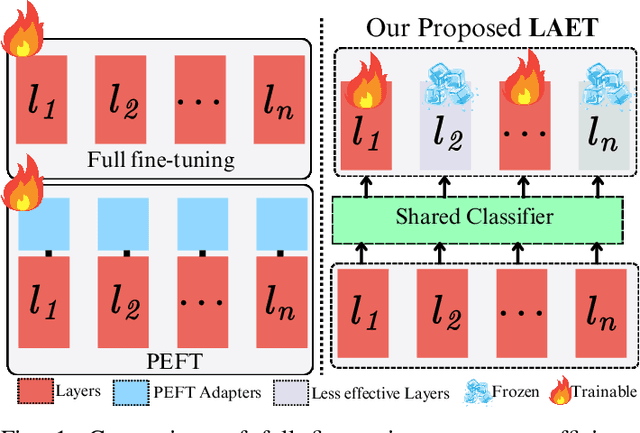
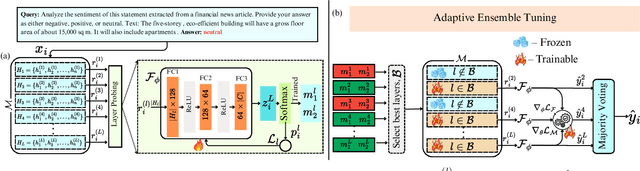

Natural Language Processing (NLP) has transformed the financial industry, enabling advancements in areas such as textual analysis, risk management, and forecasting. Large language models (LLMs) like BloombergGPT and FinMA have set new benchmarks across various financial NLP tasks, including sentiment analysis, stock movement prediction, and credit risk assessment. Furthermore, FinMA-ES, a bilingual financial LLM, has also demonstrated strong performance using the FLARE and FLARE-ES benchmarks. However, the high computational demands of these models limit the accessibility of many organizations. To address this, we propose Layer-wise Adaptive Ensemble Tuning (LAET), a novel strategy that selectively fine-tunes the most effective layers of pre-trained LLMs by analyzing hidden state representations while freezing less critical layers. LAET significantly reduces computational overhead while enhancing task-specific performance. Our approach shows strong results in financial NLP tasks, outperforming existing benchmarks and state-of-the-art LLMs such as GPT-4, even with smaller LLMs ($\sim$3B parameters). This work bridges cutting-edge financial NLP research and real-world deployment with efficient and scalable models for financial applications.