 Add to Chrome
 Add to Firefox
 Add to Edge
From Noise to Diversity: Random Embedding Injection in LLM Reasoning
May 12, 2026
Recent soft prompt research has tried to improve reasoning by inserting trained vectors into LLM inputs, yet whether the gain comes from the learned content or from the act of injection itself has not been carefully separated. We study Random Soft Prompts (RSPs), which drop the training step entirely and append a freshly drawn sequence of random embedding vectors to the input. Each RSP vector is sampled from an isotropic Gaussian fitted to the entrywise mean and variance of the pretrained embedding table; the sequence carries no learned content, and yet reaches accuracy comparable to optimized soft prompts on math reasoning benchmarks in several settings. The mechanism unfolds in two stages: because attention has to absorb a never-seen-before random position, the distribution over the first few generated tokens flattens and reasoning trajectories branch, and as generation continues this influence dilutes naturally so the response commits to a single completion. We show that during inference RSPs lift early-stage token diversity and, combined with temperature sampling, widen Pass@N, the probability that at least one out of N attempts is correct. Beyond inference, we carry the same effect into DAPO training and demonstrate practical gains. Our contributions are: (i) RSP isolates the simplest form of soft prompt -- training-free, freshly resampled -- providing a unified lens for the structural effect of injection that variants otherwise differing in training and form all share; (ii) a theoretical and empirical validation of the underlying mechanism; and (iii) an extension from inference to training.

ARCLE: The Abstraction and Reasoning Corpus Learning Environment for Reinforcement Learning
Jul 30, 2024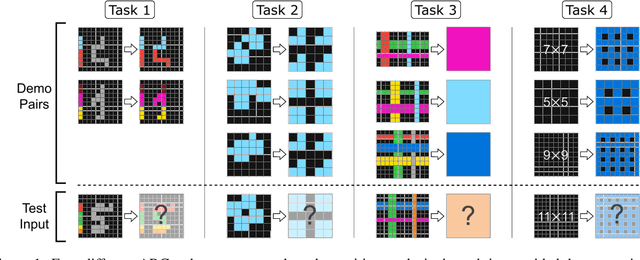
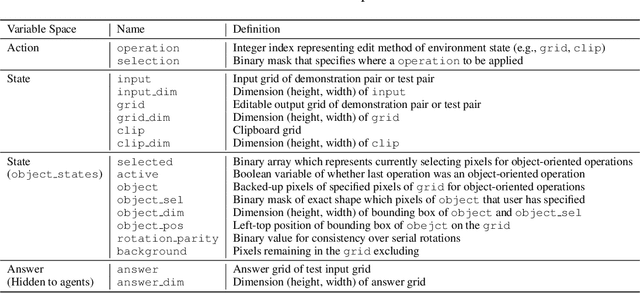
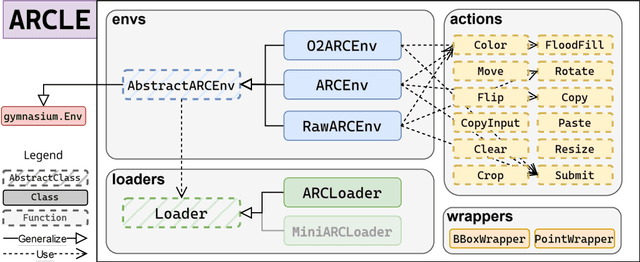

This paper introduces ARCLE, an environment designed to facilitate reinforcement learning research on the Abstraction and Reasoning Corpus (ARC). Addressing this inductive reasoning benchmark with reinforcement learning presents these challenges: a vast action space, a hard-to-reach goal, and a variety of tasks. We demonstrate that an agent with proximal policy optimization can learn individual tasks through ARCLE. The adoption of non-factorial policies and auxiliary losses led to performance enhancements, effectively mitigating issues associated with action spaces and goal attainment. Based on these insights, we propose several research directions and motivations for using ARCLE, including MAML, GFlowNets, and World Models.
Reasoning Abilities of Large Language Models: In-Depth Analysis on the Abstraction and Reasoning Corpus
Mar 18, 2024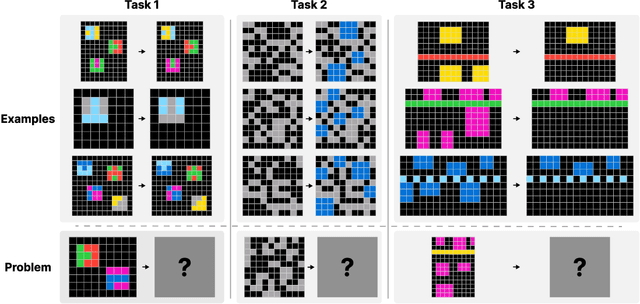
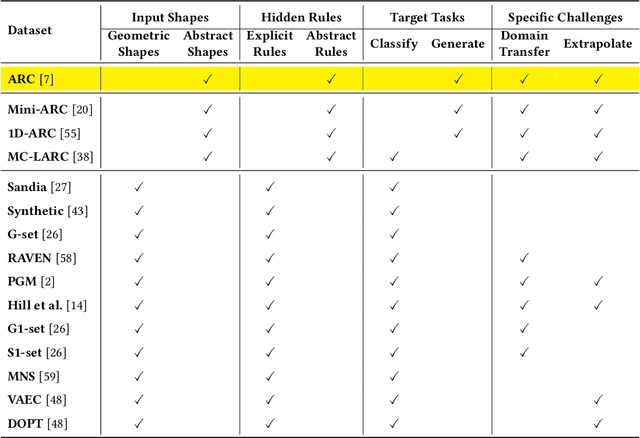
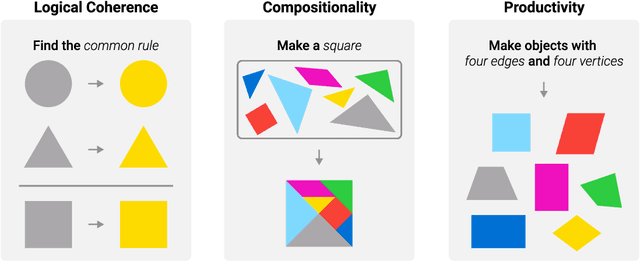
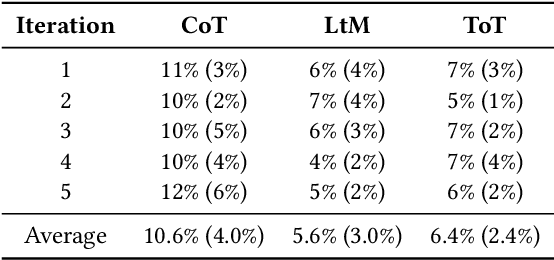
The existing methods for evaluating the inference abilities of Large Language Models (LLMs) have been results-centric, making it difficult to assess the inference process. We introduce a new approach using the Abstract and Reasoning Corpus (ARC) dataset to evaluate the inference and contextual understanding abilities of large language models in a process-centric manner. ARC demands rigorous logical structures for problem-solving, making it a benchmark that facilitates the comparison of model inference abilities with humans. Experimental results confirm that while large language models possess weak inference abilities, they still lag in terms of logical coherence, compositionality, and productivity. Our experiments highlight the reasoning capabilities of LLMs, proposing development paths for achieving human-level reasoning.