 Add to Chrome
 Add to Firefox
 Add to Edge
K-EXAONE 2.0 Technical Report
Aug 05, 2026
This technical report presents K-EXAONE 2.0, an open-weight multilingual foundation model developed by LG AI Research as a step in our effort toward global frontier-scale foundation models. Rather than training from scratch, we upcycle K-EXAONE and expand its architecture, yielding a Mixture-of-Experts (MoE) model with 750B total parameters and approximately 37B activated per token---more than three times the capacity of its predecessor. K-EXAONE 2.0 supports context lengths of up to 256K tokens and expands multilingual coverage from six to ten languages. Its training pipeline combines continual pre-training, difficulty-focused mid-training, and post-training to strengthen reasoning, agentic coding, multilingual capability, and safety grounded in Korean sociocultural contexts. Across nine evaluation categories selected to reflect the conditions of practical use, K-EXAONE 2.0 improves over K-EXAONE and remains competitive with open-weight models, showing its largest gains in agentic coding and long-context understanding and its clearest strengths in long-context retrieval and safety. Released under the Apache 2.0 license, K-EXAONE 2.0 enables the wider AI ecosystem to evaluate, deploy, adapt, and build upon it, while marking the beginning---rather than the endpoint---of our challenge toward the global frontier.

Reasoning Abilities of Large Language Models: In-Depth Analysis on the Abstraction and Reasoning Corpus
Mar 18, 2024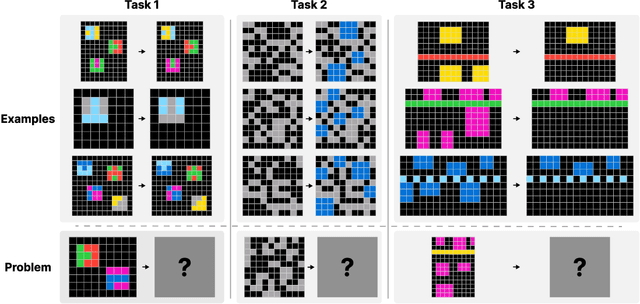
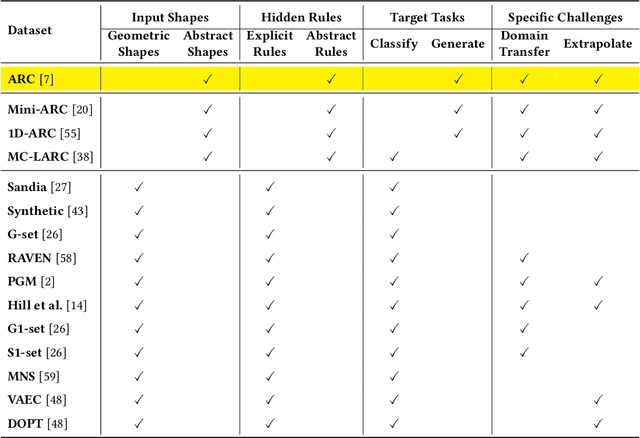
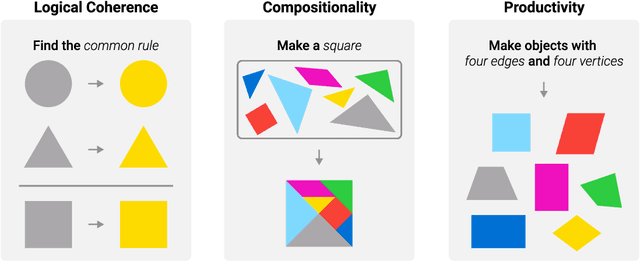
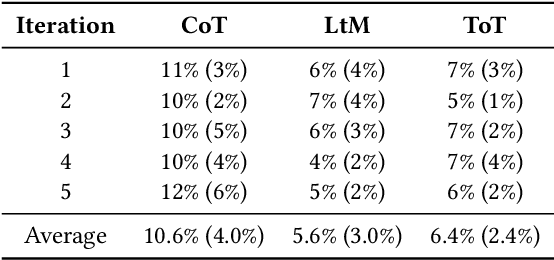
The existing methods for evaluating the inference abilities of Large Language Models (LLMs) have been results-centric, making it difficult to assess the inference process. We introduce a new approach using the Abstract and Reasoning Corpus (ARC) dataset to evaluate the inference and contextual understanding abilities of large language models in a process-centric manner. ARC demands rigorous logical structures for problem-solving, making it a benchmark that facilitates the comparison of model inference abilities with humans. Experimental results confirm that while large language models possess weak inference abilities, they still lag in terms of logical coherence, compositionality, and productivity. Our experiments highlight the reasoning capabilities of LLMs, proposing development paths for achieving human-level reasoning.