 Add to Chrome
 Add to Firefox
 Add to Edge
Casting the Net! Revisiting MasterFace Impersonation Attacks
Aug 07, 2026
Impersonation is a fundamental security threat in face recognition systems (FRSs). While the security of FRSs has been challenged by various attack vectors, under realistic adversarial capabilities, e.g., a limited number of decision-only authentication trials and no internal system knowledge, most attack techniques become infeasible. As a result, impersonation by zero-effort impostors, characterized by false match rate (FMR), is commonly regarded as a standalone baseline. A few years ago, impersonation attacks based on MasterFaces emerged as a notable security threat that could break the barrier of the FMR-based baseline under such realistic constraints. However, they were believed not to yield impersonation above the standard FMR in modern FRSs, as discussed by multiple follow-up studies. In this paper, we demonstrate that even legitimate access to public commercial APIs allows an adversary to amplify impersonation rates through MasterFaces, resulting in a non-trivial impersonation attack beyond FMR on downstream applications built on top of these APIs. We observe that several real-world FRS deployments are implemented using commercial APIs, and that the backend service provider is publicly disclosed or trivially inferable. As a result, the adversary can purchase these pay-as-you-go API services without requiring any additional privilege over the target FRS. From this observation, we formalize the MasterFaces attack as a maximum coverage problem over the biometric representation space, which we call a NET, and show that the adversary can construct an API-tailored NET by leveraging the geometric structure of the representation space. We demonstrate that our attack amplifies the impersonation rates of several open-source and commercial API-based FRSs by up to 9.5$\times$ within at most 30 authentication trials, compared to those expected from the standard FMR.

Scores Know Bobs Voice: Speaker Impersonation Attack
Mar 03, 2026Advances in deep learning have enabled the widespread deployment of speaker recognition systems (SRSs), yet they remain vulnerable to score-based impersonation attacks. Existing attacks that operate directly on raw waveforms require a large number of queries due to the difficulty of optimizing in high-dimensional audio spaces. Latent-space optimization within generative models offers improved efficiency, but these latent spaces are shaped by data distribution matching and do not inherently capture speaker-discriminative geometry. As a result, optimization trajectories often fail to align with the adversarial direction needed to maximize victim scores. To address this limitation, we propose an inversion-based generative attack framework that explicitly aligns the latent space of the synthesis model with the discriminative feature space of SRSs. We first analyze the requirements of an inverse model for score-based attacks and introduce a feature-aligned inversion strategy that geometrically synchronizes latent representations with speaker embeddings. This alignment ensures that latent updates directly translate into score improvements. Moreover, it enables new attack paradigms, including subspace-projection-based attacks, which were previously infeasible due to the absence of a faithful feature-to-audio mapping. Experiments show that our method significantly improves query efficiency, achieving competitive attack success rates with on average 10x fewer queries than prior approaches. In particular, the enabled subspace-projection-based attack attains up to 91.65% success using only 50 queries. These findings establish feature-aligned inversion as a key tool for evaluating the robustness of modern SRSs against score-based impersonation threats.
Non-Adaptive Adversarial Face Generation
Jul 16, 2025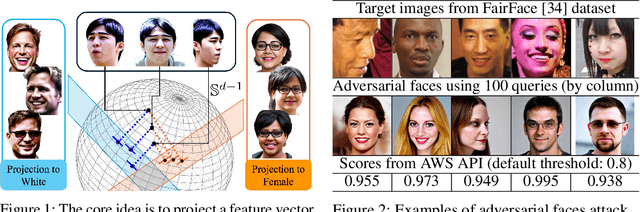
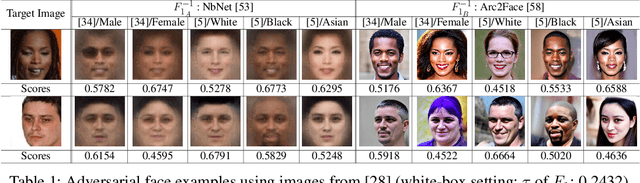
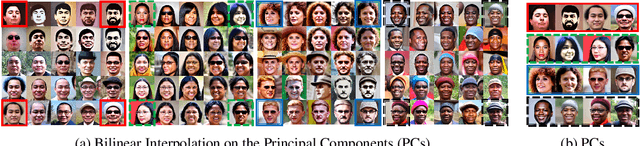
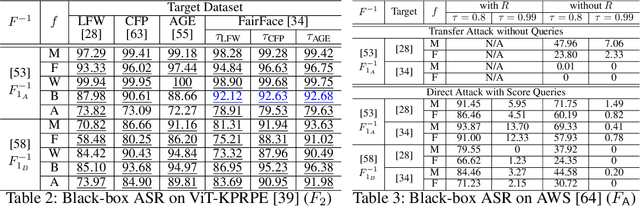
Adversarial attacks on face recognition systems (FRSs) pose serious security and privacy threats, especially when these systems are used for identity verification. In this paper, we propose a novel method for generating adversarial faces-synthetic facial images that are visually distinct yet recognized as a target identity by the FRS. Unlike iterative optimization-based approaches (e.g., gradient descent or other iterative solvers), our method leverages the structural characteristics of the FRS feature space. We figure out that individuals sharing the same attribute (e.g., gender or race) form an attributed subsphere. By utilizing such subspheres, our method achieves both non-adaptiveness and a remarkably small number of queries. This eliminates the need for relying on transferability and open-source surrogate models, which have been a typical strategy when repeated adaptive queries to commercial FRSs are impossible. Despite requiring only a single non-adaptive query consisting of 100 face images, our method achieves a high success rate of over 93% against AWS's CompareFaces API at its default threshold. Furthermore, unlike many existing attacks that perturb a given image, our method can deliberately produce adversarial faces that impersonate the target identity while exhibiting high-level attributes chosen by the adversary.
IDFace: Face Template Protection for Efficient and Secure Identification
Jul 16, 2025As face recognition systems (FRS) become more widely used, user privacy becomes more important. A key privacy issue in FRS is protecting the user's face template, as the characteristics of the user's face image can be recovered from the template. Although recent advances in cryptographic tools such as homomorphic encryption (HE) have provided opportunities for securing the FRS, HE cannot be used directly with FRS in an efficient plug-and-play manner. In particular, although HE is functionally complete for arbitrary programs, it is basically designed for algebraic operations on encrypted data of predetermined shape, such as a polynomial ring. Thus, a non-tailored combination of HE and the system can yield very inefficient performance, and many previous HE-based face template protection methods are hundreds of times slower than plain systems without protection. In this study, we propose IDFace, a new HE-based secure and efficient face identification method with template protection. IDFace is designed on the basis of two novel techniques for efficient searching on a (homomorphically encrypted) biometric database with an angular metric. The first technique is a template representation transformation that sharply reduces the unit cost for the matching test. The second is a space-efficient encoding that reduces wasted space from the encryption algorithm, thus saving the number of operations on encrypted templates. Through experiments, we show that IDFace can identify a face template from among a database of 1M encrypted templates in 126ms, showing only 2X overhead compared to the identification over plaintexts.