 Add to Chrome
 Add to Firefox
 Add to Edge
Mechanistic Interpretability of Structure-Aware Numerical Reasoning in LLaMA 3.1 8B
Aug 19, 2026
Recent work has shown that large language models (LLMs) exhibit strong numerical sequence modeling capabilities and show promise in time-series prediction. While LLMs display in-context learning capabilities, the mechanisms with which they accomplish time-series prediction remain unclear. Specifically, whether they truly understand the underlying structure, which at a minimum requires reasoning over first differences in the sequence of numbers. To study this, we investigate Llama 3.1-8B from a mechanistic interpretability point of view. Mechanistic interpretability is an emerging field concerned with the reverse engineering of the algorithms learned by neural networks such as LLMs. To assess Llamas' numerical sequence modeling capabilities and to facilitate our mechanistic interpretability analysis, we create a sequence modeling task that cannot be solved without picking up structural cues. Specifically, we sample n random numbers and repeat them with an offset. We find that Llama displays strong performance on our tasks suggesting that it can pick up on the underlying structure. To understand the mechanisms that allow it to do so, we perform probing experiments and activation patching based counterfactual analysis. Probing reveals that the model computes and stores first differences in its internal representations without explicit supervision, indicating that it tracks structural information about the sequence. Activation patching reveals that Llama retrieves the relevant first-difference with a mechanism similar to an induction circuit and subsequently adds it to the current value. Notably, our work represents one of the first studies to identify this form of concept induction in LLMs.

Reliability-aware Execution Gating for Near-field and Off-axis Vision-guided Robotic Alignment
Feb 09, 2026Vision-guided robotic systems are increasingly deployed in precision alignment tasks that require reliable execution under near-field and off-axis configurations. While recent advances in pose estimation have significantly improved numerical accuracy, practical robotic systems still suffer from frequent execution failures even when pose estimates appear accurate. This gap suggests that pose accuracy alone is insufficient to guarantee execution-level reliability. In this paper, we reveal that such failures arise from a deterministic geometric error amplification mechanism, in which small pose estimation errors are magnified through system structure and motion execution, leading to unstable or failed alignment. Rather than modifying pose estimation algorithms, we propose a Reliability-aware Execution Gating mechanism that operates at the execution level. The proposed approach evaluates geometric consistency and configuration risk before execution, and selectively rejects or scales high-risk pose updates. We validate the proposed method on a real UR5 robotic platform performing single-step visual alignment tasks under varying camera-target distances and off-axis configurations. Experimental results demonstrate that the proposed execution gating significantly improves task success rates, reduces execution variance, and suppresses tail-risk behavior, while leaving average pose accuracy largely unchanged. Importantly, the proposed mechanism is estimator-agnostic and can be readily integrated with both classical geometry-based and learning-based pose estimation pipelines. These results highlight the importance of execution-level reliability modeling and provide a practical solution for improving robustness in near-field vision-guided robotic systems.
System-Level Error Propagation and Tail-Risk Amplification in Reference-Based Robotic Navigation
Feb 08, 2026Image guided robotic navigation systems often rely on reference based geometric perception pipelines, where accurate spatial mapping is established through multi stage estimation processes. In biplanar X ray guided navigation, such pipelines are widely used due to their real time capability and geometric interpretability. However, navigation reliability can be constrained by an overlooked system level failure mechanism in which installation induced structural perturbations introduced at the perception stage are progressively amplified along the perception reconstruction execution chain and dominate execution level error and tail risk behavior. This paper investigates this mechanism from a system level perspective and presents a unified error propagation modeling framework that characterizes how installation induced structural perturbations propagate and couple with pixel level observation noise through biplanar imaging, projection matrix estimation, triangulation, and coordinate mapping. Using first order analytic uncertainty propagation and Monte Carlo simulations, we analyze dominant sensitivity channels and quantify worst case error behavior beyond mean accuracy metrics. The results show that rotational installation error is a primary driver of system level error amplification, while translational misalignment of comparable magnitude plays a secondary role under typical biplanar geometries. Real biplanar X ray bench top experiments further confirm that the predicted amplification trends persist under realistic imaging conditions. These findings reveal a broader structural limitation of reference based multi stage geometric perception pipelines and provide a framework for system level reliability analysis and risk aware design in safety critical robotic navigation systems.
Independent Density Estimation
Dec 21, 2025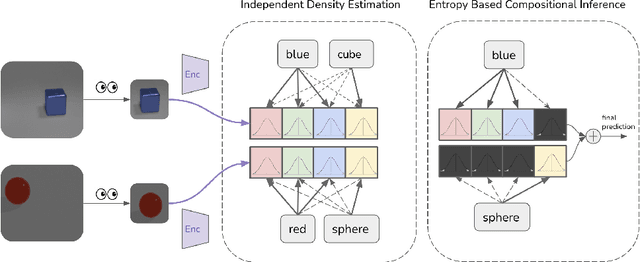

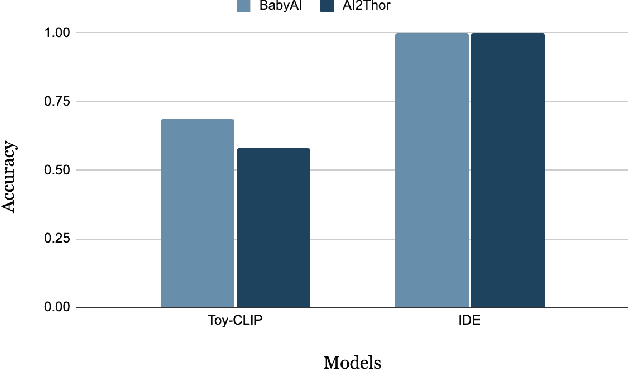
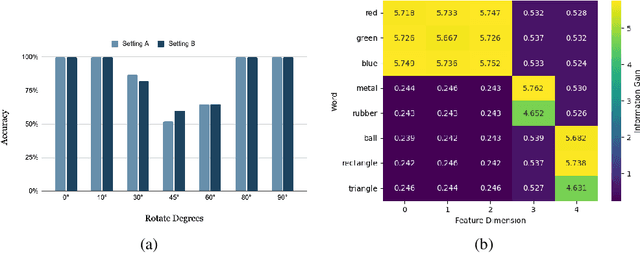
Large-scale Vision-Language models have achieved remarkable results in various domains, such as image captioning and conditioned image generation. Nevertheless, these models still encounter difficulties in achieving human-like compositional generalization. In this study, we propose a new method called Independent Density Estimation (IDE) to tackle this challenge. IDE aims to learn the connection between individual words in a sentence and the corresponding features in an image, enabling compositional generalization. We build two models based on the philosophy of IDE. The first one utilizes fully disentangled visual representations as input, and the second leverages a Variational Auto-Encoder to obtain partially disentangled features from raw images. Additionally, we propose an entropy-based compositional inference method to combine predictions of each word in the sentence. Our models exhibit superior generalization to unseen compositions compared to current models when evaluated on various datasets.