 Add to Chrome
 Add to Firefox
 Add to Edge
Spatially Grounded Long-Horizon Task Planning in the Wild
Mar 13, 2026
Recent advances in robot manipulation increasingly leverage Vision-Language Models (VLMs) for high-level reasoning, such as decomposing task instructions into sequential action plans expressed in natural language that guide downstream low-level motor execution. However, current benchmarks do not assess whether these plans are spatially executable, particularly in specifying the exact spatial locations where the robot should interact to execute the plan, limiting evaluation of real-world manipulation capability. To bridge this gap, we define a novel task of grounded planning and introduce GroundedPlanBench, a newly curated benchmark for spatially grounded long-horizon action planning in the wild. GroundedPlanBench jointly evaluates hierarchical sub-action planning and spatial action grounding (where to act), enabling systematic assessment of whether generated sub-actions are spatially executable for robot manipulation. We further introduce Video-to-Spatially Grounded Planning (V2GP), an automated data generation framework that leverages real-world robot video demonstrations to improve spatially grounded long-horizon planning. Our evaluations reveal that spatially grounded long-horizon planning remains a major bottleneck for current VLMs. Our results demonstrate that V2GP provides a promising approach for improving both action planning and spatial grounding performance, validated on our benchmark as well as through real-world robot manipulation experiments, advancing progress toward spatially actionable planning.

Learning Generalizable Prompt for CLIP with Class Similarity Knowledge
Feb 17, 2025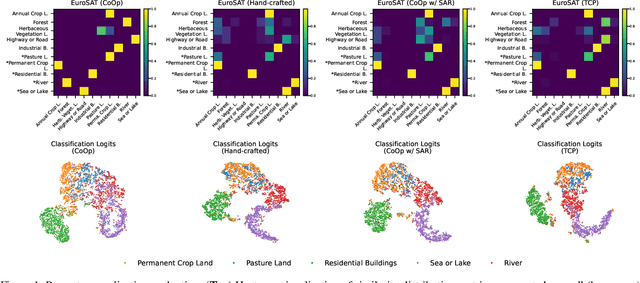
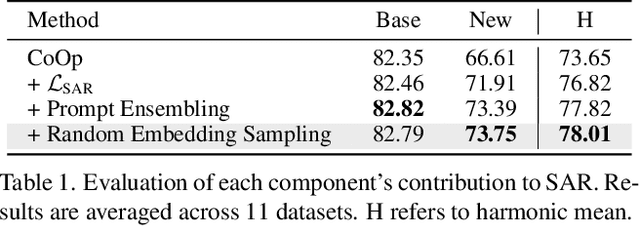
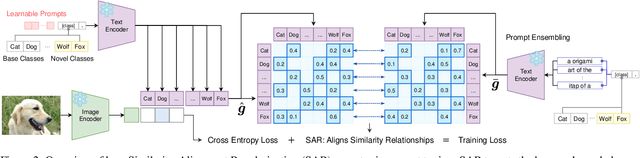
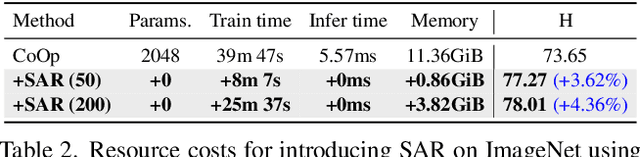
In vision-language models (VLMs), prompt tuning has shown its effectiveness in adapting models to downstream tasks. However, learned prompts struggle to generalize to unseen classes, as they tend to overfit to the classes that are targeted during prompt tuning. Examining failure cases, we observed that learned prompts disrupt the semantics of unseen classes, generating text embeddings with incorrect semantic relationships among classes. To address this, we propose Similarity Alignment Regularization (SAR), which regularizes learnable prompts to preserve the semantic relationships among classes captured by hand-crafted prompts. Specifically, we first obtain novel classes related to base classes using ChatGPT-4o and utilize them as potential unseen classes during prompt tuning. Then, by targeting both base and novel classes, SAR aligns the similarity relationships among text embeddings generated by learnable prompts with the similarity relationships from hand-crafted prompts. Extensive experiments applying SAR to existing prompt tuning methods demonstrate its effectiveness in improving generalization to unseen classes.