 Add to Chrome
 Add to Firefox
 Add to Edge
Censoring-Aware In-Context Learning for Generalized Supplier Lead Time Estimation in Supply Chain Planning
Jul 20, 2026
Supplier lead time forecasting is a central input to material requirements planning, inventory optimization, and supply chain risk management. However, many industrial lead time datasets are naturally right-censored: at the time forecasts are required, some orders have not yet arrived. Standard regression and classification approaches discard this information, while conventional survival models require task-specific modeling. We propose LeadTime-ICL (LT-ICL), a censoring-aware in-context learning model for probabilistic lead time forecasting. LT-ICL combines a transformer backbone with a conditional normalizing-flow head, producing a full predictive distribution over lead times. The model is pretrained on synthetic right-censored lead time tasks, enabling in-context adaptation to new industrial datasets without task-specific parameter updates. We provide theoretical support for this formulation by showing that excess CRPS is bounded by prior misspecification and amortized approximation errors, providing clear direction for improving forecasting performance. We evaluate LT-ICL on 24 proprietary supply-chain datasets spanning seven industries. LT-ICL achieves the lowest point-forecasting error on 15 of the 24 datasets, and the lowest probabilistic forecasting error on 14 datasets, yielding the best average rank across both. These results support right-censored probabilistic forecasting as a practical formulation for supplier lead time prediction and demonstrate that pretrained in-context models can provide accurate, low-adaptation-cost forecasting for industrial planning systems.

Uncertainty-Aware Delivery Delay Duration Prediction via Multi-Task Deep Learning
Feb 23, 2026Accurate delivery delay prediction is critical for maintaining operational efficiency and customer satisfaction across modern supply chains. Yet the increasing complexity of logistics networks, spanning multimodal transportation, cross-country routing, and pronounced regional variability, makes this prediction task inherently challenging. This paper introduces a multi-task deep learning model for delivery delay duration prediction in the presence of significant imbalanced data, where delayed shipments are rare but operationally consequential. The model embeds high-dimensional shipment features with dedicated embedding layers for tabular data, and then uses a classification-then-regression strategy to predict the delivery delay duration for on-time and delayed shipments. Unlike sequential pipelines, this approach enables end-to-end training, improves the detection of delayed cases, and supports probabilistic forecasting for uncertainty-aware decision making. The proposed approach is evaluated on a large-scale real-world dataset from an industrial partner, comprising more than 10 million historical shipment records across four major source locations with distinct regional characteristics. The proposed model is compared with traditional machine learning methods. Experimental results show that the proposed method achieves a mean absolute error of 0.67-0.91 days for delayed-shipment predictions, outperforming single-step tree-based regression baselines by 41-64% and two-step classify-then-regress tree-based models by 15-35%. These gains demonstrate the effectiveness of the proposed model in operational delivery delay forecasting under highly imbalanced and heterogeneous conditions.
Let CONAN tell you a story: Procedural quest generation
Aug 19, 2018
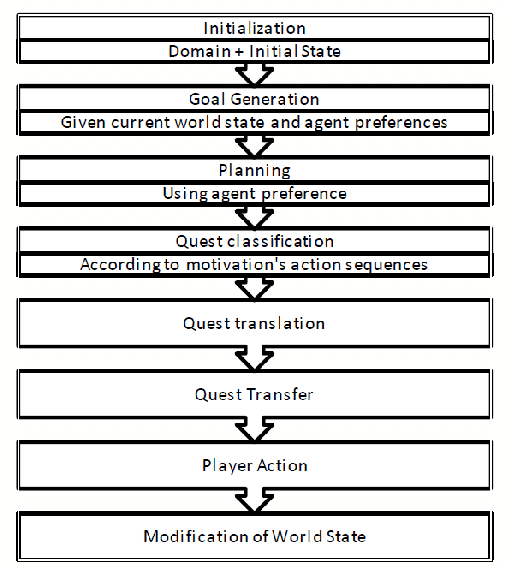
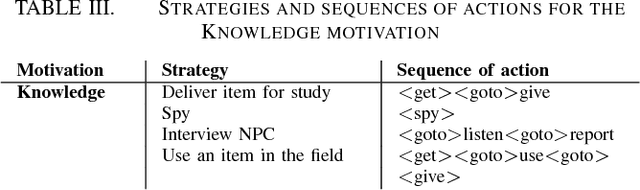
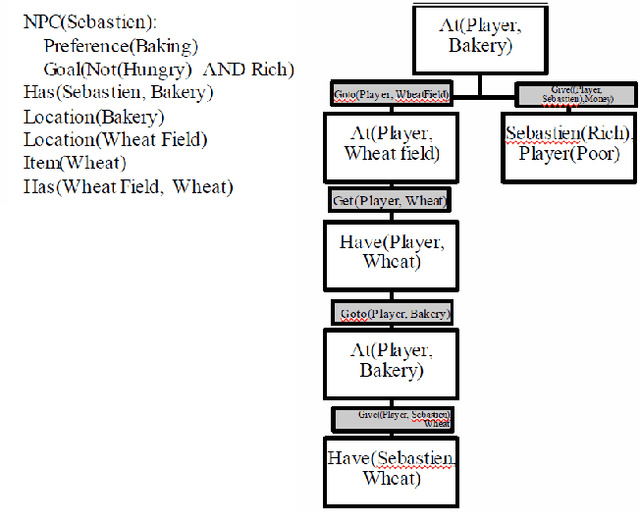
This work proposes an engine for the Creation Of Novel Adventure Narrative (CONAN), which is a procedural quest generator. It uses a planning approach to story generation. The engine is tested on its ability to create quests, which are sets of actions that must be performed in order to achieve a certain goal, usually for a reward. The engine takes in a world description represented as a set of facts, including characters, locations, and items, and generates quests according to the state of the world and the preferences of the characters. We evaluate quests through the classification of the motivations behind the quests, based on the sequences of actions required to complete the quests. We also compare different world descriptions and analyze the difference in motivations for the quests produced by the engine. Compared against human structural quest analysis, the current engine was found to be able to replicate the quest structures found in commercial video game quests.