 Add to Chrome
 Add to Firefox
 Add to Edge
Performance and Explainability Requirements of Evolutionary Algorithms in Real-World Physics-Informed Optimization
May 27, 2026
Evolutionary computation offers a variety of tools to solve complex real-world optimization problems. However, research often focuses on smaller, simplified problems and optimization algorithms that sometimes miss expectations in real-world scenarios. Additionally, trust in the applied algorithm and the solutions it provides is often essential in such settings, but requires an understanding of the search process itself. This leads to evolutionary computation often not being seriously considered by practitioners in many application contexts, among them physics-based modeling. In this article, techniques from evolutionary computation are detailed that can alleviate these problems. First, five real-world physics-based optimization problems are introduced and described by domain experts. For each of these, the requirements for the evolutionary algorithm regarding performance and explainability to increase trust and usability are presented. We found that all domain experts expect fast convergence to a good solution and want some explanations for how the results were formed, while other requirements strongly depend on the respective problem. Finally, we present existing approaches that can be leveraged to improve those aspects of evolutionary algorithms but have to our knowledge never been employed in complex real-world scenarios. This implies a gap between both domains that needs to be closed to exploit the full potential of evolutionary computation.

Signal-to-noise ratio is more important than sampling rate in beat-to-beat interval estimation from optical sensors
Feb 28, 2022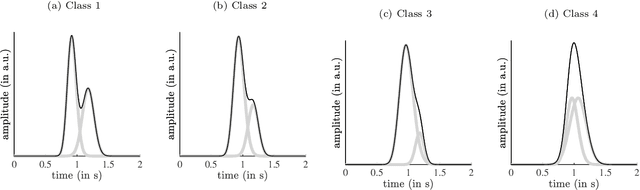
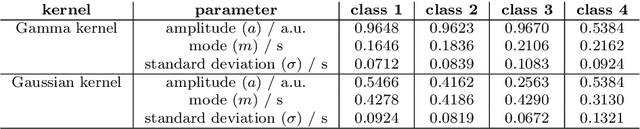
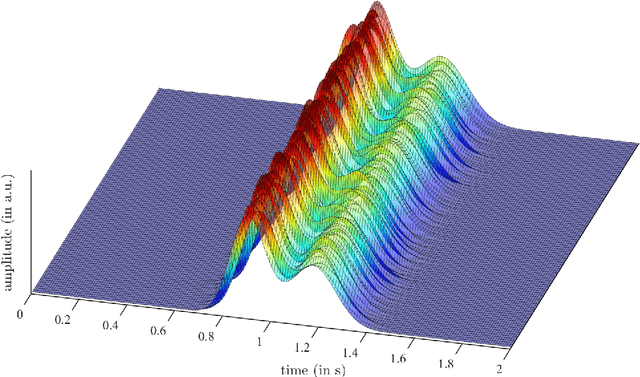
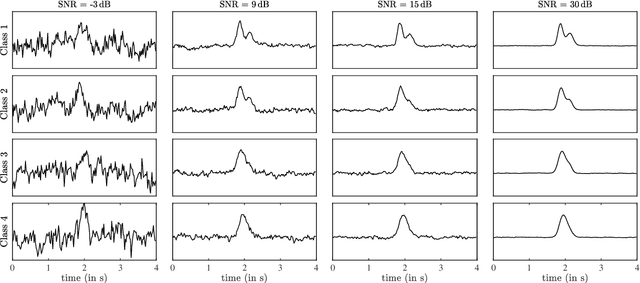
Photoplethysmographic Imaging (PPGI) allows the determination of pulse rate variability from sequential beat-to-beat intervals (BBI) and pulse wave velocity from spatially resolved recorded pulse waves. In either case, sufficient temporal accuracy is essential. The presented work investigates the temporal accuracy of BBI estimation from photoplethysmographic signals. Within comprehensive numerical simulation, we systematically assess the impact of sampling rate, signal-to-noise ratio (SNR), and beat-to-beat shape variations on the root mean square error (RMSE) between real and estimated BBI. Our results show that at sampling rates beyond 14 Hz only small errors exist when interpolation is used. For example, the average RMSE is 3 ms for a sampling rate of 14 Hz and an SNR of 18 dB. Further increasing the sampling rate only results in marginal improvements, e.g. more than tripling the sampling rate to 50 Hz reduces the error by approx. 14%. The most important finding relates to the SNR, which is shown to have a much stronger influence on the error than the sampling rate. For example, increasing the SNR from 18 dB to 24 dB at 14 Hz sampling rate reduced the error by almost 50% to 1.5 ms. Subtle beat-to-beat shape variations, moreover, increase the error decisively by up to 800%. Our results are highly relevant in three regards: first, they partially explain different results in the literature on minimum sampling rates. Second, they emphasize the importance to consider SNR and possibly shape variation in investigations on the minimal sampling rate. Third, they underline the importance of appropriate processing techniques to increase SNR. Importantly, though our motivation is PPGI, the presented work immediately applies to contact PPG and PPG in other settings such as wearables. To enable further investigations, we make the scripts used in modelling and simulation freely available.
* 18 pages, 11 figures