 Add to Chrome
 Add to Firefox
 Add to Edge
Task- and Metric-Specific Signal Quality Indices for Medical Time Series
Feb 12, 2026
Medical time series such as electrocardiograms (ECGs) and photoplethysmograms (PPGs) are frequently affected by measurement artifacts due to challenging acquisition environments, such as in ambulances and during routine daily activities. Since automated algorithms for analyzing such signals increasingly inform clinically relevant decisions, identifying signal segments on which these algorithms may produce unreliable outputs is of critical importance. Signal quality indices (SQIs) are commonly used for this purpose. However, most existing SQIs are task agnostic and do not account for the specific algorithm and performance metric used downstream. In this work, we formalize signal quality as a task- and metric-dependent concept and propose a perturbation-based SQI (pSQI) that aims to detect an algorithm's performance degradation on an input signal with respect to a metric. The pSQI is defined as the worst-case value of the performance metric under an additive, colored Gaussian noise perturbation with a lower-bounded signal-to-noise ratio. We introduce formal requirements for task- and metric-specific SQIs, including monotonicity of the metric in expectation and maximal separation under thresholding. Experiments on R-peak detection and atrial fibrillation classification benchmarks demonstrate that the proposed pSQI consistently outperforms existing feature- and deep learning-based SQIs in identifying unreliable inputs without requiring training.

3D Blood Pulsation Maps
Dec 11, 2025We present Pulse3DFace, the first dataset of its kind for estimating 3D blood pulsation maps. These maps can be used to develop models of dynamic facial blood pulsation, enabling the creation of synthetic video data to improve and validate remote pulse estimation methods via photoplethysmography imaging. Additionally, the dataset facilitates research into novel multi-view-based approaches for mitigating illumination effects in blood pulsation analysis. Pulse3DFace consists of raw videos from 15 subjects recorded at 30 Hz with an RGB camera from 23 viewpoints, blood pulse reference measurements, and facial 3D scans generated using monocular structure-from-motion techniques. It also includes processed 3D pulsation maps compatible with the texture space of the 3D head model FLAME. These maps provide signal-to-noise ratio, local pulse amplitude, phase information, and supplementary data. We offer a comprehensive evaluation of the dataset's illumination conditions, map consistency, and its ability to capture physiologically meaningful features in the facial and neck skin regions.
Signal-to-noise ratio is more important than sampling rate in beat-to-beat interval estimation from optical sensors
Feb 28, 2022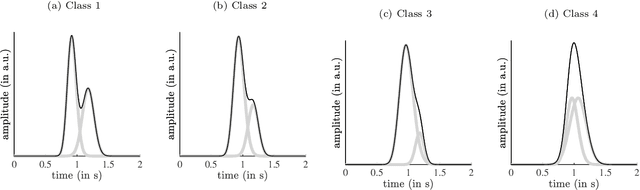
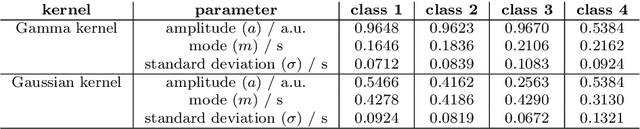
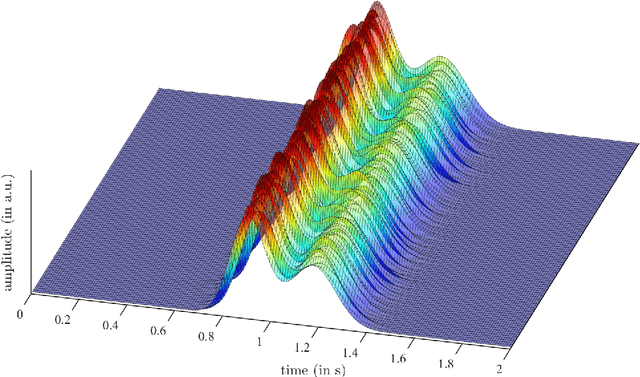
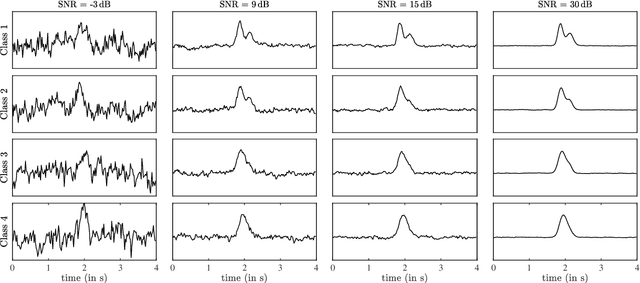
Photoplethysmographic Imaging (PPGI) allows the determination of pulse rate variability from sequential beat-to-beat intervals (BBI) and pulse wave velocity from spatially resolved recorded pulse waves. In either case, sufficient temporal accuracy is essential. The presented work investigates the temporal accuracy of BBI estimation from photoplethysmographic signals. Within comprehensive numerical simulation, we systematically assess the impact of sampling rate, signal-to-noise ratio (SNR), and beat-to-beat shape variations on the root mean square error (RMSE) between real and estimated BBI. Our results show that at sampling rates beyond 14 Hz only small errors exist when interpolation is used. For example, the average RMSE is 3 ms for a sampling rate of 14 Hz and an SNR of 18 dB. Further increasing the sampling rate only results in marginal improvements, e.g. more than tripling the sampling rate to 50 Hz reduces the error by approx. 14%. The most important finding relates to the SNR, which is shown to have a much stronger influence on the error than the sampling rate. For example, increasing the SNR from 18 dB to 24 dB at 14 Hz sampling rate reduced the error by almost 50% to 1.5 ms. Subtle beat-to-beat shape variations, moreover, increase the error decisively by up to 800%. Our results are highly relevant in three regards: first, they partially explain different results in the literature on minimum sampling rates. Second, they emphasize the importance to consider SNR and possibly shape variation in investigations on the minimal sampling rate. Third, they underline the importance of appropriate processing techniques to increase SNR. Importantly, though our motivation is PPGI, the presented work immediately applies to contact PPG and PPG in other settings such as wearables. To enable further investigations, we make the scripts used in modelling and simulation freely available.
* 18 pages, 11 figures