 Add to Chrome
 Add to Firefox
 Add to Edge
We Need Explanation Cards to Connect Explanation Algorithms to the Real World
Jun 15, 2026
Algorithmic explanations are intended to help stakeholders understand opaque algorithmic decisions, but in practice, they often fall short. First, the meaning of algorithmic explanations is often not what one might intuitively expect, so expert knowledge is required to interpret them correctly. Second, recent work has shown that popular explanation algorithms are uninformative about the behavior of complex decision functions. Together, these issues create a gap between what explanations appear to convey and what they actually provide. In this work, we propose Explanation Cards for Explanation Algorithms, which augment standard explanations with complementary information about robustness and validity, as well as clear instructions for interpretation. The complementary information can render otherwise uninformative explanations practically useful, while also helping to detect cases where they are not. Importantly, the interpretation instructions in explanation cards shift responsibility from users to providers: Rather than expecting users to recognize what can and cannot be concluded from an explanation, providers must make this explicit upfront. Using counterfactual explanations and SHAP as examples, we demonstrate how providers can construct explanation cards and that these cards provide users with the guidance needed for sound interpretation. We further argue that explanation cards offer a practical means of operationalising the explainability provisions of the EU AI Act. Overall, explanation cards are a significant step toward making explanation algorithms fit for real-world use cases.

Validity Threats for Foundation Model Research
Jun 03, 2026Controlled experiments are the backbone of machine learning research, but at the scale of modern foundation models, they have become prohibitively expensive. Instead, the community increasingly relies on research strategies that approximate the ideal experiment at a fraction of the cost: proxy experiments and scaling laws, observational studies with publicly available models, and single-run designs that leverage variation within individual training runs. In this work, we argue that there is no free lunch when approximating large-scale experiments on a compute budget. Specifically, savings in compute come at the cost of validity threats -- hidden and sometimes untestable assumptions that, when violated, can invalidate research claims. To help navigate such threats, we propose an evaluation framework that casts foundation model research as a causal inference problem. Within this framework, we evaluate different research strategies through four types of validity adapted from the empirical social sciences -- statistical, internal, external, and construct validity. We find that each strategy comes with a characteristic validity profile: proxy experiments trade external and construct validity for statistical and internal validity; observational studies face confounding and effect heterogeneity; and single-run designs are strained by interference between treated units. This analysis reveals several validity threats that have received insufficient attention in the literature. Overall, our evaluation framework provides researchers with a practical toolkit for scrutinizing validity threats in foundation model research~designs.
How to Scale Mixture-of-Experts: From muP to the Maximally Scale-Stable Parameterization
May 13, 2026Recent frontier large language models predominantly rely on Mixture-of-Experts (MoE) architectures. Despite empirical progress, there is still no principled understanding of how hyperparameters should scale with network width $N$, expert width $N_e$, number of experts $M$, sparsity $K$, and depth $L$ to ensure both stability and optimal performance at scale. We take a principled step toward resolving this gap by analyzing three different scaling regimes: (I) co-scaling $N\asymp N_e$, (II) co-scaling $N\asymp M\asymp K$, and (III) full proportional scaling of $N, N_e, M$, and $K$. For each regime, we develop a novel Dynamical Mean Field Theory (DMFT) description of the limiting training dynamics of MoEs that provides a formal foundation for our analysis. Within this framework, we derive the unique parameterization for SGD and Adam satisfying all maximal-update ($μ$) desiderata. We then show that the resulting $μ$P prescription does not reliably induce monotonic improvement with scale or robust learning-rate transfer. We trace these pathologies to scale-dependent observables in the aggregation dynamics, which motivates a refined set of desiderata that we term maximal scale stability. Guided by this principle, we derive a Maximally Scale-Stable Parameterization (MSSP) for both SGD and Adam in all three scaling regimes, and characterize the corresponding limiting dynamics - qualitatively distinct from the $μ$P limit - through a separate DMFT analysis. Experiments verify that MSSP robustly recovers learning rate transfer and monotonic improvement with scale across regimes. Combined with existing depth-scaling theory, these results provide a complete scaling prescription for MoE architectures as a function of width, depth, expert width, and number of experts.
Using predictive multiplicity to measure individual performance within the AI Act
Feb 12, 2026When building AI systems for decision support, one often encounters the phenomenon of predictive multiplicity: a single best model does not exist; instead, one can construct many models with similar overall accuracy that differ in their predictions for individual cases. Especially when decisions have a direct impact on humans, this can be highly unsatisfactory. For a person subject to high disagreement between models, one could as well have chosen a different model of similar overall accuracy that would have decided the person's case differently. We argue that this arbitrariness conflicts with the EU AI Act, which requires providers of high-risk AI systems to report performance not only at the dataset level but also for specific persons. The goal of this paper is to put predictive multiplicity in context with the EU AI Act's provisions on accuracy and to subsequently derive concrete suggestions on how to evaluate and report predictive multiplicity in practice. Specifically: (1) We argue that incorporating information about predictive multiplicity can serve compliance with the EU AI Act's accuracy provisions for providers. (2) Based on this legal analysis, we suggest individual conflict ratios and $δ$-ambiguity as tools to quantify the disagreement between models on individual cases and to help detect individuals subject to conflicting predictions. (3) Based on computational insights, we derive easy-to-implement rules on how model providers could evaluate predictive multiplicity in practice. (4) Ultimately, we suggest that information about predictive multiplicity should be made available to deployers under the AI Act, enabling them to judge whether system outputs for specific individuals are reliable enough for their use case.
Weight Decay Improves Language Model Plasticity
Feb 11, 2026The prevailing paradigm in large language model (LLM) development is to pretrain a base model, then perform further training to improve performance and model behavior. However, hyperparameter optimization and scaling laws have been studied primarily from the perspective of the base model's validation loss, ignoring downstream adaptability. In this work, we study pretraining from the perspective of model plasticity, that is, the ability of the base model to successfully adapt to downstream tasks through fine-tuning. We focus on the role of weight decay, a key regularization parameter during pretraining. Through systematic experiments, we show that models trained with larger weight decay values are more plastic, meaning they show larger performance gains when fine-tuned on downstream tasks. This phenomenon can lead to counterintuitive trade-offs where base models that perform worse after pretraining can perform better after fine-tuning. Further investigation of weight decay's mechanistic effects on model behavior reveals that it encourages linearly separable representations, regularizes attention matrices, and reduces overfitting on the training data. In conclusion, this work demonstrates the importance of using evaluation metrics beyond cross-entropy loss for hyperparameter optimization and casts light on the multifaceted role of that a single optimization hyperparameter plays in shaping model behavior.
On the Surprising Effectiveness of Large Learning Rates under Standard Width Scaling
May 28, 2025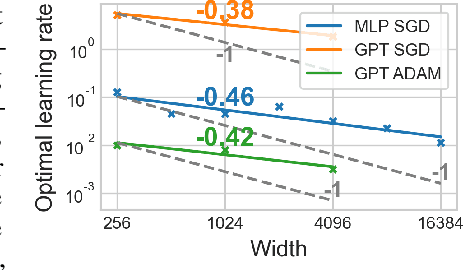
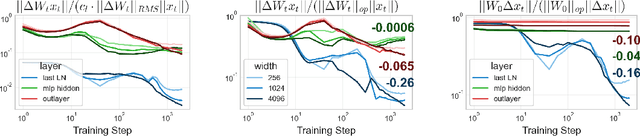
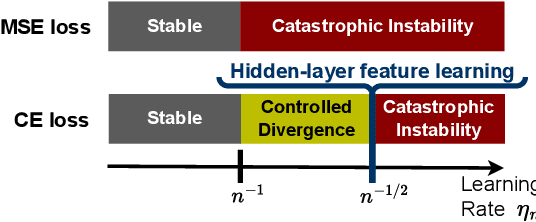
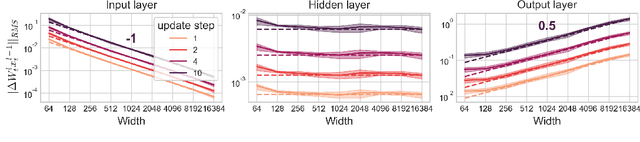
The dominant paradigm for training large-scale vision and language models is He initialization and a single global learning rate (\textit{standard parameterization}, SP). Despite its practical success, standard parametrization remains poorly understood from a theoretical perspective: Existing infinite-width theory would predict instability under large learning rates and vanishing feature learning under stable learning rates. However, empirically optimal learning rates consistently decay much slower than theoretically predicted. By carefully studying neural network training dynamics, we demonstrate that this discrepancy is not fully explained by finite-width phenomena such as catapult effects or a lack of alignment between weights and incoming activations. We instead show that the apparent contradiction can be fundamentally resolved by taking the loss function into account: In contrast to Mean Squared Error (MSE) loss, we prove that under cross-entropy (CE) loss, an intermediate \textit{controlled divergence} regime emerges, where logits diverge but loss, gradients, and activations remain stable. Stable training under large learning rates enables persistent feature evolution at scale in all hidden layers, which is crucial for the practical success of SP. In experiments across optimizers (SGD, Adam), architectures (MLPs, GPT) and data modalities (vision, language), we validate that neural networks operate in this controlled divergence regime under CE loss but not under MSE loss. Our empirical evidence suggests that width-scaling considerations are surprisingly useful for predicting empirically optimal learning rate exponents. Finally, our analysis clarifies the effectiveness and limitations of recently proposed layerwise learning rate scalings for standard initialization.
How much can we forget about Data Contamination?
Oct 04, 2024


The leakage of benchmark data into the training data has emerged as a significant challenge for evaluating the capabilities of large language models (LLMs). In this work, we use experimental evidence and theoretical estimates to challenge the common assumption that small-scale contamination renders benchmark evaluations invalid. First, we experimentally quantify the magnitude of benchmark overfitting based on scaling along three dimensions: The number of model parameters (up to 1.6B), the number of times an example is seen (up to 144), and the number of training tokens (up to 40B). We find that if model and data follow the Chinchilla scaling laws, minor contamination indeed leads to overfitting. At the same time, even 144 times of contamination can be forgotten if the training data is scaled beyond five times Chinchilla, a regime characteristic of many modern LLMs. We then derive a simple theory of example forgetting via cumulative weight decay. It allows us to bound the number of gradient steps required to forget past data for any training run where we know the hyperparameters of AdamW. This indicates that many LLMs, including Llama 3, have forgotten the data seen at the beginning of training. Experimentally, we demonstrate that forgetting occurs faster than what is predicted by our bounds. Taken together, our results suggest that moderate amounts of contamination can be forgotten at the end of realistically scaled training runs.
Elephants Never Forget: Memorization and Learning of Tabular Data in Large Language Models
Apr 09, 2024While many have shown how Large Language Models (LLMs) can be applied to a diverse set of tasks, the critical issues of data contamination and memorization are often glossed over. In this work, we address this concern for tabular data. Specifically, we introduce a variety of different techniques to assess whether a language model has seen a tabular dataset during training. This investigation reveals that LLMs have memorized many popular tabular datasets verbatim. We then compare the few-shot learning performance of LLMs on datasets that were seen during training to the performance on datasets released after training. We find that LLMs perform better on datasets seen during training, indicating that memorization leads to overfitting. At the same time, LLMs show non-trivial performance on novel datasets and are surprisingly robust to data transformations. We then investigate the in-context statistical learning abilities of LLMs. Without fine-tuning, we find them to be limited. This suggests that much of the few-shot performance on novel datasets is due to the LLM's world knowledge. Overall, our results highlight the importance of testing whether an LLM has seen an evaluation dataset during pre-training. We make the exposure tests we developed available as the tabmemcheck Python package at https://github.com/interpretml/LLM-Tabular-Memorization-Checker
Elephants Never Forget: Testing Language Models for Memorization of Tabular Data
Mar 11, 2024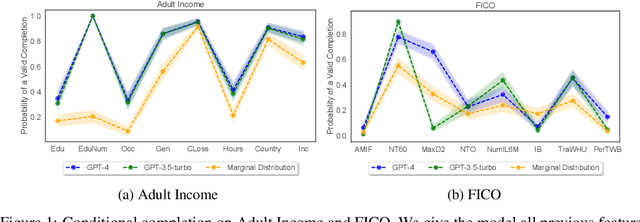


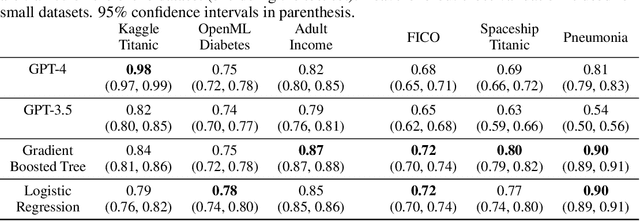
While many have shown how Large Language Models (LLMs) can be applied to a diverse set of tasks, the critical issues of data contamination and memorization are often glossed over. In this work, we address this concern for tabular data. Starting with simple qualitative tests for whether an LLM knows the names and values of features, we introduce a variety of different techniques to assess the degrees of contamination, including statistical tests for conditional distribution modeling and four tests that identify memorization. Our investigation reveals that LLMs are pre-trained on many popular tabular datasets. This exposure can lead to invalid performance evaluation on downstream tasks because the LLMs have, in effect, been fit to the test set. Interestingly, we also identify a regime where the language model reproduces important statistics of the data, but fails to reproduce the dataset verbatim. On these datasets, although seen during training, good performance on downstream tasks might not be due to overfitting. Our findings underscore the need for ensuring data integrity in machine learning tasks with LLMs. To facilitate future research, we release an open-source tool that can perform various tests for memorization \url{https://github.com/interpretml/LLM-Tabular-Memorization-Checker}.
Data Science with LLMs and Interpretable Models
Feb 22, 2024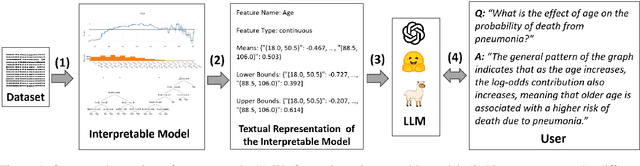


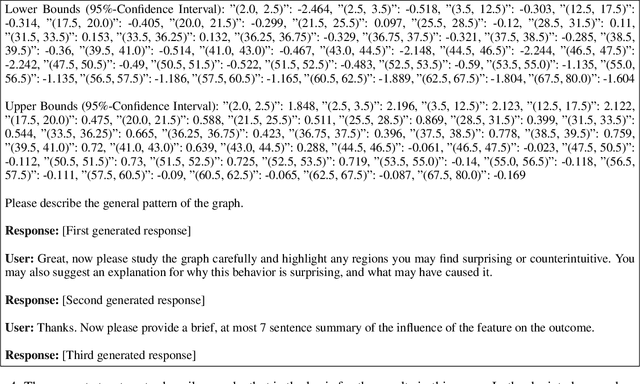
Recent years have seen important advances in the building of interpretable models, machine learning models that are designed to be easily understood by humans. In this work, we show that large language models (LLMs) are remarkably good at working with interpretable models, too. In particular, we show that LLMs can describe, interpret, and debug Generalized Additive Models (GAMs). Combining the flexibility of LLMs with the breadth of statistical patterns accurately described by GAMs enables dataset summarization, question answering, and model critique. LLMs can also improve the interaction between domain experts and interpretable models, and generate hypotheses about the underlying phenomenon. We release \url{https://github.com/interpretml/TalkToEBM} as an open-source LLM-GAM interface.