 Add to Chrome
 Add to Firefox
 Add to Edge
Using predictive multiplicity to measure individual performance within the AI Act
Feb 12, 2026
When building AI systems for decision support, one often encounters the phenomenon of predictive multiplicity: a single best model does not exist; instead, one can construct many models with similar overall accuracy that differ in their predictions for individual cases. Especially when decisions have a direct impact on humans, this can be highly unsatisfactory. For a person subject to high disagreement between models, one could as well have chosen a different model of similar overall accuracy that would have decided the person's case differently. We argue that this arbitrariness conflicts with the EU AI Act, which requires providers of high-risk AI systems to report performance not only at the dataset level but also for specific persons. The goal of this paper is to put predictive multiplicity in context with the EU AI Act's provisions on accuracy and to subsequently derive concrete suggestions on how to evaluate and report predictive multiplicity in practice. Specifically: (1) We argue that incorporating information about predictive multiplicity can serve compliance with the EU AI Act's accuracy provisions for providers. (2) Based on this legal analysis, we suggest individual conflict ratios and $δ$-ambiguity as tools to quantify the disagreement between models on individual cases and to help detect individuals subject to conflicting predictions. (3) Based on computational insights, we derive easy-to-implement rules on how model providers could evaluate predictive multiplicity in practice. (4) Ultimately, we suggest that information about predictive multiplicity should be made available to deployers under the AI Act, enabling them to judge whether system outputs for specific individuals are reliable enough for their use case.

How to safely discard features based on aggregate SHAP values
Mar 29, 2025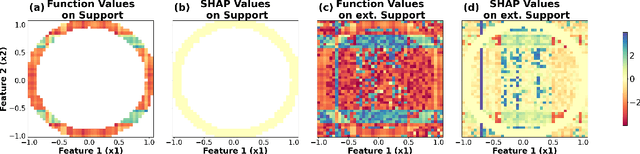
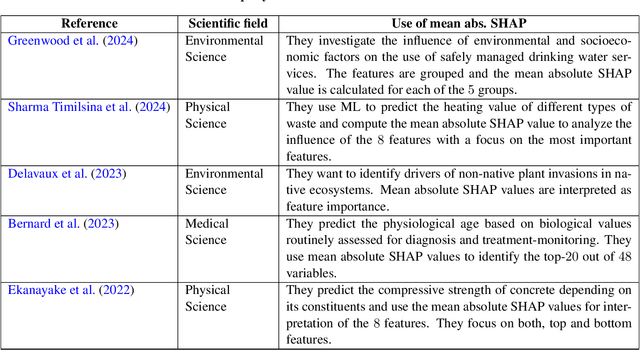

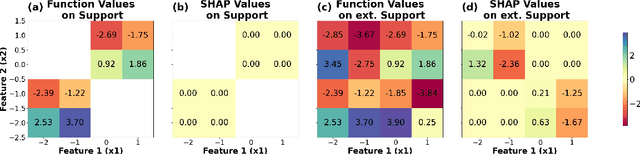
SHAP is one of the most popular local feature-attribution methods. Given a function f and an input x, it quantifies each feature's contribution to f(x). Recently, SHAP has been increasingly used for global insights: practitioners average the absolute SHAP values over many data points to compute global feature importance scores, which are then used to discard unimportant features. In this work, we investigate the soundness of this practice by asking whether small aggregate SHAP values necessarily imply that the corresponding feature does not affect the function. Unfortunately, the answer is no: even if the i-th SHAP value is 0 on the entire data support, there exist functions that clearly depend on Feature i. The issue is that computing SHAP values involves evaluating f on points outside of the data support, where f can be strategically designed to mask its dependence on Feature i. To address this, we propose to aggregate SHAP values over the extended support, which is the product of the marginals of the underlying distribution. With this modification, we show that a small aggregate SHAP value implies that we can safely discard the corresponding feature. We then extend our results to KernelSHAP, the most popular method to approximate SHAP values in practice. We show that if KernelSHAP is computed over the extended distribution, a small aggregate value justifies feature removal. This result holds independently of whether KernelSHAP accurately approximates true SHAP values, making it one of the first theoretical results to characterize the KernelSHAP algorithm itself. Our findings have both theoretical and practical implications. We introduce the Shapley Lie algebra, which offers algebraic insights that may enable a deeper investigation of SHAP and we show that randomly permuting each column of the data matrix enables safely discarding features based on aggregate SHAP and KernelSHAP values.