 Add to Chrome
 Add to Firefox
 Add to Edge
Scaling and Stabilizing Large-Scale Embedding-Based Retrieval
Jul 11, 2026
Embedding-based retrieval (EBR) is foundational to large-scale e-commerce search, yet its effectiveness is often constrained by the quality of training signals and the representational capacity of the encoder. Standard dual-encoders suffer from a training-inference gap: they are optimized on narrow candidate pools but must discriminate against hundreds of millions of items during inference. Furthermore, while transitioning to higher-capacity backbones can mitigate this gap, simply replacing a mature model can lead to inconsistent retrieval behavior and a loss of the domain-specific knowledge established in previous iterations. In this paper, we present a unified pipeline deployed at Walmart that addresses both signal quality and model evolution. Our contributions are two-fold: (1) Hybrid Hard Negative Mining: We integrate Online Cross-Batch Sampling to increase negative diversity by an order of magnitude and Hybrid Offline Mining, which combines cross-encoder predictions with metadata heuristics to identify nuanced mismatches. (2) Legacy-Aware Distillation: We transition from DistilBERT to a higher-capacity GTE-base encoder. To ensure a smooth and superior transition, we introduce a Warm-Start Distillation technique that transfers domain-specific expertise from the legacy model to the new backbone. Validated through extensive offline experiments and online A/B testing, the proposed pipeline is deployed in live production, delivering a +7.34% improvement in NDCG@5 and a +0.50% lift in gross revenue.

Enhancing Relevance of Embedding-based Retrieval at Walmart
Aug 09, 2024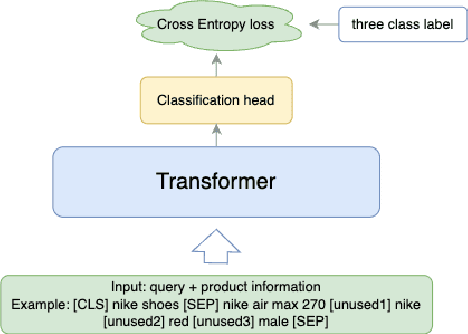
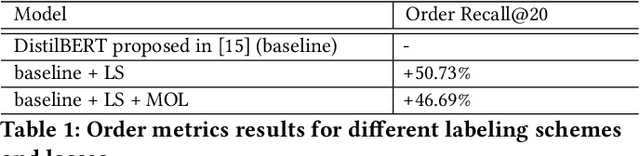
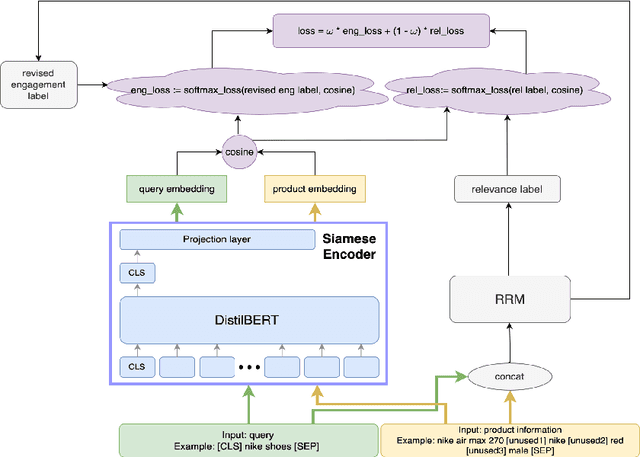
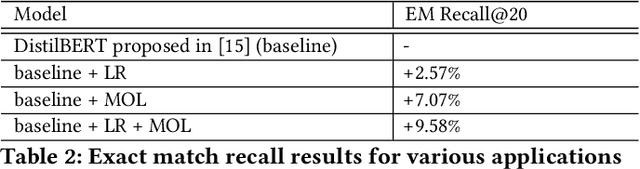
Embedding-based neural retrieval (EBR) is an effective search retrieval method in product search for tackling the vocabulary gap between customer search queries and products. The initial launch of our EBR system at Walmart yielded significant gains in relevance and add-to-cart rates [1]. However, despite EBR generally retrieving more relevant products for reranking, we have observed numerous instances of relevance degradation. Enhancing retrieval performance is crucial, as it directly influences product reranking and affects the customer shopping experience. Factors contributing to these degradations include false positives/negatives in the training data and the inability to handle query misspellings. To address these issues, we present several approaches to further strengthen the capabilities of our EBR model in terms of retrieval relevance. We introduce a Relevance Reward Model (RRM) based on human relevance feedback. We utilize RRM to remove noise from the training data and distill it into our EBR model through a multi-objective loss. In addition, we present the techniques to increase the performance of our EBR model, such as typo-aware training, and semi-positive generation. The effectiveness of our EBR is demonstrated through offline relevance evaluation, online AB tests, and successful deployments to live production. [1] Alessandro Magnani, Feng Liu, Suthee Chaidaroon, Sachin Yadav, Praveen Reddy Suram, Ajit Puthenputhussery, Sijie Chen, Min Xie, Anirudh Kashi, Tony Lee, et al. 2022. Semantic retrieval at walmart. In Proceedings of the 28th ACM SIGKDD Conference on Knowledge Discovery and Data Mining. 3495-3503.