 Add to Chrome
 Add to Firefox
 Add to Edge
SGHA: Evidence-Grounded Research Problem Discovery with Local Language Models
Aug 18, 2026
Recent efforts toward fully automated AI scientists have demonstrated that language-model agents can generate hypotheses, execute experiments, and draft scientific manuscripts. However, during the early stages of research, when research problems are formulated, these AI scientists often rely heavily on proprietary frontier models. Their proposals are shaped by opaque parametric knowledge and by literature searches conditioned on the proposals themselves. Such knowledge is effectively a black box, and this dependence makes the evidential basis and validity of generated research problems difficult to audit and leaves the process vulnerable to model-specific hallucinations and biases. Furthermore, if proprietary research materials are transmitted to external APIs, the use of these models creates confidentiality, privacy, and data-governance concerns. We introduce the Structural Gap Hypothesis Agent (SGHA), a fully automated, corpus-first research-problem discovery system that runs entirely on a local LLM. SGHA structures a scientific literature corpus into evidence-linked paper objects and a typed evidence graph, detects unresolved structural patterns across papers, screens candidate gaps before formulation, and produces traceable research-problem families. In particular, it is able to output assumptions, objectives, success criteria, and remaining ambiguities. All LLM-based components of SGHA are executed using a locally served open-weight 9B language model, without requiring proprietary frontier-model APIs. We compare SGHA with the AI Scientist-v2 idea formulation module in five machine-learning domains. Our results suggest that explicit corpus structure and evidence-constrained reasoning can support promising, inspectable research-problem formulation without relying on frontier models during generation or verification.

ThinkRetrieve: Retrieval-Augmented Reasoning Traces for Test-Time Scaling
Aug 11, 2026Large Reasoning Models (LRMs) improve performance by allocating additional inference-time compute to generate extended chain-of-thought reasoning. However, recent studies reveal that sequential test-time scaling often yields diminishing or even negative returns, as longer traces exhibit increased uncertainty, error compounding, and drift from the original problem. We propose ThinkRetrieve, a test-time scaling framework that augments the reasoning traces of LRMs with dynamically retrieved solved examples at each reasoning step. Given an external corpus of problems paired with step-by-step solutions, ThinkRetrieve retrieves relevant exemplars at each intermediate step and injects them directly into the thinking trace, providing the model with guidance on how to reason rather than merely what facts are relevant. Experiments across five reasoning models (1.5B--8B parameters) on GSM-8K, MATH-500, AIME 2025, and SciQ demonstrate that ThinkRetrieve consistently improves accuracy over standard test-time scaling, with relative gains of up to $60\%$ on AIME 2025.
Beyond Listenership: AI-Predicted Interventions Drive Improvements in Maternal Health Behaviours
Jul 28, 2025Automated voice calls with health information are a proven method for disseminating maternal and child health information among beneficiaries and are deployed in several programs around the world. However, these programs often suffer from beneficiary dropoffs and poor engagement. In previous work, through real-world trials, we showed that an AI model, specifically a restless bandit model, could identify beneficiaries who would benefit most from live service call interventions, preventing dropoffs and boosting engagement. However, one key question has remained open so far: does such improved listenership via AI-targeted interventions translate into beneficiaries' improved knowledge and health behaviors? We present a first study that shows not only listenership improvements due to AI interventions, but also simultaneously links these improvements to health behavior changes. Specifically, we demonstrate that AI-scheduled interventions, which enhance listenership, lead to statistically significant improvements in beneficiaries' health behaviors such as taking iron or calcium supplements in the postnatal period, as well as understanding of critical health topics during pregnancy and infancy. This underscores the potential of AI to drive meaningful improvements in maternal and child health.
Representative Arm Identification: A fixed confidence approach to identify cluster representatives
Aug 26, 2024
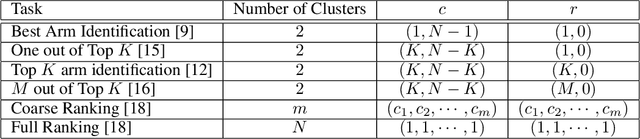
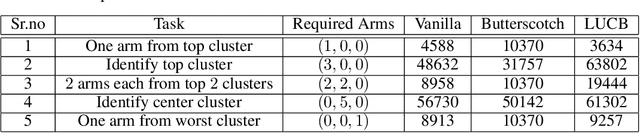
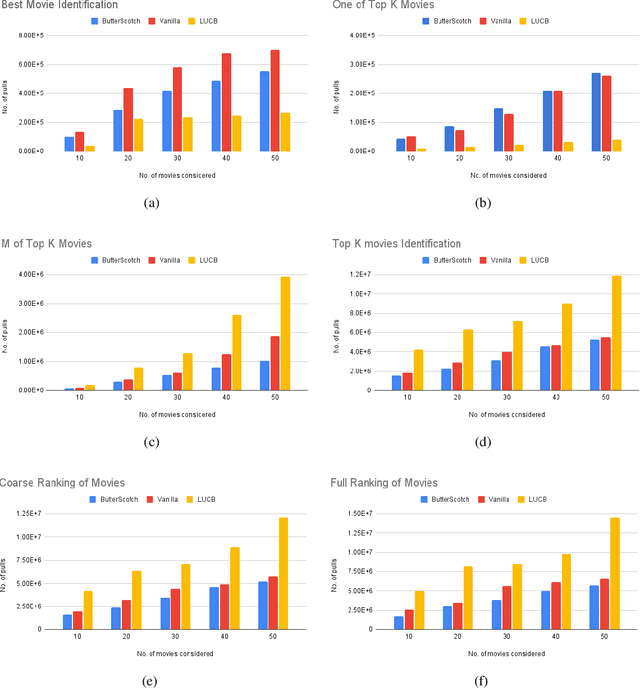
We study the representative arm identification (RAI) problem in the multi-armed bandits (MAB) framework, wherein we have a collection of arms, each associated with an unknown reward distribution. An underlying instance is defined by a partitioning of the arms into clusters of predefined sizes, such that for any $j > i$, all arms in cluster $i$ have a larger mean reward than those in cluster $j$. The goal in RAI is to reliably identify a certain prespecified number of arms from each cluster, while using as few arm pulls as possible. The RAI problem covers as special cases several well-studied MAB problems such as identifying the best arm or any $M$ out of the top $K$, as well as both full and coarse ranking. We start by providing an instance-dependent lower bound on the sample complexity of any feasible algorithm for this setting. We then propose two algorithms, based on the idea of confidence intervals, and provide high probability upper bounds on their sample complexity, which orderwise match the lower bound. Finally, we do an empirical comparison of both algorithms along with an LUCB-type alternative on both synthetic and real-world datasets, and demonstrate the superior performance of our proposed schemes in most cases.
Galaxy classification: a deep learning approach for classifying Sloan Digital Sky Survey images
Nov 01, 2022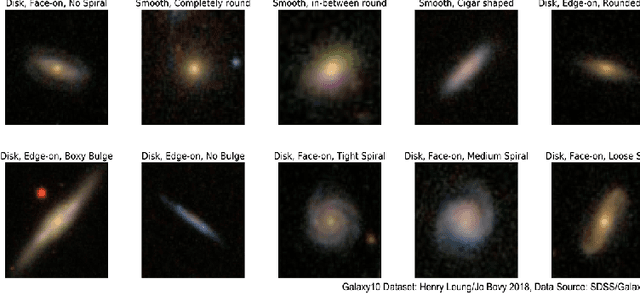
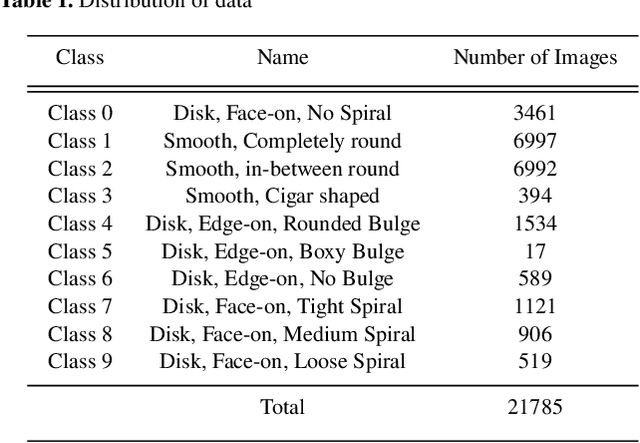
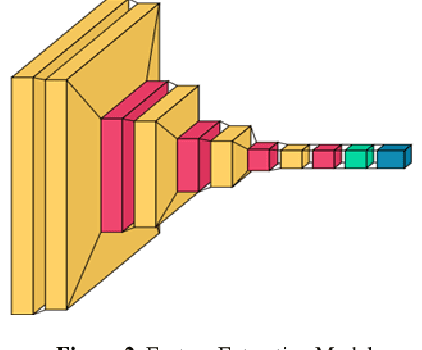
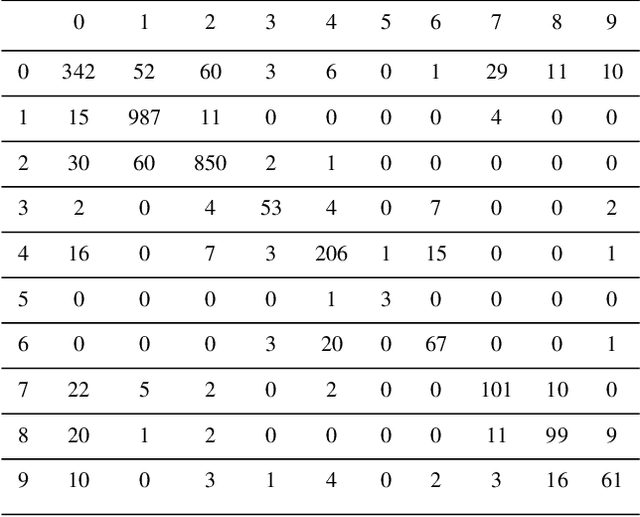
In recent decades, large-scale sky surveys such as Sloan Digital Sky Survey (SDSS) have resulted in generation of tremendous amount of data. The classification of this enormous amount of data by astronomers is time consuming. To simplify this process, in 2007 a volunteer-based citizen science project called Galaxy Zoo was introduced, which has reduced the time for classification by a good extent. However, in this modern era of deep learning, automating this classification task is highly beneficial as it reduces the time for classification. For the last few years, many algorithms have been proposed which happen to do a phenomenal job in classifying galaxies into multiple classes. But all these algorithms tend to classify galaxies into less than six classes. However, after considering the minute information which we know about galaxies, it is necessary to classify galaxies into more than eight classes. In this study, a neural network model is proposed so as to classify SDSS data into 10 classes from an extended Hubble Tuning Fork. Great care is given to disc edge and disc face galaxies, distinguishing between a variety of substructures and minute features which are associated with each class. The proposed model consists of convolution layers to extract features making this method fully automatic. The achieved test accuracy is 84.73 per cent which happens to be promising after considering such minute details in classes. Along with convolution layers, the proposed model has three more layers responsible for classification, which makes the algorithm consume less time.
* Published in MNRAS
An Image Processing approach to identify solar plages observed at 393.37 nm by Kodaikanal Solar Observatory
Oct 03, 2022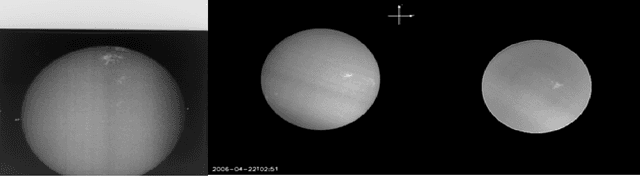
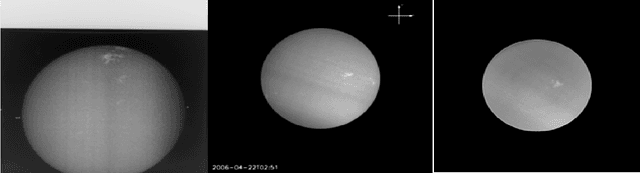
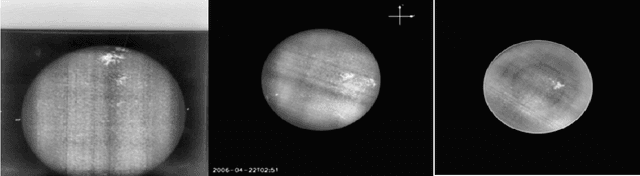

Solar Plages are bright chromospheric features observed in Ca II K photographic observations of the sun. These are regions of high magnetic field concentration thus tracer of magnetic activity of the Sun and are one of the most important features to study long term variability of the Sun as Ca II K spectroheliograms are recorded for more than a century. . However, detection of the plages from century-long databases is a non-trivial task and need significant human resources for doing it manually. Hence, in this study we propose an image processing algorithm which can identify solar plages from Ca II K photographic observations. The proposed study has been implemented on archival data from Kodaikanal Solar Observatory. To ensure that the algorithm works, irrespective of noise level, brightness and other image properties, we randomly draw a samples of images from data archive to test our algorithm.