 Add to Chrome
 Add to Firefox
 Add to Edge
SGHA: Evidence-Grounded Research Problem Discovery with Local Language Models
Aug 18, 2026
Recent efforts toward fully automated AI scientists have demonstrated that language-model agents can generate hypotheses, execute experiments, and draft scientific manuscripts. However, during the early stages of research, when research problems are formulated, these AI scientists often rely heavily on proprietary frontier models. Their proposals are shaped by opaque parametric knowledge and by literature searches conditioned on the proposals themselves. Such knowledge is effectively a black box, and this dependence makes the evidential basis and validity of generated research problems difficult to audit and leaves the process vulnerable to model-specific hallucinations and biases. Furthermore, if proprietary research materials are transmitted to external APIs, the use of these models creates confidentiality, privacy, and data-governance concerns. We introduce the Structural Gap Hypothesis Agent (SGHA), a fully automated, corpus-first research-problem discovery system that runs entirely on a local LLM. SGHA structures a scientific literature corpus into evidence-linked paper objects and a typed evidence graph, detects unresolved structural patterns across papers, screens candidate gaps before formulation, and produces traceable research-problem families. In particular, it is able to output assumptions, objectives, success criteria, and remaining ambiguities. All LLM-based components of SGHA are executed using a locally served open-weight 9B language model, without requiring proprietary frontier-model APIs. We compare SGHA with the AI Scientist-v2 idea formulation module in five machine-learning domains. Our results suggest that explicit corpus structure and evidence-constrained reasoning can support promising, inspectable research-problem formulation without relying on frontier models during generation or verification.

Privileged Solutions or Context-Induced Teacher Behavior? Dissecting On-Policy Self-Distillation
Aug 10, 2026On-Policy Self-Distillation (OPSD) is commonly interpreted as the transfer of privileged information: a teacher observes the verified solution to the target problem and supervises the student's trajectory. However, this interpretation conflates two effects. The reference solution not only reveals the answer to the current instance but also changes the context under which the teacher provides token-level supervision. We investigate the role of target-specific privilege with $\mathrm{OP}^{2}\mathrm{SD}$ (On-Policy Self-Distillation from Other Problems), which replaces the paired reference with a problem and solution from a different example, while preserving the student rollout, teacher, and distillation objective. Across three models and three mathematics benchmarks, $\mathrm{OP}^{2}\mathrm{SD}$ improves over the base model, remains competitive with OPSD. The success of $\mathrm{OP}^{2}\mathrm{SD}$ implies that OPSD gains do not necessarily come from access to the reference solution, and that the teacher's context-induced behavior is an important factor.
Learning Optimal Dynamic Matching via Graph Neural Networks
Jul 31, 2026Dynamic matching markets require decisions about whom to match and when: matching now yields value but removes participants who may create better future opportunities. We develop a value-based reinforcement-learning framework for this problem on finite, evolving weighted graphs. We study an infinite-horizon continuous-time model with stochastic arrivals, node-type transitions, edge realizations, and exogenous exits. We prove an event-time reduction: without loss of optimality, the planner acts immediately after each exogenous event and then waits for the next one. We further show that the optimal edge-wise $Q$-function is characterized by a single continuation-value function on post-decision residual graphs, reducing the learned object from state-action values to graph values. Exact action selection still requires combinatorial matching optimization; we approximate the value with a graph neural network, train it by temporal-difference learning, and use it in a forward-greedy matching heuristic. In a binary-type benchmark, the learned policy substantially outperforms immediate and threshold-greedy rules by preserving common nodes for rare arrivals of valuable matches while forming lower-value matches only in thick pools. In a kidney paired donation benchmark, it performs similarly to immediate greedy when exits are unpredictable, recovers the logic of patient matching when warnings are reliable, and outperforms the better of Immediate Greedy and Patient Greedy across intermediate warning probabilities. These results show that residual-graph value learning yields state-dependent dynamic matching policies that adapt to realized connectivity and exit information.
Fixed-Confidence Best-Arm Identification for Causal Mediation Analysis
Jul 05, 2026This paper studies the problem of identifying the treatment that maximizes the expected natural direct potential outcome (NDPO), which captures the potential outcome of an intervention while excluding the pathway transmitted through a mediator that researchers may wish to remove from evaluation. We first establish population-level identification of the expected NDPO in a causal bandit setting using observable interventional distributions. We then develop a fixed-confidence best-arm identification (BAI) algorithm based on the Track-and-Stop (TaS) framework, employing a cutting-set method to solve the resulting semi-infinite optimization problem. The proposed algorithm achieves sample-efficient identification with a high-probability correctness guarantee. We prove that it satisfies $δ$-correctness and asymptotic optimality. Finally, we validate the approach through empirical evaluations on a large-scale real-world advertising dataset (IPinYou).
Finite-Time Regret Analysis of Retry-Aware Bandits
May 20, 2026We study a stochastic bandit algorithm motivated by retry-aware objectives that value the best outcome among multiple attempts, such as pass@$k$ and max@$k$. Given a posterior over arm values, ReMax chooses a sampling distribution that maximizes the posterior expected maximum reward over $M$ virtual draws. Although this objective was introduced in reinforcement learning as an exploration mechanism under uncertainty, its regret properties in bandit problems have remained unclear. For Gaussian rewards and the first nontrivial case $M=2$, we characterize the optimal ReMax distribution through an expected-improvement balance condition and prove the first sublinear regret bound for ReMax. Our analysis separates the usual saturation behavior of suboptimal arms from a ReMax-specific underestimation effect, in which the optimal arm may be sampled too rarely after an unfavorable estimate. This explains why ReMax can be more exploitative than Thompson sampling (TS) and why its regret analysis is technically delicate. Experiments support this picture: ReMax often outperforms KL-UCB and Thompson sampling under mild underestimation, while posterior-variance scaling empirically mitigates severe underestimation.
CITE: Anytime-Valid Statistical Inference in LLM Self-Consistency
May 07, 2026Large language models often improve reasoning by sampling multiple outputs and aggregating their final answers, but precise and efficient control of error levels remains a challenging task. In particular, deciding when to stop sampling remains difficult when the stopping rule is data-dependent and the set of possible answers is not known in advance. We study anytime-valid certification of a prespecified target answer as the unique mode of the model's response distribution, a guarantee distinct from answer correctness. We propose the Certification by Intersection-union Testing with E-processes (CITE) algorithm, which provably controls false certification at any prescribed level under arbitrary data-driven stopping, without requiring prior knowledge of the answer category set. We also prove an category-set-size-free stopping-time rate, establish matching minimax lower bounds up to constants in the main regime, and extend the construction to confidence-weighted voting. Simulations and LLM self-consistency experiments show empirical error control and improved certification in diffuse-tail settings.
An Efficient Algorithm for Thresholding Monte Carlo Tree Search
Jan 30, 2026We introduce the Thresholding Monte Carlo Tree Search problem, in which, given a tree $\mathcal{T}$ and a threshold $θ$, a player must answer whether the root node value of $\mathcal{T}$ is at least $θ$ or not. In the given tree, `MAX' or `MIN' is labeled on each internal node, and the value of a `MAX'-labeled (`MIN'-labeled) internal node is the maximum (minimum) of its child values. The value of a leaf node is the mean reward of an unknown distribution, from which the player can sample rewards. For this problem, we develop a $δ$-correct sequential sampling algorithm based on the Track-and-Stop strategy that has asymptotically optimal sample complexity. We show that a ratio-based modification of the D-Tracking arm-pulling strategy leads to a substantial improvement in empirical sample complexity, as well as reducing the per-round computational cost from linear to logarithmic in the number of arms.
High-dimensional Nonparametric Contextual Bandit Problem
May 20, 2025We consider the kernelized contextual bandit problem with a large feature space. This problem involves $K$ arms, and the goal of the forecaster is to maximize the cumulative rewards through learning the relationship between the contexts and the rewards. It serves as a general framework for various decision-making scenarios, such as personalized online advertising and recommendation systems. Kernelized contextual bandits generalize the linear contextual bandit problem and offers a greater modeling flexibility. Existing methods, when applied to Gaussian kernels, yield a trivial bound of $O(T)$ when we consider $\Omega(\log T)$ feature dimensions. To address this, we introduce stochastic assumptions on the context distribution and show that no-regret learning is achievable even when the number of dimensions grows up to the number of samples. Furthermore, we analyze lenient regret, which allows a per-round regret of at most $\Delta > 0$. We derive the rate of lenient regret in terms of $\Delta$.
No-regret incentive-compatible online learning under exact truthfulness with non-myopic experts
Feb 17, 2025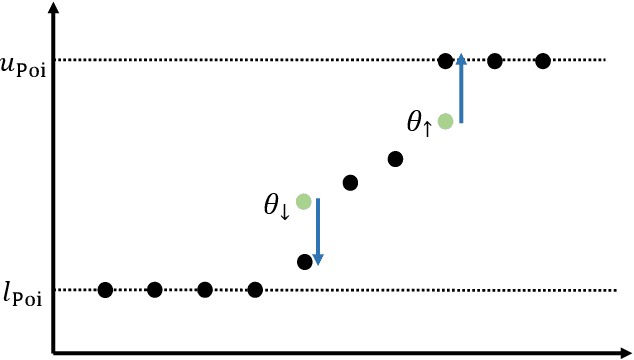
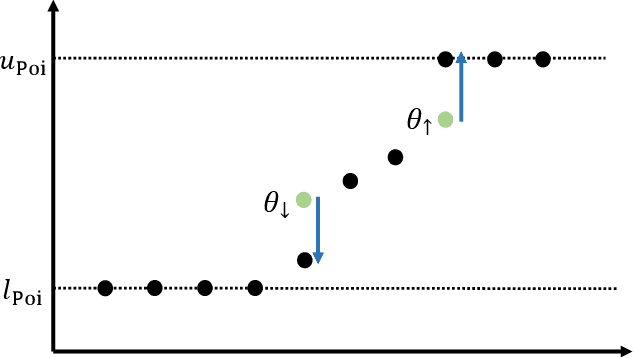
We study an online forecasting setting in which, over $T$ rounds, $N$ strategic experts each report a forecast to a mechanism, the mechanism selects one forecast, and then the outcome is revealed. In any given round, each expert has a belief about the outcome, but the expert wishes to select its report so as to maximize the total number of times it is selected. The goal of the mechanism is to obtain low belief regret: the difference between its cumulative loss (based on its selected forecasts) and the cumulative loss of the best expert in hindsight (as measured by the experts' beliefs). We consider exactly truthful mechanisms for non-myopic experts, meaning that truthfully reporting its belief strictly maximizes the expert's subjective probability of being selected in any future round. Even in the full-information setting, it is an open problem to obtain the first no-regret exactly truthful mechanism in this setting. We develop the first no-regret mechanism for this setting via an online extension of the Independent-Event Lotteries Forecasting Competition Mechanism (I-ELF). By viewing this online I-ELF as a novel instance of Follow the Perturbed Leader (FPL) with noise based on random walks with loss-dependent perturbations, we obtain $\tilde{O}(\sqrt{T N})$ regret. Our results are fueled by new tail bounds for Poisson binomial random variables that we develop. We extend our results to the bandit setting, where we give an exactly truthful mechanism obtaining $\tilde{O}(T^{2/3} N^{1/3})$ regret; this is the first no-regret result even among approximately truthful mechanisms.
Data-dependent Bounds with $T$-Optimal Best-of-Both-Worlds Guarantees in Multi-Armed Bandits using Stability-Penalty Matching
Feb 12, 2025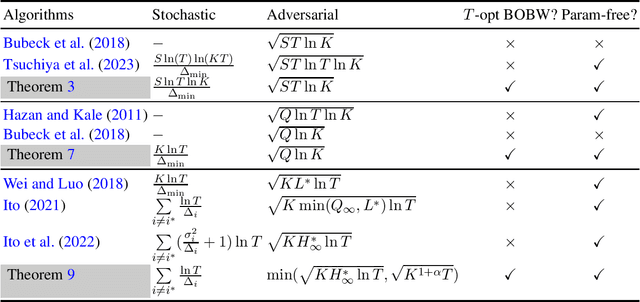
Existing data-dependent and best-of-both-worlds regret bounds for multi-armed bandits problems have limited adaptivity as they are either data-dependent but not best-of-both-worlds (BOBW), BOBW but not data-dependent or have sub-optimal $O(\sqrt{T\ln{T}})$ worst-case guarantee in the adversarial regime. To overcome these limitations, we propose real-time stability-penalty matching (SPM), a new method for obtaining regret bounds that are simultaneously data-dependent, best-of-both-worlds and $T$-optimal for multi-armed bandits problems. In particular, we show that real-time SPM obtains bounds with worst-case guarantees of order $O(\sqrt{T})$ in the adversarial regime and $O(\ln{T})$ in the stochastic regime while simultaneously being adaptive to data-dependent quantities such as sparsity, variations, and small losses. Our results are obtained by extending the SPM technique for tuning the learning rates in the follow-the-regularized-leader (FTRL) framework, which further indicates that the combination of SPM and FTRL is a promising approach for proving new adaptive bounds in online learning problems.