 Add to Chrome
 Add to Firefox
 Add to Edge
Lyra 2.0: Explorable Generative 3D Worlds
Apr 14, 2026
Recent advances in video generation enable a new paradigm for 3D scene creation: generating camera-controlled videos that simulate scene walkthroughs, then lifting them to 3D via feed-forward reconstruction techniques. This generative reconstruction approach combines the visual fidelity and creative capacity of video models with 3D outputs ready for real-time rendering and simulation. Scaling to large, complex environments requires 3D-consistent video generation over long camera trajectories with large viewpoint changes and location revisits, a setting where current video models degrade quickly. Existing methods for long-horizon generation are fundamentally limited by two forms of degradation: spatial forgetting and temporal drifting. As exploration proceeds, previously observed regions fall outside the model's temporal context, forcing the model to hallucinate structures when revisited. Meanwhile, autoregressive generation accumulates small synthesis errors over time, gradually distorting scene appearance and geometry. We present Lyra 2.0, a framework for generating persistent, explorable 3D worlds at scale. To address spatial forgetting, we maintain per-frame 3D geometry and use it solely for information routing -- retrieving relevant past frames and establishing dense correspondences with the target viewpoints -- while relying on the generative prior for appearance synthesis. To address temporal drifting, we train with self-augmented histories that expose the model to its own degraded outputs, teaching it to correct drift rather than propagate it. Together, these enable substantially longer and 3D-consistent video trajectories, which we leverage to fine-tune feed-forward reconstruction models that reliably recover high-quality 3D scenes.

Near-realtime Facial Animation by Deep 3D Simulation Super-Resolution
May 05, 2023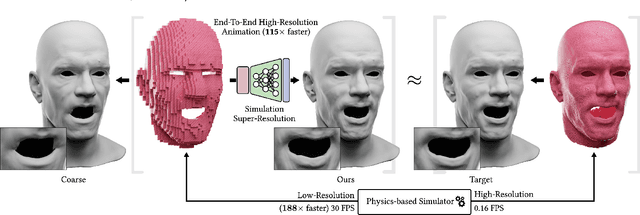
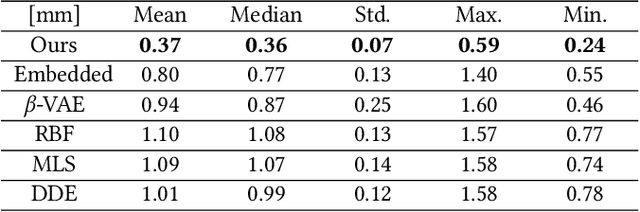
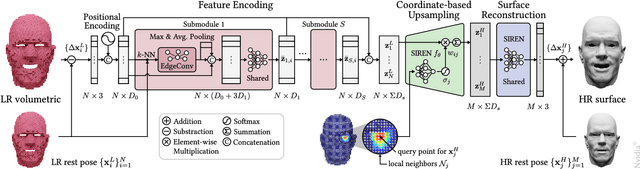
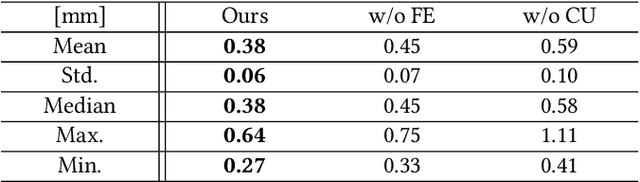
We present a neural network-based simulation super-resolution framework that can efficiently and realistically enhance a facial performance produced by a low-cost, realtime physics-based simulation to a level of detail that closely approximates that of a reference-quality off-line simulator with much higher resolution (26x element count in our examples) and accurate physical modeling. Our approach is rooted in our ability to construct - via simulation - a training set of paired frames, from the low- and high-resolution simulators respectively, that are in semantic correspondence with each other. We use face animation as an exemplar of such a simulation domain, where creating this semantic congruence is achieved by simply dialing in the same muscle actuation controls and skeletal pose in the two simulators. Our proposed neural network super-resolution framework generalizes from this training set to unseen expressions, compensates for modeling discrepancies between the two simulations due to limited resolution or cost-cutting approximations in the real-time variant, and does not require any semantic descriptors or parameters to be provided as input, other than the result of the real-time simulation. We evaluate the efficacy of our pipeline on a variety of expressive performances and provide comparisons and ablation experiments for plausible variations and alternatives to our proposed scheme.