 Add to Chrome
 Add to Firefox
 Add to Edge
Persona2Web: Benchmarking Personalized Web Agents for Contextual Reasoning with User History
Feb 19, 2026
Large language models have advanced web agents, yet current agents lack personalization capabilities. Since users rarely specify every detail of their intent, practical web agents must be able to interpret ambiguous queries by inferring user preferences and contexts. To address this challenge, we present Persona2Web, the first benchmark for evaluating personalized web agents on the real open web, built upon the clarify-to-personalize principle, which requires agents to resolve ambiguity based on user history rather than relying on explicit instructions. Persona2Web consists of: (1) user histories that reveal preferences implicitly over long time spans, (2) ambiguous queries that require agents to infer implicit user preferences, and (3) a reasoning-aware evaluation framework that enables fine-grained assessment of personalization. We conduct extensive experiments across various agent architectures, backbone models, history access schemes, and queries with varying ambiguity levels, revealing key challenges in personalized web agent behavior. For reproducibility, our codes and datasets are publicly available at https://anonymous.4open.science/r/Persona2Web-73E8.

SAGEO Arena: A Realistic Environment for Evaluating Search-Augmented Generative Engine Optimization
Feb 12, 2026Search-Augmented Generative Engines (SAGE) have emerged as a new paradigm for information access, bridging web-scale retrieval with generative capabilities to deliver synthesized answers. This shift has fundamentally reshaped how web content gains exposure online, giving rise to Search-Augmented Generative Engine Optimization (SAGEO), the practice of optimizing web documents to improve their visibility in AI-generated responses. Despite growing interest, no evaluation environment currently supports comprehensive investigation of SAGEO. Specifically, existing benchmarks lack end-to-end visibility evaluation of optimization strategies, operating on pre-determined candidate documents that abstract away retrieval and reranking preceding generation. Moreover, existing benchmarks discard structural information (e.g., schema markup) present in real web documents, overlooking the rich signals that search systems actively leverage in practice. Motivated by these gaps, we introduce SAGEO Arena, a realistic and reproducible environment for stage-level SAGEO analysis. Our objective is to jointly target search-oriented optimization (SEO) and generation-centric optimization (GEO). To achieve this, we integrate a full generative search pipeline over a large-scale corpus of web documents with rich structural information. Our findings reveal that existing approaches remain largely impractical under realistic conditions and often degrade performance in retrieval and reranking. We also find that structural information helps mitigate these limitations, and that effective SAGEO requires tailoring optimization to each pipeline stage. Overall, our benchmark paves the way for realistic SAGEO evaluation and optimization beyond simplified settings.
Imagine All The Relevance: Scenario-Profiled Indexing with Knowledge Expansion for Dense Retrieval
Mar 29, 2025Existing dense retrieval models struggle with reasoning-intensive retrieval task as they fail to capture implicit relevance that requires reasoning beyond surface-level semantic information. To address these challenges, we propose Scenario-Profiled Indexing with Knowledge Expansion (SPIKE), a dense retrieval framework that explicitly indexes implicit relevance by decomposing documents into scenario-based retrieval units. SPIKE organizes documents into scenario, which encapsulates the reasoning process necessary to uncover implicit relationships between hypothetical information needs and document content. SPIKE constructs a scenario-augmented dataset using a powerful teacher large language model (LLM), then distills these reasoning capabilities into a smaller, efficient scenario generator. During inference, SPIKE incorporates scenario-level relevance alongside document-level relevance, enabling reasoning-aware retrieval. Extensive experiments demonstrate that SPIKE consistently enhances retrieval performance across various query types and dense retrievers. It also enhances the retrieval experience for users through scenario and offers valuable contextual information for LLMs in retrieval-augmented generation (RAG).
Why These Documents? Explainable Generative Retrieval with Hierarchical Category Paths
Nov 08, 2024
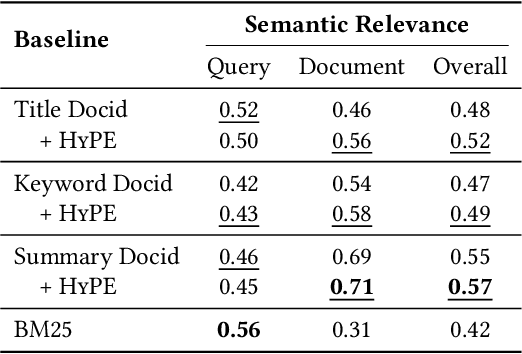
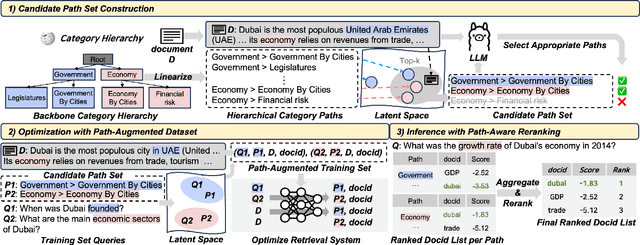
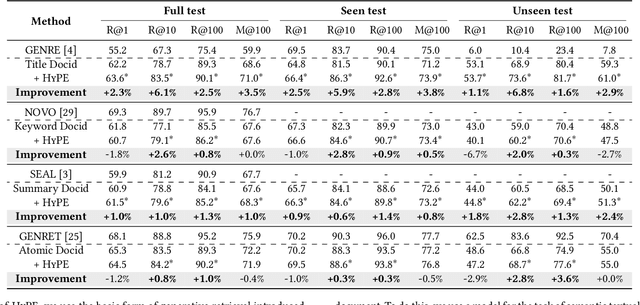
Generative retrieval has recently emerged as a new alternative of traditional information retrieval approaches. However, existing generative retrieval methods directly decode docid when a query is given, making it impossible to provide users with explanations as an answer for "Why this document is retrieved?". To address this limitation, we propose Hierarchical Category Path-Enhanced Generative Retrieval(HyPE), which enhances explainability by generating hierarchical category paths step-by-step before decoding docid. HyPE leverages hierarchical category paths as explanation, progressing from broad to specific semantic categories. This approach enables diverse explanations for the same document depending on the query by using shared category paths between the query and the document, and provides reasonable explanation by reflecting the document's semantic structure through a coarse-to-fine manner. HyPE constructs category paths with external high-quality semantic hierarchy, leverages LLM to select appropriate candidate paths for each document, and optimizes the generative retrieval model with path-augmented dataset. During inference, HyPE utilizes path-aware reranking strategy to aggregate diverse topic information, allowing the most relevant documents to be prioritized in the final ranked list of docids. Our extensive experiments demonstrate that HyPE not only offers a high level of explainability but also improves the retrieval performance in the document retrieval task.