 Add to Chrome
 Add to Firefox
 Add to Edge
Verified Misguidance: Measuring Structural Citation Failures in Search-Augmented LLMs
May 27, 2026
Users of search-augmented LLMs rely on citations as evidence that responses are grounded in real sources, and rarely verify the cited pages themselves. Millions of queries per day now pass through these systems, making citation quality a silent determinant of whether users are informed or misled-yet existing benchmarks each address one facet in isolation, leaving the joint structure that determines citation trustworthiness unmeasured. We construct CITETRACE, a large-scale dataset that traces the full citation chain from user query through retrieved source to generated answer: 11,200 real-world queries from 28 communities paired with 112,000 responses from ten models across five providers, yielding 761,495 evaluable citation pairs. We design a three-dimension evaluation framework that scores each citation on intent-purpose alignment, source suitability, and answer-source fidelity, using expert-validated predefined matrices and a five-level fidelity rubric; the framework applies to any system that produces citation-bearing responses. Applying this framework at scale, we identify a systematic pattern we call VERIFIED MISGUIDANCE (VM): models cite real, accessible sources yet fail along one or more dimensions, producing a fidelity-suitability trade-off in which faithful models select inappropriate sources and vice versa. Across our pool, 30.6% of citations distort their sources and 27.1% originate from domain-inappropriate sources; at the response level, up to 96% of users encounter at least one structurally misleading citation. Provider-level differences explain 88-96% of citation-quality variance, suggesting that source selection is governed more by factors beyond individual model capability than by the LLMs themselves. Together, CITETRACE and its evaluation framework provide the first resource for diagnosing structural citation failures in deployed search-augmented systems.

SAGEO Arena: A Realistic Environment for Evaluating Search-Augmented Generative Engine Optimization
Feb 12, 2026Search-Augmented Generative Engines (SAGE) have emerged as a new paradigm for information access, bridging web-scale retrieval with generative capabilities to deliver synthesized answers. This shift has fundamentally reshaped how web content gains exposure online, giving rise to Search-Augmented Generative Engine Optimization (SAGEO), the practice of optimizing web documents to improve their visibility in AI-generated responses. Despite growing interest, no evaluation environment currently supports comprehensive investigation of SAGEO. Specifically, existing benchmarks lack end-to-end visibility evaluation of optimization strategies, operating on pre-determined candidate documents that abstract away retrieval and reranking preceding generation. Moreover, existing benchmarks discard structural information (e.g., schema markup) present in real web documents, overlooking the rich signals that search systems actively leverage in practice. Motivated by these gaps, we introduce SAGEO Arena, a realistic and reproducible environment for stage-level SAGEO analysis. Our objective is to jointly target search-oriented optimization (SEO) and generation-centric optimization (GEO). To achieve this, we integrate a full generative search pipeline over a large-scale corpus of web documents with rich structural information. Our findings reveal that existing approaches remain largely impractical under realistic conditions and often degrade performance in retrieval and reranking. We also find that structural information helps mitigate these limitations, and that effective SAGEO requires tailoring optimization to each pipeline stage. Overall, our benchmark paves the way for realistic SAGEO evaluation and optimization beyond simplified settings.
RAWtoBit: A Fully End-to-end Camera ISP Network
Aug 16, 2022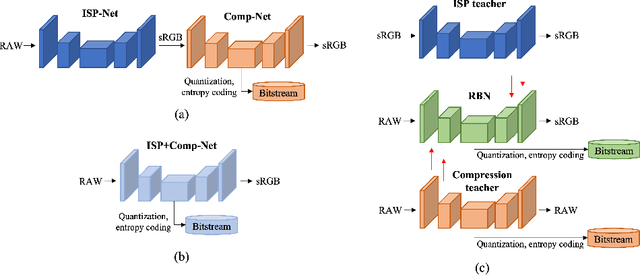
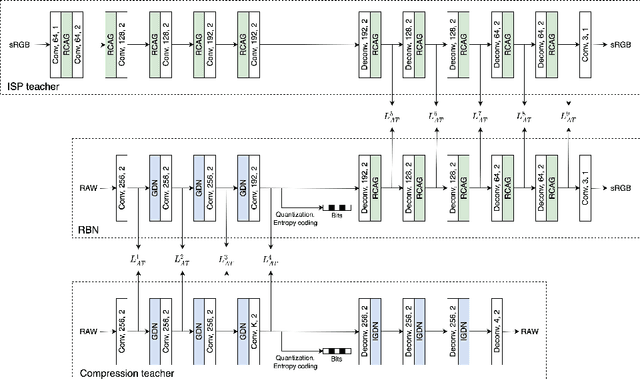
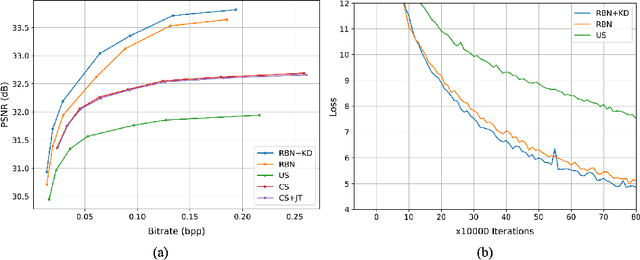
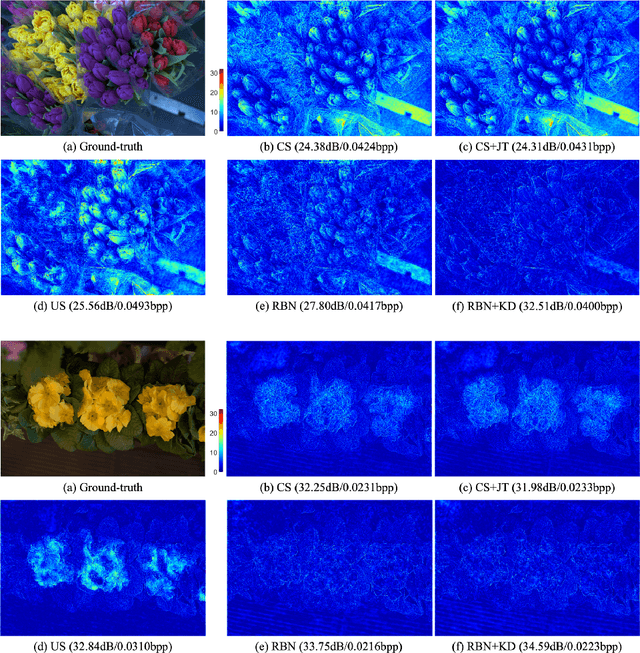
Image compression is an essential and last processing unit in the camera image signal processing (ISP) pipeline. While many studies have been made to replace the conventional ISP pipeline with a single end-to-end optimized deep learning model, image compression is barely considered as a part of the model. In this paper, we investigate the designing of a fully end-to-end optimized camera ISP incorporating image compression. To this end, we propose RAWtoBit network (RBN) that can effectively perform both tasks simultaneously. RBN is further improved with a novel knowledge distillation scheme by introducing two teacher networks specialized in each task. Extensive experiments demonstrate that our proposed method significantly outperforms alternative approaches in terms of rate-distortion trade-off.