 Add to Chrome
 Add to Firefox
 Add to Edge
Coachable agents for interactive gameplay
Jul 01, 2026
Reinforcement learning has proven to be a valuable tool in the creation of advanced AI and robotic systems, contributing to everything from game playing to robotics to foundation models. Through trial-and-error, these AI systems typically learn one, near-optimal behavior to solve their tasks. However, there are many use cases in which one would like to assert some level of control, preferably in real time, over how the task is solved. We refer to these modifications of a core task as styles. We combine universal value function approximators (UVFAs) with carefully selected training scenarios, learning algorithms, and data augmentation to create a framework for coaching agents that exhibit styles in complex domains. We demonstrate the framework's application in the AAA video games Horizon Forbidden West and Gran Turismo, and in an open-source humanoid test domain. Despite the different nature of the domains -- car racing, stylized game combat, and humanoid walking -- each agent shows strong coherence to the style requests while still satisfying the main task in its domain. Importantly, the techniques outlined in this paper allow an end user to choose the final behavior at run time, giving them flexible control over the final executed performance.

Event Tables for Efficient Experience Replay
Nov 01, 2022Experience replay (ER) is a crucial component of many deep reinforcement learning (RL) systems. However, uniform sampling from an ER buffer can lead to slow convergence and unstable asymptotic behaviors. This paper introduces Stratified Sampling from Event Tables (SSET), which partitions an ER buffer into Event Tables, each capturing important subsequences of optimal behavior. We prove a theoretical advantage over the traditional monolithic buffer approach and combine SSET with an existing prioritized sampling strategy to further improve learning speed and stability. Empirical results in challenging MiniGrid domains, benchmark RL environments, and a high-fidelity car racing simulator demonstrate the advantages and versatility of SSET over existing ER buffer sampling approaches.
Transformer Grammars: Augmenting Transformer Language Models with Syntactic Inductive Biases at Scale
Mar 01, 2022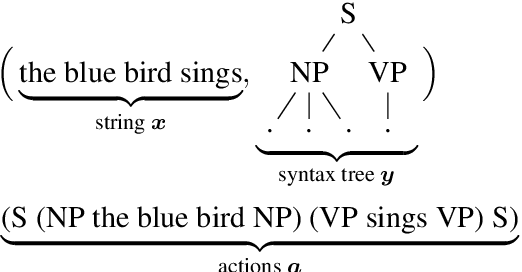
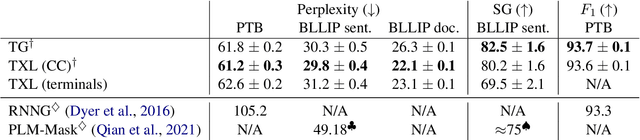
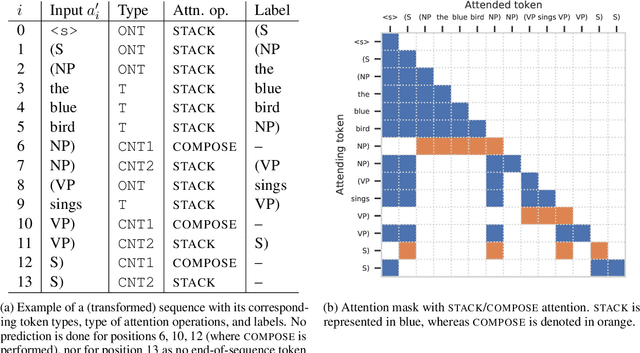
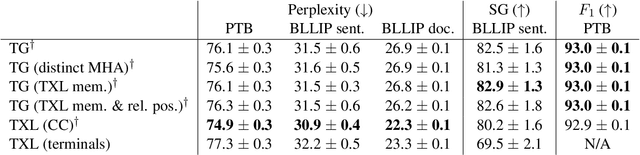
Transformer language models that are trained on vast amounts of data have achieved remarkable success at various NLP benchmarks. Intriguingly, this success is achieved by models that lack an explicit modeling of hierarchical syntactic structures, which were hypothesized by decades of linguistic research to be necessary for good generalization. This naturally leaves a question: to what extent can we further improve the performance of Transformer language models, through an inductive bias that encourages the model to explain the data through the lens of recursive syntactic compositions? Although the benefits of modeling recursive syntax have been shown at the small data and model scales, it remains an open question whether -- and to what extent -- a similar design principle is still beneficial in the case of powerful Transformer language models that work well at scale. To answer these questions, we introduce Transformer Grammars -- a novel class of Transformer language models that combine: (i) the expressive power, scalability, and strong performance of Transformers, and (ii) recursive syntactic compositions, which here are implemented through a special attention mask. We find that Transformer Grammars outperform various strong baselines on multiple syntax-sensitive language modeling evaluation metrics, in addition to sentence-level language modeling perplexity. Nevertheless, we find that the recursive syntactic composition bottleneck harms perplexity on document-level modeling, providing evidence that a different kind of memory mechanism -- that works independently of syntactic structures -- plays an important role in the processing of long-form text.