 Add to Chrome
 Add to Firefox
 Add to Edge
The Ethical Decision Head: Operationalizing Normative Ethics in Autonomous Vehicles via Reinforcement Learning from Human Feedback
Aug 17, 2026
As autonomous vehicles (AVs) approach Level 4 and Level 5 operational capability [SAE International, 2018], their on- board decision systems must handle not only safety-critical locomotion but also their subsequent moral weight. This paper details the Ethical Decision Head (EDH), a deep re- inforcement learning (RL) framework that encodes ethical reasoning as a differentiable reward signal, enabling a pol- icy gradient agent to learn morally-aligned driving behavior in scenarios whose state representation is aligned with the CARLA simulation environment [Dosovitskiy et al., 2017]. Two normative frameworks are instantiated and evaluated: a Utilitarian framework minimizing total casualties and a Kan- tian framework enforcing course maintenance as a categori- cal imperative. The EDH is trained via Proximal Policy Op- timization (PPO) [Schulman et al., 2017] against a Bradley- Terry reward model [Bradley and Terry, 1952] learned from pairwise human preference annotations over 200 collision- imminent scenarios. Results reveal an asymmetry in the learnability of normative ethical frameworks under human su- pervision. The Kantian condition, which reduces to a con- stant prediction task under the codebook, serves as a pipeline control: it confirms training stability and rules out infrastruc- ture failure as an explanation for the utilitarian result. The Utilitarian agent learned something more unsettling: human raters rewarded self-sacrifice over casualty minimization, and the model learned that preference faithfully. This divergence between what humans prescribe in theory and what they re- ward in practice suggests that RLHF does not learn ethics as philosophers define it, but as humans live it.

Representation Learning for Event-based Visuomotor Policies
Mar 01, 2021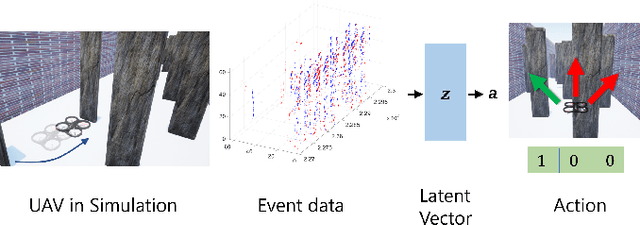
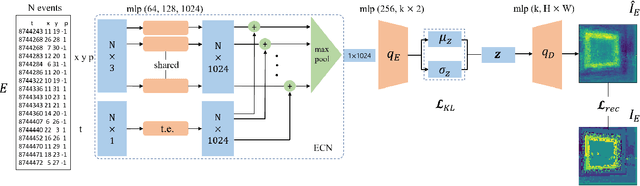
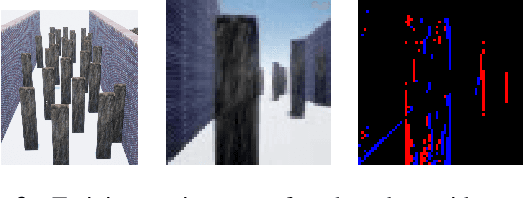
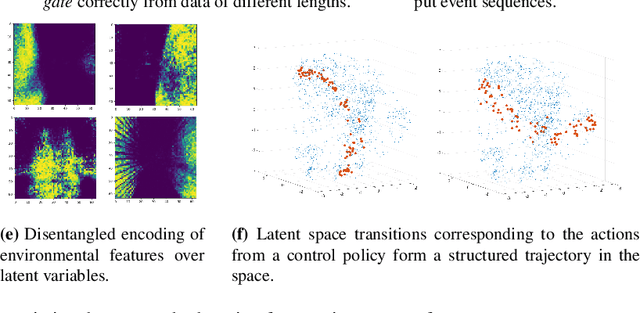
Event-based cameras are dynamic vision sensors that can provide asynchronous measurements of changes in per-pixel brightness at a microsecond level. This makes them significantly faster than conventional frame-based cameras, and an appealing choice for high-speed navigation. While an interesting sensor modality, this asynchronous data poses a challenge for common machine learning techniques. In this paper, we present an event variational autoencoder for unsupervised representation learning from asynchronous event camera data. We show that it is feasible to learn compact representations from spatiotemporal event data to encode the context. Furthermore, we show that such pretrained representations can be beneficial for navigation, allowing for usage in reinforcement learning instead of end-to-end reward driven perception. We validate this framework of learning visuomotor policies by applying it to an obstacle avoidance scenario in simulation. We show that representations learnt from event data enable training fast control policies that can adapt to different control capacities, and demonstrate a higher degree of robustness than end-to-end learning from event images.