 Add to Chrome
 Add to Firefox
 Add to Edge
Fine-tuning a multimodal large language model for clinician-grade autism behavioral scoring from short home videos
Jun 25, 2026
Autism spectrum disorder (ASD) affects 1 in 31 US children, yet median age at diagnosis exceeds four years. Artificial intelligence pipelines that provide quantified diagnosis using easy to access observational data (e.g., home videos) could help with earlier diagnosis, and timely delivery of early treatments. We fine-tuned Gemini 2.5 Pro on 400 clinician-rated home videos with low-rank adaptation, training only on 30 behavioral features previously validated to produce reliable predictions when passed to various ML models. On 99 held-out children (49 ASD, 50 neurotypical), inter-rater reliability with clinicians (per-feature weighted Cohen's kappa) improved by 40% (p<0.001), with 27 of 28 evaluable features improving. As an emergent zero-shot capability, direct ASD diagnosis F1 improved by 53% (p<0.001), matching or exceeding clinician outcomes. Classifier-assisted pipelines using fine-tuned LLM-derived behavioral features matched clinician-scored inputs across all tested pathways and achieved 77% accuracy (95% CI: 68-85%) and an AUC of 86% (95% CI: 78-92%). Fine-tuned multimodal LLMs can serve as scalable behavioral feature extractors for use in autism assessment and diagnosis.

Generative AI for Named Entity Recognition in Low-Resource Language Nepali
Mar 12, 2025Generative Artificial Intelligence (GenAI), particularly Large Language Models (LLMs), has significantly advanced Natural Language Processing (NLP) tasks, such as Named Entity Recognition (NER), which involves identifying entities like person, location, and organization names in text. LLMs are especially promising for low-resource languages due to their ability to learn from limited data. However, the performance of GenAI models for Nepali, a low-resource language, has not been thoroughly evaluated. This paper investigates the application of state-of-the-art LLMs for Nepali NER, conducting experiments with various prompting techniques to assess their effectiveness. Our results provide insights into the challenges and opportunities of using LLMs for NER in low-resource settings and offer valuable contributions to the advancement of NLP research in languages like Nepali.
Wearable Meets LLM for Stress Management: A Duoethnographic Study Integrating Wearable-Triggered Stressors and LLM Chatbots for Personalized Interventions
Feb 24, 2025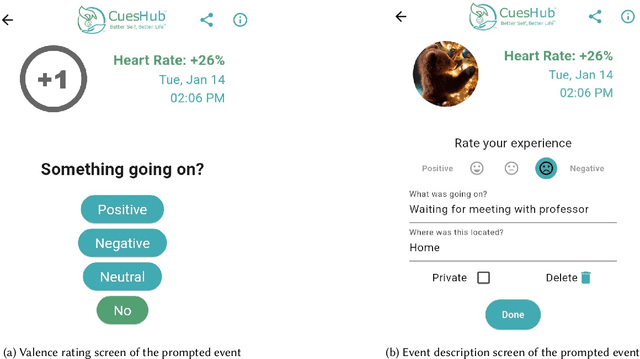
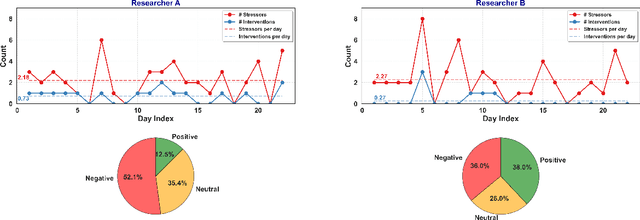
We use a duoethnographic approach to study how wearable-integrated LLM chatbots can assist with personalized stress management, addressing the growing need for immediacy and tailored interventions. Two researchers interacted with custom chatbots over 22 days, responding to wearable-detected physiological prompts, recording stressor phrases, and using them to seek tailored interventions from their LLM-powered chatbots. They recorded their experiences in autoethnographic diaries and analyzed them during weekly discussions, focusing on the relevance, clarity, and impact of chatbot-generated interventions. Results showed that even though most events triggered by the wearable were meaningful, only one in five warranted an intervention. It also showed that interventions tailored with brief event descriptions were more effective than generic ones. By examining the intersection of wearables and LLM, this research contributes to developing more effective, user-centric mental health tools for real-time stress relief and behavior change.
Pulse-PPG: An Open-Source Field-Trained PPG Foundation Model for Wearable Applications Across Lab and Field Settings
Feb 03, 2025Photoplethysmography (PPG)-based foundation models are gaining traction due to the widespread use of PPG in biosignal monitoring and their potential to generalize across diverse health applications. In this paper, we introduce Pulse-PPG, the first open-source PPG foundation model trained exclusively on raw PPG data collected over a 100-day field study with 120 participants. Existing PPG foundation models are either open-source but trained on clinical data or closed-source, limiting their applicability in real-world settings. We evaluate Pulse-PPG across multiple datasets and downstream tasks, comparing its performance against a state-of-the-art foundation model trained on clinical data. Our results demonstrate that Pulse-PPG, trained on uncurated field data, exhibits superior generalization across clinical and mobile health applications in both lab and field settings. This suggests that exposure to real-world variability enables the model to learn fine-grained representations, making it more adaptable across tasks. Furthermore, pre-training on field data surprisingly outperforms its pre-training on clinical data in many tasks, reinforcing the importance of training on real-world, diverse datasets. To encourage further advancements in robust foundation models leveraging field data, we plan to release Pulse-PPG, providing researchers with a powerful resource for developing more generalizable PPG-based models.