 Add to Chrome
 Add to Firefox
 Add to Edge
Adaptive data selection improves wearable prediction under low baseline performance
May 29, 2026
Adaptive sensing strategies that selectively sample data are increasingly used in wearable health systems to improve prediction performance under limited data budgets, yet their benefits across individuals remain poorly understood. Here, we evaluate adaptive selection of time windows for model training under fixed measurement budgets across multiple sensing modalities, including heart rate, activity, and ecological momentary assessment (EMA), in a longitudinal wearable dataset. We quantify performance gains relative to random sampling using both area under the receiver operating characteristic curve (AUROC) and F1 score. Adaptive strategies yield substantial improvements in AUROC for participants with low baseline performance (with gains up to 0.7), while offering limited or negative gains for participants with strong baselines. Across modalities, adaptive gain is strongly inversely correlated with baseline performance (Pearson r = -0.67; Spearman p = -0.62). At the participant level, most individuals benefit in AUROC (60-80% across modalities), although improvements in F1 are smaller and less consistent. These findings show that adaptive sensing is not uniformly beneficial, but instead provides the greatest value in underperforming settings. Our results support selective deployment strategies that tailor adaptive sensing based on baseline performance to improve efficiency in wearable health monitoring.

TikTokActions: A TikTok-Derived Video Dataset for Human Action Recognition
Feb 14, 2024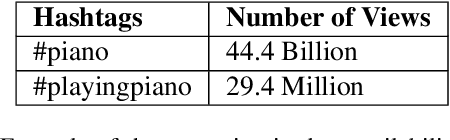
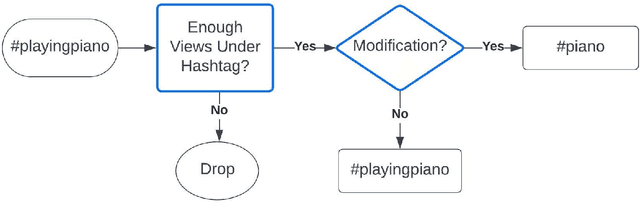
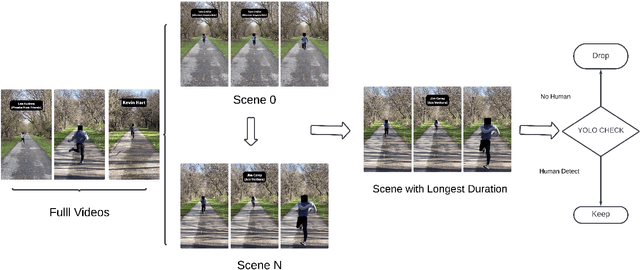
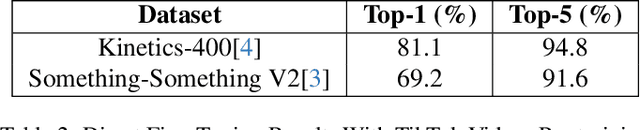
The increasing variety and quantity of tagged multimedia content on platforms such as TikTok provides an opportunity to advance computer vision modeling. We have curated a distinctive dataset of 283,582 unique video clips categorized under 386 hashtags relating to modern human actions. We release this dataset as a valuable resource for building domain-specific foundation models for human movement modeling tasks such as action recognition. To validate this dataset, which we name TikTokActions, we perform two sets of experiments. First, we pretrain the state-of-the-art VideoMAEv2 with a ViT-base backbone on TikTokActions subset, and then fine-tune and evaluate on popular datasets such as UCF101 and the HMDB51. We find that the performance of the model pre-trained using our Tik-Tok dataset is comparable to models trained on larger action recognition datasets (95.3% on UCF101 and 53.24% on HMDB51). Furthermore, our investigation into the relationship between pre-training dataset size and fine-tuning performance reveals that beyond a certain threshold, the incremental benefit of larger training sets diminishes. This work introduces a useful TikTok video dataset that is available for public use and provides insights into the marginal benefit of increasing pre-training dataset sizes for video-based foundation models.
Computer Vision Estimation of Emotion Reaction Intensity in the Wild
Mar 19, 2023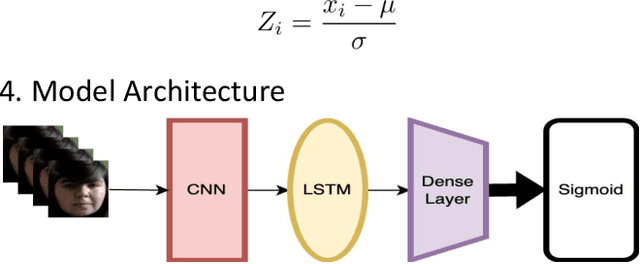

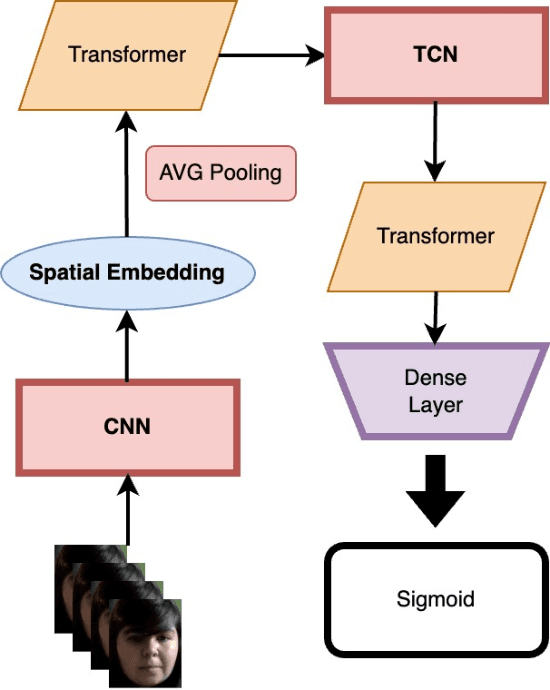
Emotions play an essential role in human communication. Developing computer vision models for automatic recognition of emotion expression can aid in a variety of domains, including robotics, digital behavioral healthcare, and media analytics. There are three types of emotional representations which are traditionally modeled in affective computing research: Action Units, Valence Arousal (VA), and Categorical Emotions. As part of an effort to move beyond these representations towards more fine-grained labels, we describe our submission to the newly introduced Emotional Reaction Intensity (ERI) Estimation challenge in the 5th competition for Affective Behavior Analysis in-the-Wild (ABAW). We developed four deep neural networks trained in the visual domain and a multimodal model trained with both visual and audio features to predict emotion reaction intensity. Our best performing model on the Hume-Reaction dataset achieved an average Pearson correlation coefficient of 0.4080 on the test set using a pre-trained ResNet50 model. This work provides a first step towards the development of production-grade models which predict emotion reaction intensities rather than discrete emotion categories.