 Add to Chrome
 Add to Firefox
 Add to Edge
Temporal Feature Distillation for Label-Efficient Precise Event Spotting in Sports Videos
Jul 13, 2026
Precise Event Spotting (PES) requires distinguishing visually similar yet semantically distinct adjacent frames, making it fundamentally different from image classification and coarse action recognition. Although self-distillation methods such as DINO have shown strong representation learning ability in images, we find that directly applying them to PES is ineffective: without supervised guidance, subtle but crucial motion cues are often suppressed as noise, leading to representations that are insensitive to precise event boundaries. To address this, we propose Temporal Feature Distillation, a semi-supervised objective that aligns temporally informative backbone features, rather than projection-head outputs, to preserve motion-sensitive and boundary-aware cues for frame-level localization. A supervised warm-up with a ramp-up schedule further stabilizes training by ensuring that meaningful event cues are learned before unlabeled distillation begins. We also introduce Transformer Gate Shift, a multi-scale gated shifting module that injects motion-aware temporal information into Vision Transformers. Experiments on four fine-grained sports benchmarks show consistent improvements over fully supervised and semi-supervised baselines. Under 10\% supervision on FSPerf, our method improves mAP by 4.54 points over the strongest competing approach, and with only 80\% labeled data, it matches or surpasses the fully supervised 100\% baseline on two of the four datasets.

Multi-Scale Attention and Gated Shifting for Fine-Grained Event Spotting in Videos
Jul 10, 2025
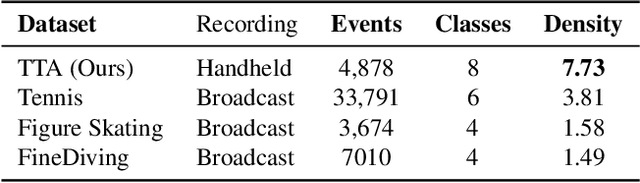
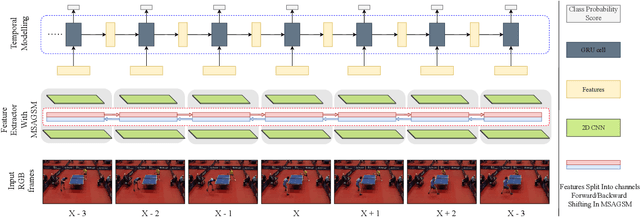
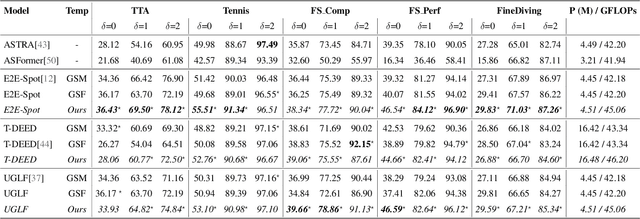
Precise Event Spotting (PES) in sports videos requires frame-level recognition of fine-grained actions from single-camera footage. Existing PES models typically incorporate lightweight temporal modules such as Gate Shift Module (GSM) or Gate Shift Fuse (GSF) to enrich 2D CNN feature extractors with temporal context. However, these modules are limited in both temporal receptive field and spatial adaptability. We propose a Multi-Scale Attention Gate Shift Module (MSAGSM) that enhances GSM with multi-scale temporal dilations and multi-head spatial attention, enabling efficient modeling of both short- and long-term dependencies while focusing on salient regions. MSAGSM is a lightweight plug-and-play module that can be easily integrated with various 2D backbones. To further advance the field, we introduce the Table Tennis Australia (TTA) dataset-the first PES benchmark for table tennis-containing over 4800 precisely annotated events. Extensive experiments across five PES benchmarks demonstrate that MSAGSM consistently improves performance with minimal overhead, setting new state-of-the-art results.