 Add to Chrome
 Add to Firefox
 Add to Edge
Out-of-Distribution Detection for Continual Learning: Design Principles and Benchmarking
Dec 16, 2025
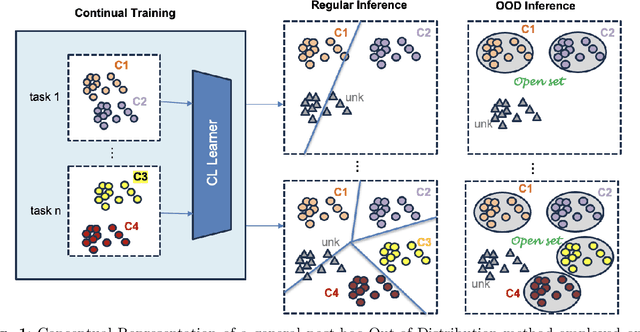
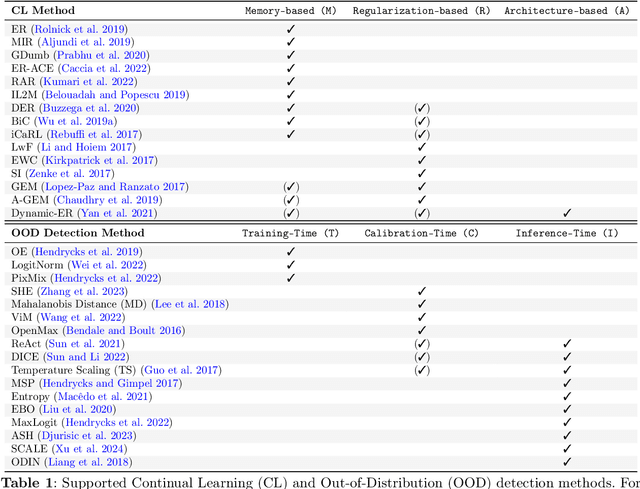
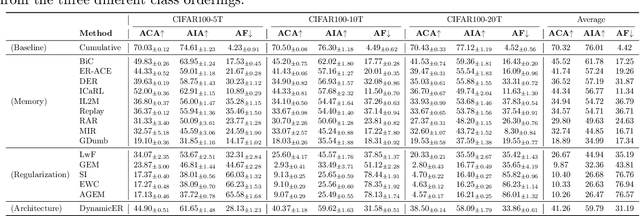
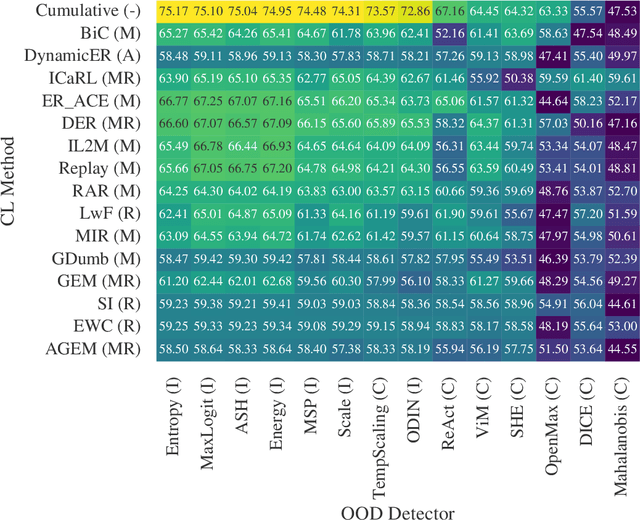
Recent years have witnessed significant progress in the development of machine learning models across a wide range of fields, fueled by increased computational resources, large-scale datasets, and the rise of deep learning architectures. From malware detection to enabling autonomous navigation, modern machine learning systems have demonstrated remarkable capabilities. However, as these models are deployed in ever-changing real-world scenarios, their ability to remain reliable and adaptive over time becomes increasingly important. For example, in the real world, new malware families are continuously developed, whereas autonomous driving cars are employed in many different cities and weather conditions. Models trained in fixed settings can not respond effectively to novel conditions encountered post-deployment. In fact, most machine learning models are still developed under the assumption that training and test data are independent and identically distributed (i.i.d.), i.e., sampled from the same underlying (unknown) distribution. While this assumption simplifies model development and evaluation, it does not hold in many real-world applications, where data changes over time and unexpected inputs frequently occur. Retraining models from scratch whenever new data appears is computationally expensive, time-consuming, and impractical in resource-constrained environments. These limitations underscore the need for Continual Learning (CL), which enables models to incrementally learn from evolving data streams without forgetting past knowledge, and Out-of-Distribution (OOD) detection, which allows systems to identify and respond to novel or anomalous inputs. Jointly addressing both challenges is critical to developing robust, efficient, and adaptive AI systems.

LIMBA: An Open-Source Framework for the Preservation and Valorization of Low-Resource Languages using Generative Models
Nov 20, 2024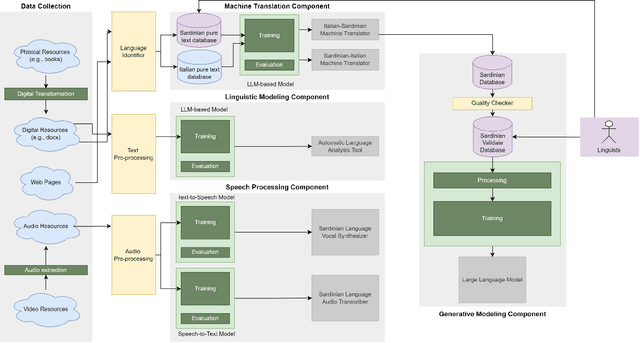
Minority languages are vital to preserving cultural heritage, yet they face growing risks of extinction due to limited digital resources and the dominance of artificial intelligence models trained on high-resource languages. This white paper proposes a framework to generate linguistic tools for low-resource languages, focusing on data creation to support the development of language models that can aid in preservation efforts. Sardinian, an endangered language, serves as the case study to demonstrate the framework's effectiveness. By addressing the data scarcity that hinders intelligent applications for such languages, we contribute to promoting linguistic diversity and support ongoing efforts in language standardization and revitalization through modern technologies.
Transfer Learning from Simulated to Real Scenes for Monocular 3D Object Detection
Aug 28, 2024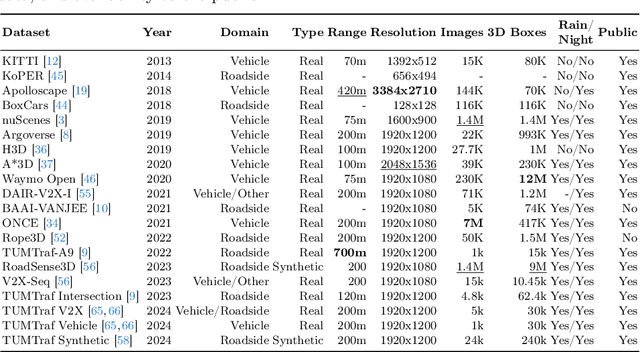
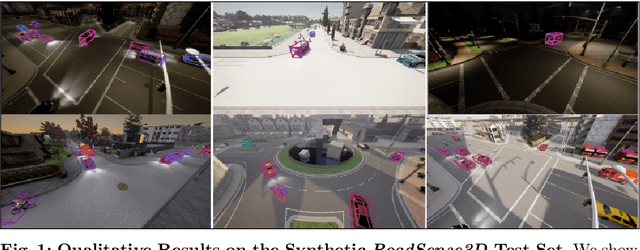
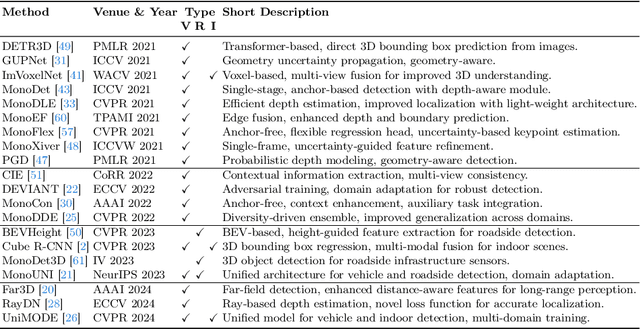
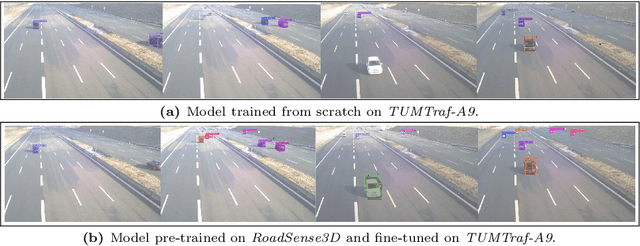
Accurately detecting 3D objects from monocular images in dynamic roadside scenarios remains a challenging problem due to varying camera perspectives and unpredictable scene conditions. This paper introduces a two-stage training strategy to address these challenges. Our approach initially trains a model on the large-scale synthetic dataset, RoadSense3D, which offers a diverse range of scenarios for robust feature learning. Subsequently, we fine-tune the model on a combination of real-world datasets to enhance its adaptability to practical conditions. Experimental results of the Cube R-CNN model on challenging public benchmarks show a remarkable improvement in detection performance, with a mean average precision rising from 0.26 to 12.76 on the TUM Traffic A9 Highway dataset and from 2.09 to 6.60 on the DAIR-V2X-I dataset when performing transfer learning. Code, data, and qualitative video results are available on the project website: https://roadsense3d.github.io.