 Add to Chrome
 Add to Firefox
 Add to Edge
Ego-1K -- A Large-Scale Multiview Video Dataset for Egocentric Vision
Mar 14, 2026
We present Ego-1K, a large-scale collection of time-synchronized egocentric multiview videos designed to advance neural 3D video synthesis and dynamic scene understanding. The dataset contains nearly 1,000 short egocentric videos captured with a custom rig with 12 synchronized cameras surrounding a 4-camera VR headset worn by the user. Scene content focuses on hand motions and hand-object interactions in different settings. We describe rig design, data processing, and calibration. Our dataset enables new ways to benchmark egocentric scene reconstruction methods, an important research area as smart glasses with multiple cameras become omnipresent. Our experiments demonstrate that our dataset presents unique challenges for existing 3D and 4D novel view synthesis methods due to large disparities and image motion caused by close dynamic objects and rig egomotion. Our dataset supports future research in this challenging domain. It is available at https://huggingface.co/datasets/facebook/ego-1k.

Federated Online Clustering of Bandits
Aug 31, 2022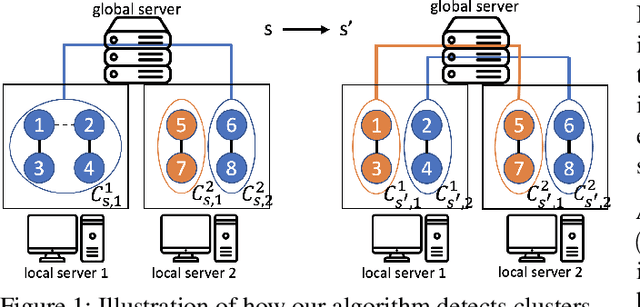
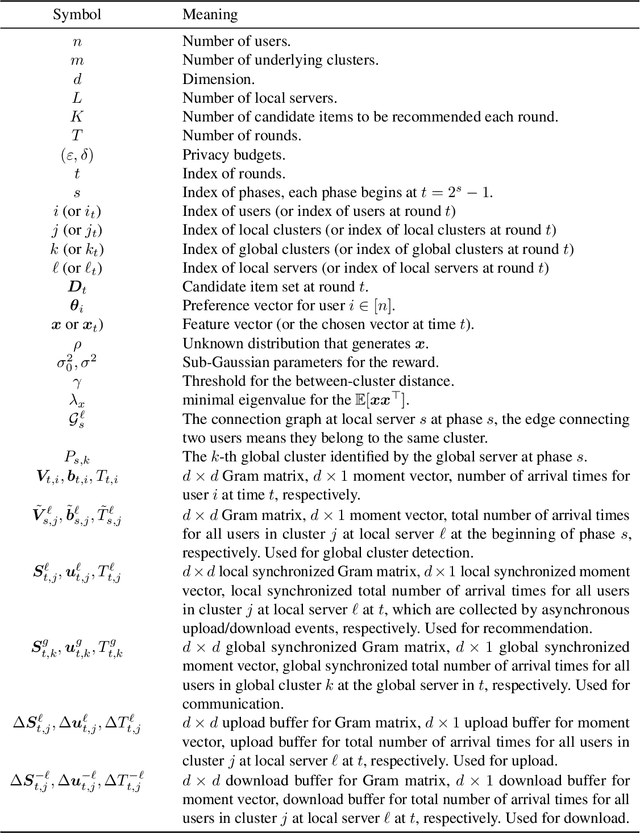
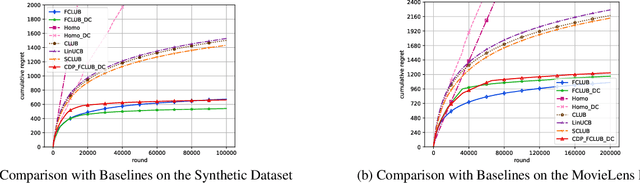
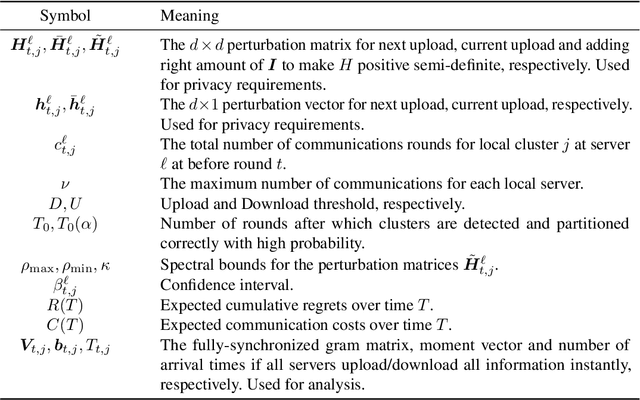
Contextual multi-armed bandit (MAB) is an important sequential decision-making problem in recommendation systems. A line of works, called the clustering of bandits (CLUB), utilize the collaborative effect over users and dramatically improve the recommendation quality. Owing to the increasing application scale and public concerns about privacy, there is a growing demand to keep user data decentralized and push bandit learning to the local server side. Existing CLUB algorithms, however, are designed under the centralized setting where data are available at a central server. We focus on studying the federated online clustering of bandit (FCLUB) problem, which aims to minimize the total regret while satisfying privacy and communication considerations. We design a new phase-based scheme for cluster detection and a novel asynchronous communication protocol for cooperative bandit learning for this problem. To protect users' privacy, previous differential privacy (DP) definitions are not very suitable, and we propose a new DP notion that acts on the user cluster level. We provide rigorous proofs to show that our algorithm simultaneously achieves (clustered) DP, sublinear communication complexity and sublinear regret. Finally, experimental evaluations show our superior performance compared with benchmark algorithms.