 Add to Chrome
 Add to Firefox
 Add to Edge
FAVA: Formal Authorization for Verified Agents with Evidence-Backed Permission Graphs
Jul 29, 2026
Large language model (LLM) agents autonomously interleave semantic reasoning with complex system operations. In these dynamic environments, static tool-level permissions are fundamentally insufficient; safe authorization is highly context-dependent and heavily reliant on evolving runtime states and data flows. We present FAVA (Formal Authorization for Verified Agents), a permission-carrying authorization framework for agent execution. FAVA utilizes an LLM-guided Permission Intermediate Representation (IR) to translate ambiguous natural-language tasks into structured constraints. A deterministic lowering pass then converts this IR into an evidence-backed permission graph that explicitly tracks data flows, dependencies, and contextual labels. To provide strict security guarantees, a Satisfiability Modulo Theories (SMT) authorizer mathematically verifies the current graph against security policies before any effectful action executes. A runtime gateway then enforces the solver's result, either authorizing the execution or intercepting it with a precise counterexample. We evaluate FAVA across OpenAgentSafety, OctoBench, and ActPlane scenarios. Our evaluation demonstrates that FAVA achieves a 90.5% Decision Compliance Rate (DCR) over the aggregate dataset, successfully intercepting dynamic violating traces in the evaluated trace-conditioned scenarios.

ATOM: Instantiating Budget-Controllable Multi-Agent Collaboration via Nucleus-Electron Hierarchy
May 25, 2026Large Language Model (LLM)-based multi-agent systems rely on optimized collaboration topologies to balance performance and communication costs. However, current methods struggle with the inherent stability-extensibility trade-off and often misalign computational budgets with query difficulty. We propose \textsc{ATOM}, an adaptive framework that generates budget-controllable collaboration graphs via a novel task-driven reinforcement learning paradigm. Inspired by atomic structures, \textsc{ATOM} employs a nucleus-electron hierarchy: it maintains a stable, offline-learned collaboration backbone (the nucleus) while dynamically activating query-conditioned agents (electrons) during inference. Crucially, a complexity-aware budgeting strategy aligns resource consumption with task demands by estimating query difficulty to strictly regulate electron instantiation. Extensive experiments across six diverse benchmarks demonstrate that \textsc{ATOM} achieves state-of-the-art performance while improving token efficiency by up to $30\%$ compared to strong baselines.
Design, Implementation and Simulation of a Cloud Computing System for Enhancing Real-time Video Services by using VANET and Onboard Navigation Systems
Nov 25, 2014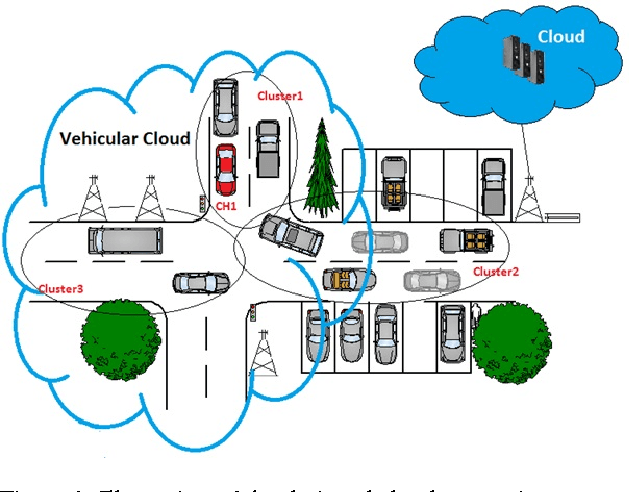

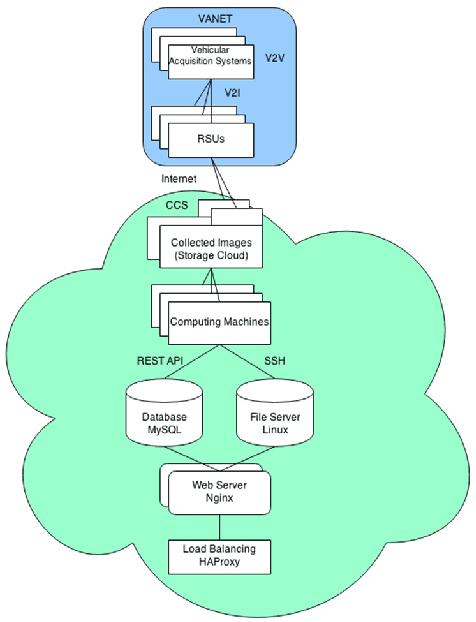
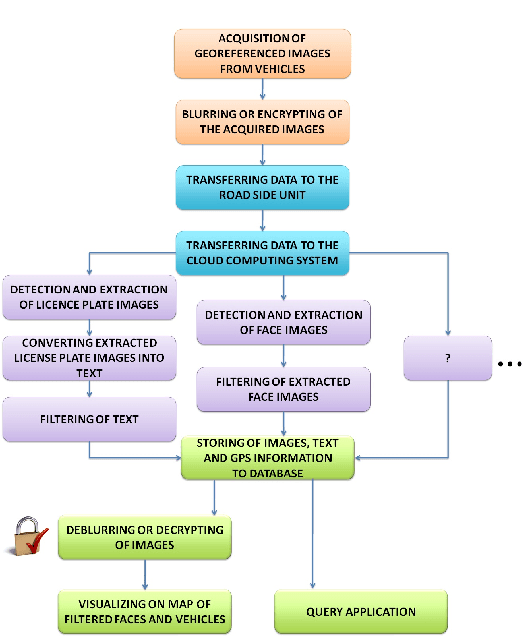
In this paper, we propose a design for novel and experimental cloud computing systems. The proposed system aims at enhancing computational, communicational and annalistic capabilities of road navigation services by merging several independent technologies, namely vision-based embedded navigation systems, prominent Cloud Computing Systems (CCSs) and Vehicular Ad-hoc NETwork (VANET). This work presents our initial investigations by describing the design of a global generic system. The designed system has been experimented with various scenarios of video-based road services. Moreover, the associated architecture has been implemented on a small-scale simulator of an in-vehicle embedded system. The implemented architecture has been experimented in the case of a simulated road service to aid the police agency. The goal of this service is to recognize and track searched individuals and vehicles in a real-time monitoring system remotely connected to moving cars. The presented work demonstrates the potential of our system for efficiently enhancing and diversifying real-time video services in road environments.