 Add to Chrome
 Add to Firefox
 Add to Edge
Contextual Procurement Auctions with Bandit Learning
Jul 08, 2026
We study repeated contextual procurement auctions in which producers have private costs and the platform must learn context-dependent product values from bandit feedback. The objective is welfare rather than revenue or a virtual-cost surrogate: regret is the total surplus loss relative to the full-information efficient procurement rule. We first show that the natural UCB allocation rule attains $\tilde O(\sqrt{ngT})$ welfare regret under truthful bids, but its adaptive bid-dependent learning path does not by itself give a truthfulness guarantee. To obtain exact incentives, we design a bid-independent explore-then-commit mechanism with empirical critical payments; it is dominant-strategy truthful and has $\tilde O((ng)^{1/3}T^{2/3})$ regret. We then introduce frozen-payment UCB, which estimates payments in an initial bid-independent exploration phase, freezes those payment estimates, and continues adaptive UCB allocation learning afterwards. Under a smoothed truthful-path margin condition, this mechanism gives a regret-incentive tradeoff: the near-UCB tuning attains $\tilde O(\sqrt{ngT})$ welfare regret, while the average per-round gain from any fixed deviation is at most $\tilde O(T^{-1/4})$ for fixed $n,g$. A matching lower bound shows that this frozen-payment frontier is unavoidable.

Efficient Inverse Multiagent Learning
Feb 20, 2025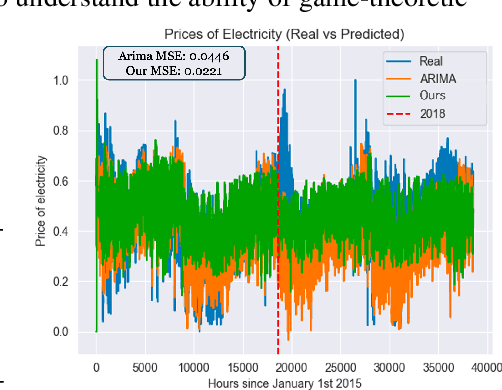

In this paper, we study inverse game theory (resp. inverse multiagent learning) in which the goal is to find parameters of a game's payoff functions for which the expected (resp. sampled) behavior is an equilibrium. We formulate these problems as generative-adversarial (i.e., min-max) optimization problems, for which we develop polynomial-time algorithms to solve, the former of which relies on an exact first-order oracle, and the latter, a stochastic one. We extend our approach to solve inverse multiagent simulacral learning in polynomial time and number of samples. In these problems, we seek a simulacrum, meaning parameters and an associated equilibrium that replicate the given observations in expectation. We find that our approach outperforms the widely-used ARIMA method in predicting prices in Spanish electricity markets based on time-series data.
Social Environment Design
Feb 21, 2024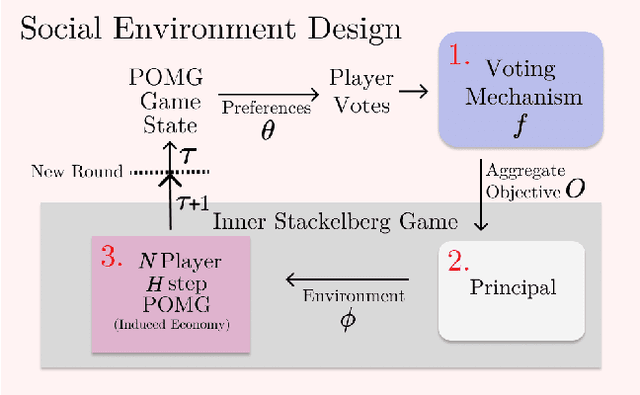
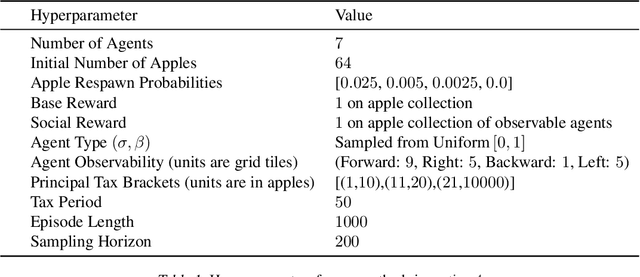
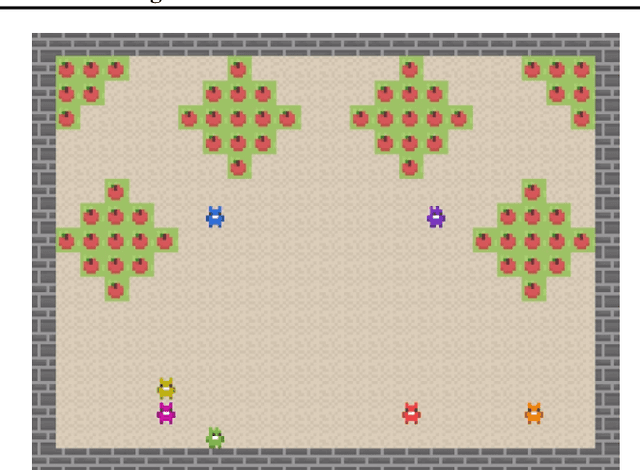
Artificial Intelligence (AI) holds promise as a technology that can be used to improve government and economic policy-making. This paper proposes a new research agenda towards this end by introducing Social Environment Design, a general framework for the use of AI for automated policy-making that connects with the Reinforcement Learning, EconCS, and Computational Social Choice communities. The framework seeks to capture general economic environments, includes voting on policy objectives, and gives a direction for the systematic analysis of government and economic policy through AI simulation. We highlight key open problems for future research in AI-based policy-making. By solving these challenges, we hope to achieve various social welfare objectives, thereby promoting more ethical and responsible decision making.