 Add to Chrome
 Add to Firefox
 Add to Edge
Learning the Cue or Learning the Word? Analyzing Generalization in Metaphor Detection for Verbs
Apr 15, 2026
Metaphor detection models achieve strong benchmark performance, yet it remains unclear whether this reflects transferable generalization or lexical memorization. To address this, we analyze generalization in metaphor detection through RoBERTa, the shared backbone of many state-of-the-art systems, focusing on English verbs using the VU Amsterdam Metaphor Corpus. We introduce a controlled lexical hold-out setup where all instances of selected target lemmas are strictly excluded from fine-tuning, and compare predictions on these Held-out lemmas against Exposed lemmas (verbs seen during fine-tuning). While the model performs best on Exposed lemmas, it maintains robust performance on Held-out lemmas. Further analysis reveals that sentence context alone is sufficient to match full-model performance on Held-out lemmas, whereas static verb-level embeddings are not. Together, these results suggest that generalization is primarily driven by "learning the cue" (transferable contextual patterns), while "learning the word" (verb-specific memorization) provides an additive boost when lexical exposure is available.

Contextualising (Im)plausible Events Triggers Figurative Language
Apr 09, 2026This work explores the connection between (non-)literalness and plausibility at the example of subject-verb-object events in English. We design a systematic setup of plausible and implausible event triples in combination with abstract and concrete constituent categories. Our analysis of human and LLM-generated judgments and example contexts reveals substantial differences between assessments of plausibility. While humans excel at nuanced detection and contextualization of (non-)literal vs. implausible events, LLM results reveal only shallow contextualization patterns with a bias to trade implausibility for non-literal, plausible interpretations.
Floating or Suggesting Ideas? A Large-Scale Contrastive Analysis of Metaphorical and Literal Verb-Object Constructions
Apr 09, 2026Metaphor pervades everyday language, allowing speakers to express abstract concepts via concrete domains. While prior work has studied metaphors cognitively and psycholinguistically, large-scale comparisons with literal language remain limited, especially for near-synonymous expressions. We analyze 297 English verb-object pairs (e.g., float idea vs. suggest idea) in ~2M corpus sentences, examining their contextual usage. Using five NLP tools, we extract 2,293 cognitive and linguistic features capturing affective, lexical, syntactic, and discourse-level properties. We address: (i) whether features differ between metaphorical and literal contexts (cross-pair analysis), and (ii) whether individual VO pairs diverge internally (within-pair analysis). Cross-pair results show literal contexts have higher lexical frequency, cohesion, and structural regularity, while metaphorical contexts show greater affective load, imageability, lexical diversity, and constructional specificity. Within-pair analyses reveal substantial heterogeneity, with most pairs showing non-uniform effects. These results suggest no single, consistent distributional pattern that distinguishes metaphorical from literal usage. Instead, differences are largely construction-specific. Overall, large-scale data combined with diverse features provides a fine-grained understanding of metaphor-literal contrasts in VO usage.
Probing BERT for German Compound Semantics
May 20, 2025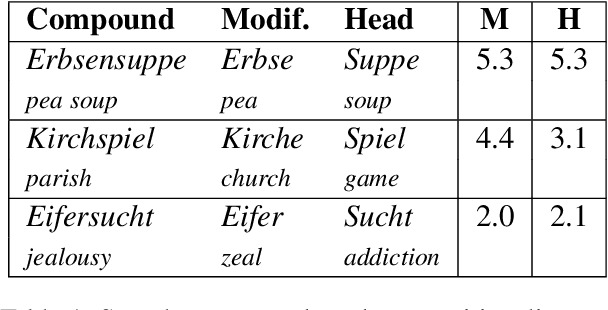
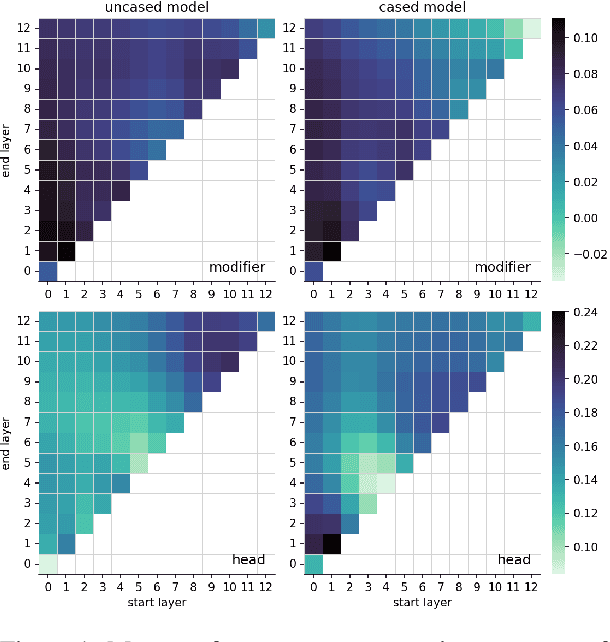
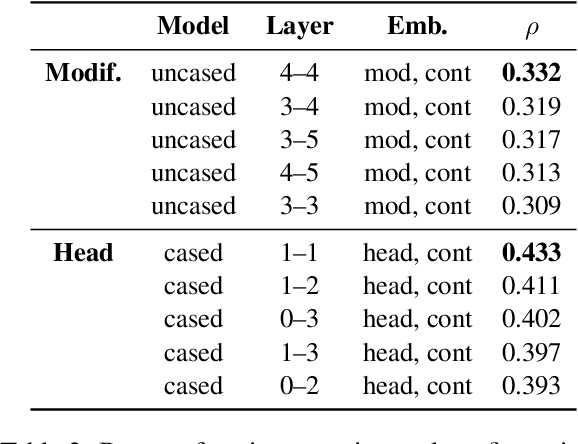
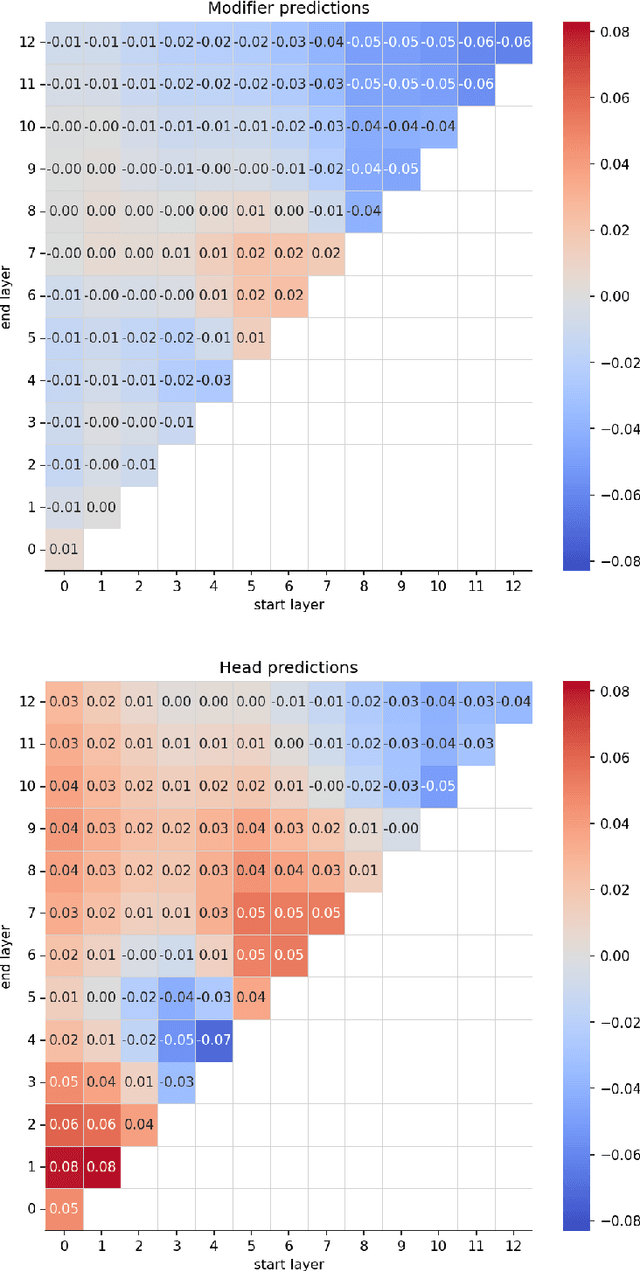
This paper investigates the extent to which pretrained German BERT encodes knowledge of noun compound semantics. We comprehensively vary combinations of target tokens, layers, and cased vs. uncased models, and evaluate them by predicting the compositionality of 868 gold standard compounds. Looking at representational patterns within the transformer architecture, we observe trends comparable to equivalent prior work on English, with compositionality information most easily recoverable in the early layers. However, our strongest results clearly lag behind those reported for English, suggesting an inherently more difficult task in German. This may be due to the higher productivity of compounding in German than in English and the associated increase in constituent-level ambiguity, including in our target compound set.
Unveiling the Mystery of Visual Attributes of Concrete and Abstract Concepts: Variability, Nearest Neighbors, and Challenging Categories
Oct 15, 2024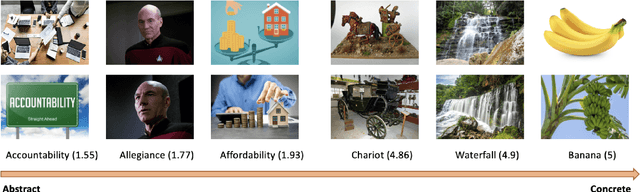
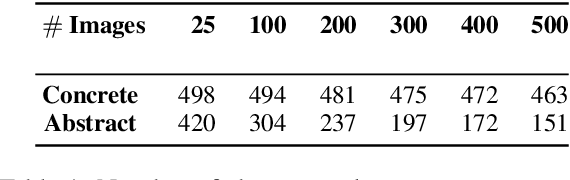
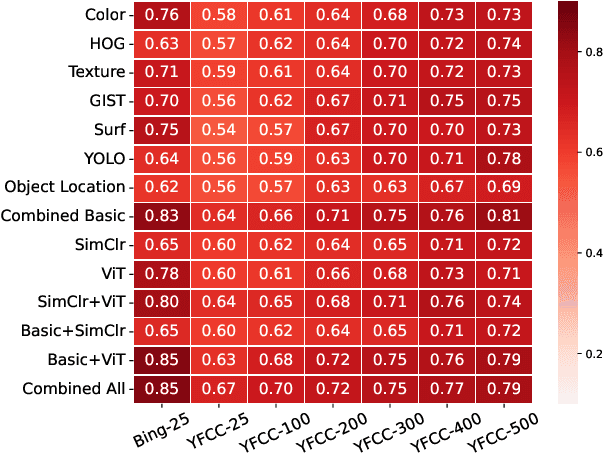
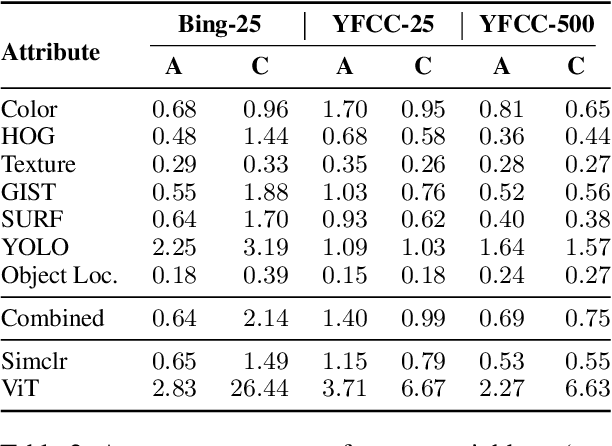
The visual representation of a concept varies significantly depending on its meaning and the context where it occurs; this poses multiple challenges both for vision and multimodal models. Our study focuses on concreteness, a well-researched lexical-semantic variable, using it as a case study to examine the variability in visual representations. We rely on images associated with approximately 1,000 abstract and concrete concepts extracted from two different datasets: Bing and YFCC. Our goals are: (i) evaluate whether visual diversity in the depiction of concepts can reliably distinguish between concrete and abstract concepts; (ii) analyze the variability of visual features across multiple images of the same concept through a nearest neighbor analysis; and (iii) identify challenging factors contributing to this variability by categorizing and annotating images. Our findings indicate that for classifying images of abstract versus concrete concepts, a combination of basic visual features such as color and texture is more effective than features extracted by more complex models like Vision Transformer (ViT). However, ViTs show better performances in the nearest neighbor analysis, emphasizing the need for a careful selection of visual features when analyzing conceptual variables through modalities other than text.
A Dataset for Physical and Abstract Plausibility and Sources of Human Disagreement
Apr 05, 2024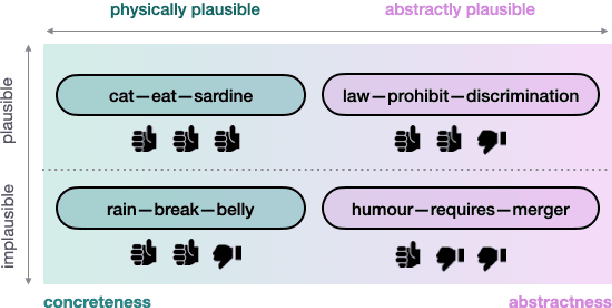
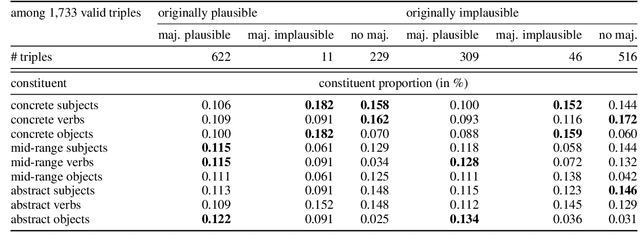
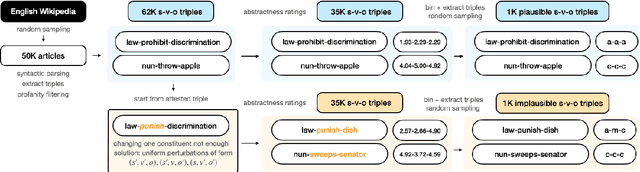
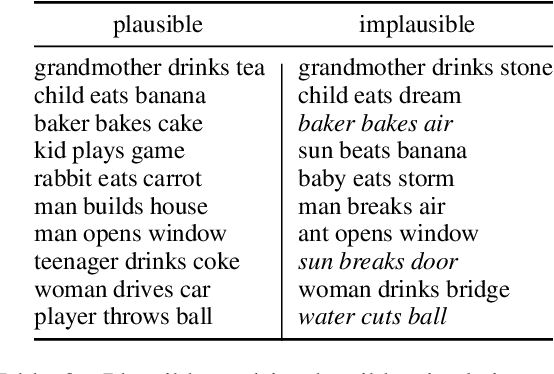
We present a novel dataset for physical and abstract plausibility of events in English. Based on naturally occurring sentences extracted from Wikipedia, we infiltrate degrees of abstractness, and automatically generate perturbed pseudo-implausible events. We annotate a filtered and balanced subset for plausibility using crowd-sourcing, and perform extensive cleansing to ensure annotation quality. In-depth quantitative analyses indicate that annotators favor plausibility over implausibility and disagree more on implausible events. Furthermore, our plausibility dataset is the first to capture abstractness in events to the same extent as concreteness, and we find that event abstractness has an impact on plausibility ratings: more concrete event participants trigger a perception of implausibility.
Willkommens-Merkel, Chaos-Johnson, and Tore-Klose: Modeling the Evaluative Meaning of German Personal Name Compounds
Apr 05, 2024We present a comprehensive computational study of the under-investigated phenomenon of personal name compounds (PNCs) in German such as Willkommens-Merkel ('Welcome-Merkel'). Prevalent in news, social media, and political discourse, PNCs are hypothesized to exhibit an evaluative function that is reflected in a more positive or negative perception as compared to the respective personal full name (such as Angela Merkel). We model 321 PNCs and their corresponding full names at discourse level, and show that PNCs bear an evaluative nature that can be captured through a variety of computational methods. Specifically, we assess through valence information whether a PNC is more positively or negatively evaluative than the person's name, by applying and comparing two approaches using (i) valence norms and (ii) pretrained language models (PLMs). We further enrich our data with personal, domain-specific, and extra-linguistic information and perform a range of regression analyses revealing that factors including compound and modifier valence, domain, and political party membership influence how a PNC is evaluated.
Semantics of Multiword Expressions in Transformer-Based Models: A Survey
Jan 27, 2024Multiword expressions (MWEs) are composed of multiple words and exhibit variable degrees of compositionality. As such, their meanings are notoriously difficult to model, and it is unclear to what extent this issue affects transformer architectures. Addressing this gap, we provide the first in-depth survey of MWE processing with transformer models. We overall find that they capture MWE semantics inconsistently, as shown by reliance on surface patterns and memorized information. MWE meaning is also strongly localized, predominantly in early layers of the architecture. Representations benefit from specific linguistic properties, such as lower semantic idiosyncrasy and ambiguity of target expressions. Our findings overall question the ability of transformer models to robustly capture fine-grained semantics. Furthermore, we highlight the need for more directly comparable evaluation setups.
The DURel Annotation Tool: Human and Computational Measurement of Semantic Proximity, Sense Clusters and Semantic Change
Nov 21, 2023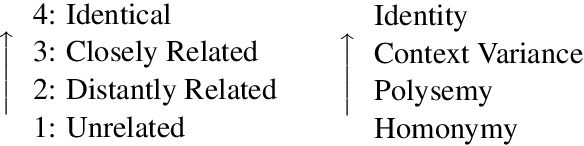
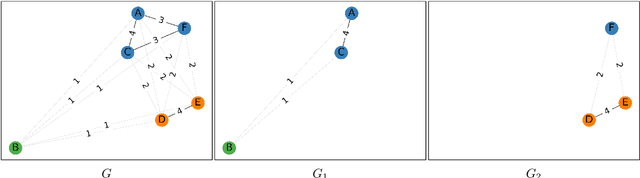
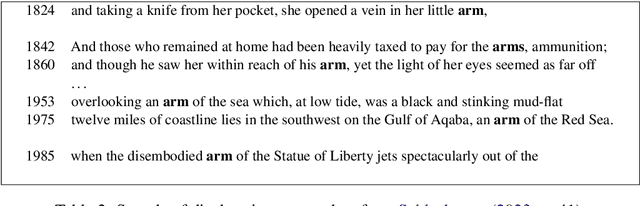
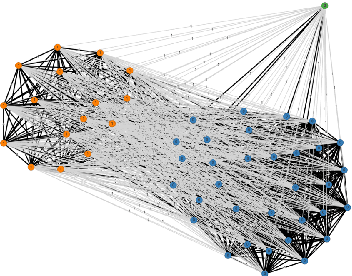
We present the DURel tool that implements the annotation of semantic proximity between uses of words into an online, open source interface. The tool supports standardized human annotation as well as computational annotation, building on recent advances with Word-in-Context models. Annotator judgments are clustered with automatic graph clustering techniques and visualized for analysis. This allows to measure word senses with simple and intuitive micro-task judgments between use pairs, requiring minimal preparation efforts. The tool offers additional functionalities to compare the agreement between annotators to guarantee the inter-subjectivity of the obtained judgments and to calculate summary statistics giving insights into sense frequency distributions, semantic variation or changes of senses over time.
Investigating the Nature of Disagreements on Mid-Scale Ratings: A Case Study on the Abstractness-Concreteness Continuum
Nov 08, 2023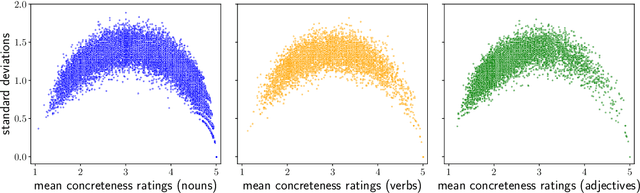
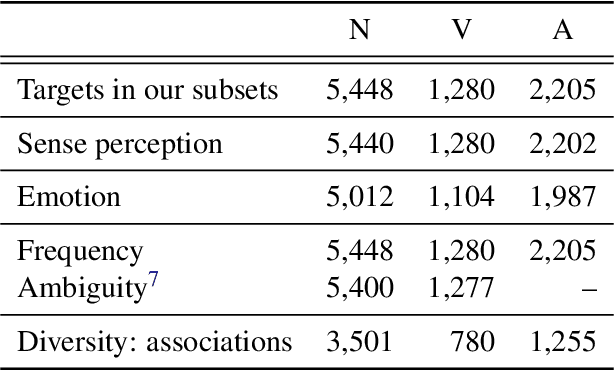
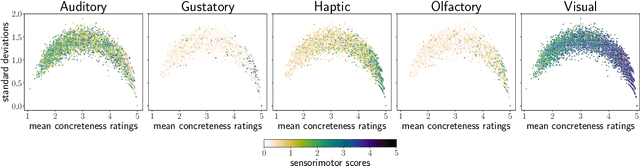
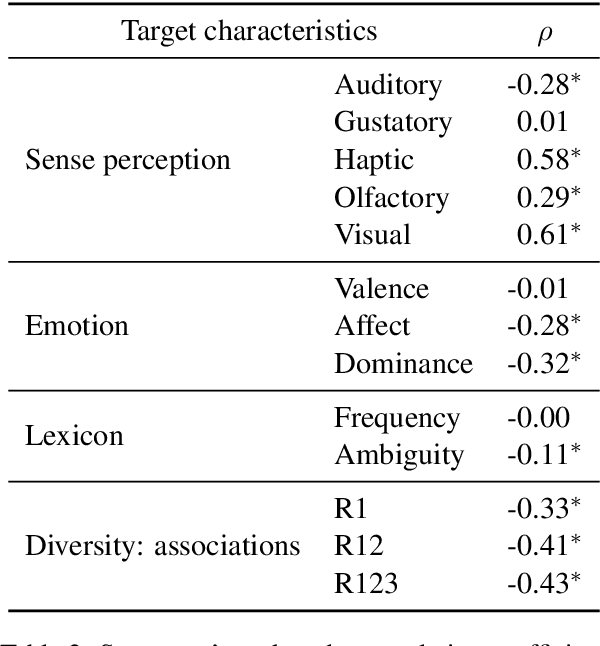
Humans tend to strongly agree on ratings on a scale for extreme cases (e.g., a CAT is judged as very concrete), but judgements on mid-scale words exhibit more disagreement. Yet, collected rating norms are heavily exploited across disciplines. Our study focuses on concreteness ratings and (i) implements correlations and supervised classification to identify salient multi-modal characteristics of mid-scale words, and (ii) applies a hard clustering to identify patterns of systematic disagreement across raters. Our results suggest to either fine-tune or filter mid-scale target words before utilising them.