 Add to Chrome
 Add to Firefox
 Add to Edge
Floating or Suggesting Ideas? A Large-Scale Contrastive Analysis of Metaphorical and Literal Verb-Object Constructions
Apr 09, 2026
Metaphor pervades everyday language, allowing speakers to express abstract concepts via concrete domains. While prior work has studied metaphors cognitively and psycholinguistically, large-scale comparisons with literal language remain limited, especially for near-synonymous expressions. We analyze 297 English verb-object pairs (e.g., float idea vs. suggest idea) in ~2M corpus sentences, examining their contextual usage. Using five NLP tools, we extract 2,293 cognitive and linguistic features capturing affective, lexical, syntactic, and discourse-level properties. We address: (i) whether features differ between metaphorical and literal contexts (cross-pair analysis), and (ii) whether individual VO pairs diverge internally (within-pair analysis). Cross-pair results show literal contexts have higher lexical frequency, cohesion, and structural regularity, while metaphorical contexts show greater affective load, imageability, lexical diversity, and constructional specificity. Within-pair analyses reveal substantial heterogeneity, with most pairs showing non-uniform effects. These results suggest no single, consistent distributional pattern that distinguishes metaphorical from literal usage. Instead, differences are largely construction-specific. Overall, large-scale data combined with diverse features provides a fine-grained understanding of metaphor-literal contrasts in VO usage.

NAP at SemEval-2023 Task 3: Is Less Really More? Translation as Data Augmentation Strategies for Detecting Persuasion Techniques
Apr 27, 2023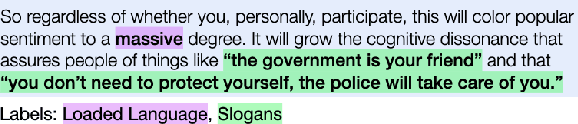
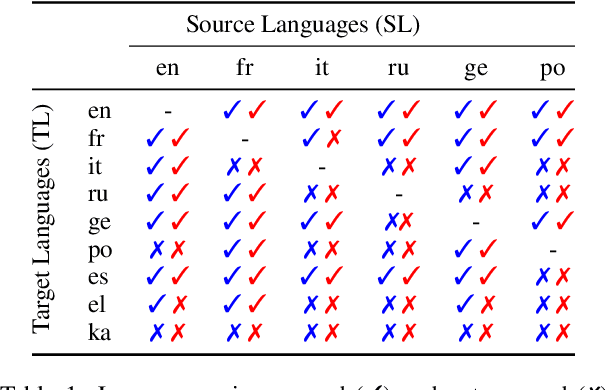

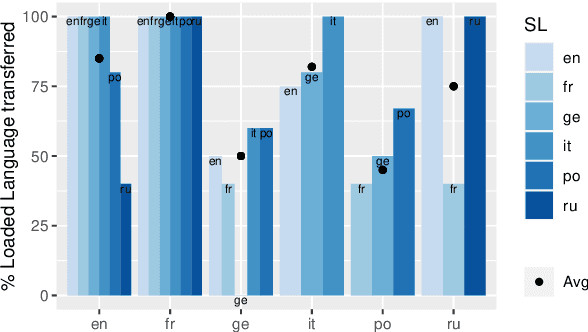
Persuasion techniques detection in news in a multi-lingual setup is non-trivial and comes with challenges, including little training data. Our system successfully leverages (back-)translation as data augmentation strategies with multi-lingual transformer models for the task of detecting persuasion techniques. The automatic and human evaluation of our augmented data allows us to explore whether (back-)translation aid or hinder performance. Our in-depth analyses indicate that both data augmentation strategies boost performance; however, balancing human-produced and machine-generated data seems to be crucial.
What Drives the Use of Metaphorical Language? Negative Insights from Abstractness, Affect, Discourse Coherence and Contextualized Word Representations
May 23, 2022
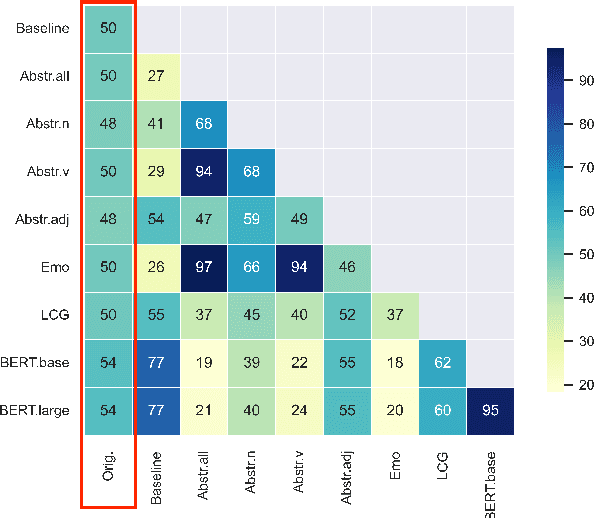
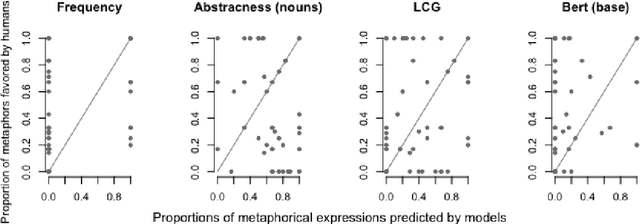
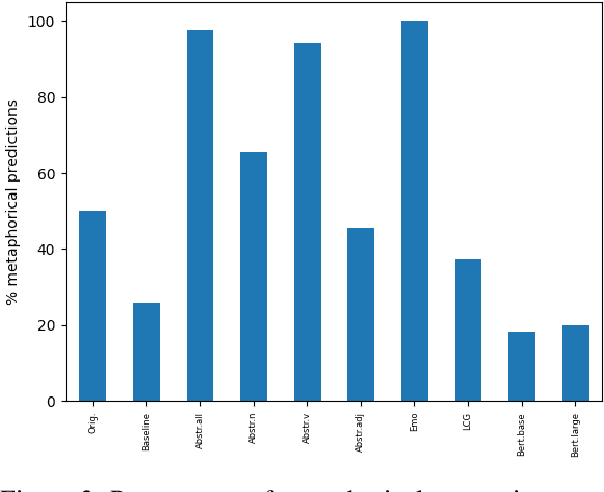
Given a specific discourse, which discourse properties trigger the use of metaphorical language, rather than using literal alternatives? For example, what drives people to say "grasp the meaning" rather than "understand the meaning" within a specific context? Many NLP approaches to metaphorical language rely on cognitive and (psycho-)linguistic insights and have successfully defined models of discourse coherence, abstractness and affect. In this work, we build five simple models relying on established cognitive and linguistic properties -- frequency, abstractness, affect, discourse coherence and contextualized word representations -- to predict the use of a metaphorical vs. synonymous literal expression in context. By comparing the models' outputs to human judgments, our study indicates that our selected properties are not sufficient to systematically explain metaphorical vs. literal language choices.
Features of Perceived Metaphoricity on the Discourse Level: Abstractness and Emotionality
May 18, 2022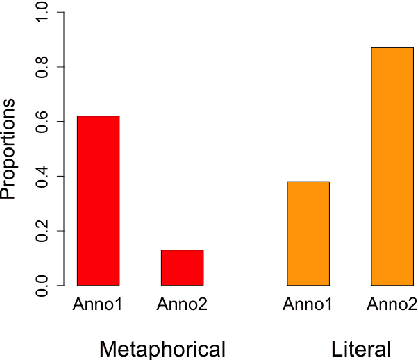
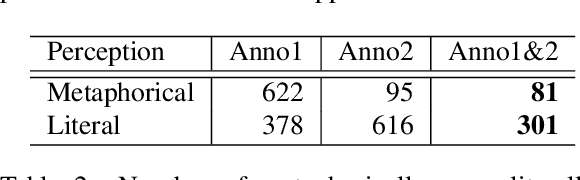
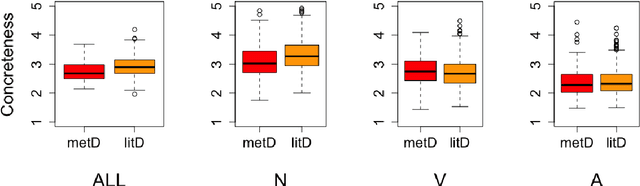
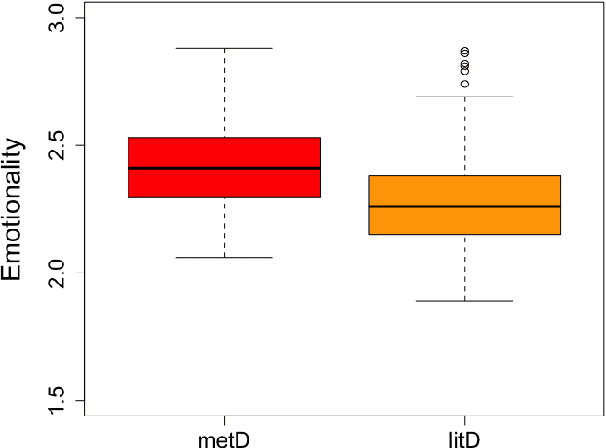
Research on metaphorical language has shown ties between abstractness and emotionality with regard to metaphoricity; prior work is however limited to the word and sentence levels, and up to date there is no empirical study establishing the extent to which this is also true on the discourse level. This paper explores which textual and perceptual features human annotators perceive as important for the metaphoricity of discourses and expressions, and addresses two research questions more specifically. First, is a metaphorically-perceived discourse more abstract and more emotional in comparison to a literally-perceived discourse? Second, is a metaphorical expression preceded by a more metaphorical/abstract/emotional context than a synonymous literal alternative? We used a dataset of 1,000 corpus-extracted discourses for which crowdsourced annotators (1) provided judgements on whether they perceived the discourses as more metaphorical or more literal, and (2) systematically listed lexical terms which triggered their decisions in (1). Our results indicate that metaphorical discourses are more emotional and to a certain extent more abstract than literal discourses. However, neither the metaphoricity nor the abstractness and emotionality of the preceding discourse seem to play a role in triggering the choice between synonymous metaphorical vs. literal expressions. Our dataset is available at https://www.ims.uni-stuttgart.de/data/discourse-met-lit.
Coordinate Constructions in English Enhanced Universal Dependencies: Analysis and Computational Modeling
Mar 16, 2021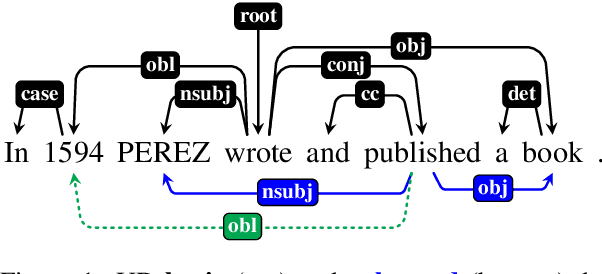
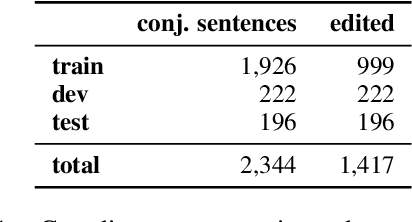
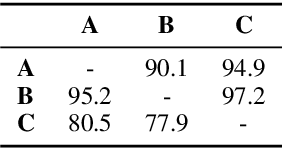
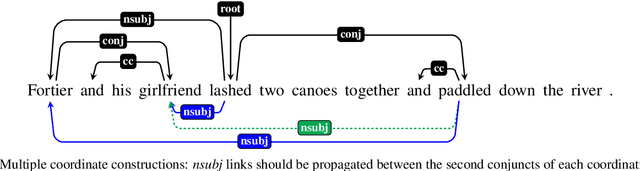
In this paper, we address the representation of coordinate constructions in Enhanced Universal Dependencies (UD), where relevant dependency links are propagated from conjunction heads to other conjuncts. English treebanks for enhanced UD have been created from gold basic dependencies using a heuristic rule-based converter, which propagates only core arguments. With the aim of determining which set of links should be propagated from a semantic perspective, we create a large-scale dataset of manually edited syntax graphs. We identify several systematic errors in the original data, and propose to also propagate adjuncts. We observe high inter-annotator agreement for this semantic annotation task. Using our new manually verified dataset, we perform the first principled comparison of rule-based and (partially novel) machine-learning based methods for conjunction propagation for English. We show that learning propagation rules is more effective than hand-designing heuristic rules. When using automatic parses, our neural graph-parser based edge predictor outperforms the currently predominant pipelinesusing a basic-layer tree parser plus converters.