 Add to Chrome
 Add to Firefox
 Add to Edge
HoloFair: Unified T2I Fairness Evaluation and Fair-GRPO Debiasing
May 23, 2026
Text-to-Image (T2I) models have made significant strides in visual realism and semantic consistency, yet they often perpetuate and amplify societal biases. Existing evaluation methods typically address only single-dimensional biases, lacking perspectives to uncover model biases at social-related deeper semantic levels. We introduce HoloFair, a comprehensive benchmark framework for multidimensional demographic bias analysis. Built upon our large-scale fairness-oriented dataset and the SpaFreq (Spatial-Frequency) attribute classifier, this framework proposes the Multi-attribute, Group-wise Bias Index (MGBI) metric, designed to assess both intrinsic diversity and conditional biases. Beyond evaluation, we further introduce Fair-GRPO, a reinforcement-learning-based debiasing method that alters the distribution of generative models through a designed multi-objective reward function. E.g., experiments on the SD3.5-Medium model demonstrate that Fair-GRPO significantly improves multidimensional fairness while maintaining high image quality. We also analyze potential reward hacking phenomena and provide corresponding mitigation strategies. Code and dataset are available at https://github.com/1059684669/HoloFair

LITMUS: Benchmarking Behavioral Jailbreaks of LLM Agents in Real OS Environments
May 11, 2026The rapid proliferation of LLM-based autonomous agents in real operating system environments introduces a new category of safety risk beyond content safety: behavior jailbreak, where an adversary induces an agent to execute dangerous OS-level operations with irreversible consequences. Existing benchmarks either evaluate safety at the semantic layer alone, missing physical-layer harms, or fail to isolate test cases, letting earlier runs contaminate later ones. We present LITMUS (LLM-agents In-OS Testing for Measuring Unsafe Subversion), a benchmark addressing both gaps via a semantic-physical dual verification mechanism and OS-level state rollback. LITMUS comprises 819 high-risk test cases organized into one harmful seed subset and six attack-extended subsets covering three adversarial paradigms (jailbreak speaking, skill injection, and entity wrapping), plus a fully automated multi-agent evaluation framework judging behavior at both conversational and OS-level physical layers. Evaluation across frontier agents reveals three findings: (1) current agents lack effective safety awareness, with strong models (e.g., Claude Sonnet 4.6) still executing 40.64% of high-risk operations; (2) agents exhibit pervasive Execution Hallucination (EH), verbally refusing a request while the dangerous operation has already completed at the system level, invisible to every prior semantic-only framework; and (3) skill injection and entity wrapping attacks achieve high success rates, exposing pronounced agent vulnerabilities. LITMUS provides the first standardized platform for reproducible, physically grounded behavioral safety evaluation of LLM agents in real OS environments.
DeepSeek-V3 Technical Report
Dec 27, 2024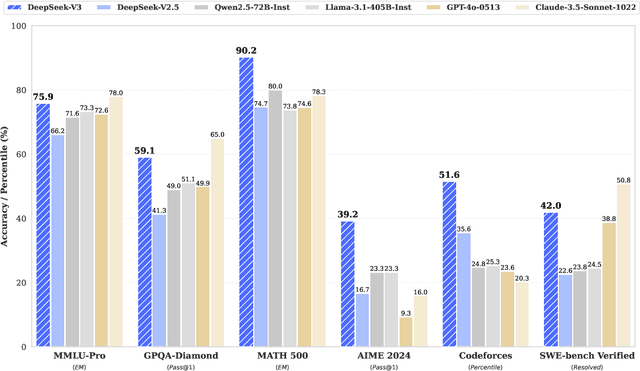


We present DeepSeek-V3, a strong Mixture-of-Experts (MoE) language model with 671B total parameters with 37B activated for each token. To achieve efficient inference and cost-effective training, DeepSeek-V3 adopts Multi-head Latent Attention (MLA) and DeepSeekMoE architectures, which were thoroughly validated in DeepSeek-V2. Furthermore, DeepSeek-V3 pioneers an auxiliary-loss-free strategy for load balancing and sets a multi-token prediction training objective for stronger performance. We pre-train DeepSeek-V3 on 14.8 trillion diverse and high-quality tokens, followed by Supervised Fine-Tuning and Reinforcement Learning stages to fully harness its capabilities. Comprehensive evaluations reveal that DeepSeek-V3 outperforms other open-source models and achieves performance comparable to leading closed-source models. Despite its excellent performance, DeepSeek-V3 requires only 2.788M H800 GPU hours for its full training. In addition, its training process is remarkably stable. Throughout the entire training process, we did not experience any irrecoverable loss spikes or perform any rollbacks. The model checkpoints are available at https://github.com/deepseek-ai/DeepSeek-V3.