 Add to Chrome
 Add to Firefox
 Add to Edge
Contact Coverage-Guided Exploration for General-Purpose Dexterous Manipulation
Mar 11, 2026
Deep Reinforcement learning (DRL) has achieved remarkable success in domains with well-defined reward structures, such as Atari games and locomotion. In contrast, dexterous manipulation lacks general-purpose reward formulations and typically depends on task-specific, handcrafted priors to guide hand-object interactions. We propose Contact Coverage-Guided Exploration (CCGE), a general exploration method designed for general-purpose dexterous manipulation tasks. CCGE represents contact state as the intersection between object surface points and predefined hand keypoints, encouraging dexterous hands to discover diverse and novel contact patterns, namely which fingers contact which object regions. It maintains a contact counter conditioned on discretized object states obtained via learned hash codes, capturing how frequently each finger interacts with different object regions. This counter is leveraged in two complementary ways: (1) to assign a count-based contact coverage reward that promotes exploration of novel contact patterns, and (2) an energy-based reaching reward that guides the agent toward under-explored contact regions. We evaluate CCGE on a diverse set of dexterous manipulation tasks, including cluttered object singulation, constrained object retrieval, in-hand reorientation, and bimanual manipulation. Experimental results show that CCGE substantially improves training efficiency and success rates over existing exploration methods, and that the contact patterns learned with CCGE transfer robustly to real-world robotic systems. Project page is https://contact-coverage-guided-exploration.github.io.

A Study of In-Context-Learning-Based Text-to-SQL Errors
Jan 16, 2025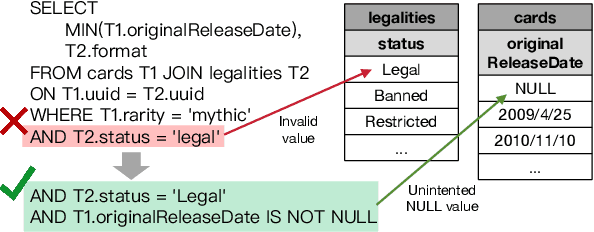
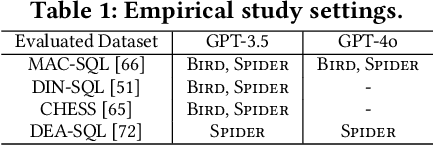
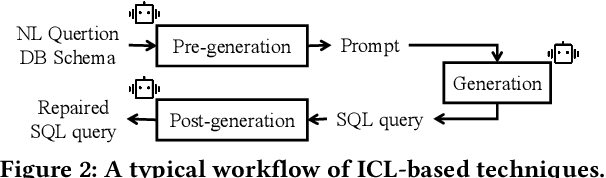
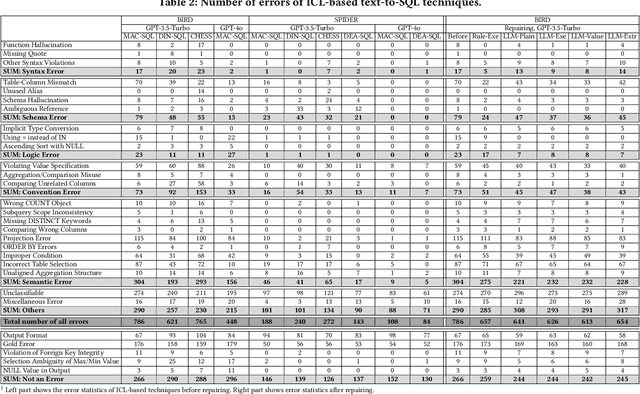
Large language models (LLMs) have been adopted to perform text-to-SQL tasks, utilizing their in-context learning (ICL) capability to translate natural language questions into structured query language (SQL). However, such a technique faces correctness problems and requires efficient repairing solutions. In this paper, we conduct the first comprehensive study of text-to-SQL errors. Our study covers four representative ICL-based techniques, five basic repairing methods, two benchmarks, and two LLM settings. We find that text-to-SQL errors are widespread and summarize 29 error types of 7 categories. We also find that existing repairing attempts have limited correctness improvement at the cost of high computational overhead with many mis-repairs. Based on the findings, we propose MapleRepair, a novel text-to-SQL error detection and repairing framework. The evaluation demonstrates that MapleRepair outperforms existing solutions by repairing 13.8% more queries with neglectable mis-repairs and 67.4% less overhead.