 Add to Chrome
 Add to Firefox
 Add to Edge
Antigen-specific Antibody Multi-modal Foundation Model for Functional Antibody Design
Jul 22, 2026
Antibodies are essential proteins that play a central role in immune recognition by binding specific antigen molecules. Although recent protein language models have enabled progress in single-chain protein modeling and generation, they often fall short in antigen-specific antibody design, where effective modeling requires explicit pairing between antibody and antigen, particularly at the epitope level. To address these limitations, we introduce AAMFM, an Antigen-specific Antibody Multimodal Foundation Model that learns unified representations of antibody sequences and structures conditioned on antigen context. AAMFM incorporates rich antigen information including geometric interfaces and epitope annotations via a cross-modal adapter, enabling joint modeling of antibody-antigen interactions in a shared latent space. To further guide the model toward functional relevance, we fine-tune AAMFM using Calibrated Direct Preference Optimization (Cal-DPO), leveraging preference signals extracted from a strong structural prior to align learning with binding-specific objectives. Extensive experiments demonstrate that AAMFM achieves state-of-the-art performance in functional antibody design, revealing its potential for antigen-specific antibody engineering. Our code is available at https://github.com/XL-S224/AAMFM.

REALM: Retrospective Encoder Alignment for LFP Modeling
May 14, 2026Spike activity has been the dominant neural signal for behavior decoding due to its high spatial and temporal resolution. However, as brain-computer interfaces (BCIs) move toward high channel counts and wireless operation, the high sampling frequency of spike signals becomes a bottleneck due to high power and bandwidth requirements. Local field potentials (LFPs) represent a different spatial-temporal scale of brain activity compared to spikes, offering key advantages including improved long-term stability, reduced energy consumption, and lower bandwidth requirement. Despite these benefits, LFP-based decoding models typically show reduced accuracy and often rely on non-causal architectures that are unsuitable for real-time deployment. To address these challenges, we propose REALM: a retrospective distillation framework that enables causal LFP decoding. Inspired by offline-to-online distillation strategies in speech recognition, REALM transfers representational knowledge from a pretrained multi-session bidirectional LFP model to a causal version for real-time deployment. We first pretrain a bidirectional Mamba-2 teacher model using a masked autoencoding objective. We then distill this teacher model into a compact student model via a combined objective of representation alignment and task supervision. REALM consistently outperforms both causal and non-causal LFP-based SOTA methods for behavior decoding. Notably, our REALM improves decoding performance while achieving a $2\times$ reduction in parameter count and a $10\times$ reduction in training time. These results demonstrate that retrospective distillation effectively bridges the gap between offline and real-time neural decoding. REALM shows that LFP-only models can achieve competitive decoding performance without reliance on spike signals, offering a practical and scalable alternative for next-generation wireless implantable BCIs.
LiteMedCoT-VL: Parameter-Efficient Adaptation for Medical Visual Question Answering
May 10, 2026The reasoning gap between large and compact vision-language models (VLMs) limits the deployment of medical AI on portable clinical devices. Compact VLMs of 2--4B parameters can run on resource-constrained hardware but lack the multi-step reasoning capacity needed for interpretable clinical decision support. Existing knowledge distillation methods transfer answers without the reasoning process behind them. Medical visual question answering (VQA) serves as a testbed for this problem, as it requires models to integrate visual evidence with clinical knowledge through structured reasoning chains. We introduce LiteMedCoT-VL, a pipeline that transfers chain-of-thought reasoning from a 235B teacher model to 2B student models through LoRA-based fine-tuning on explanation-enriched training data. All inference is conducted without image captions by default, simulating the clinical scenario in which a physician interprets a medical image directly without an accompanying radiology report. On the PMC-VQA benchmark, LiteMedCoT-VL achieves 64.9% accuracy, exceeding the zero-shot Qwen3-VL-4B baseline of 53.9% by 11.0 percentage points and outperforming all published baselines. This result indicates that a 2B model with reasoning distillation can match or exceed models with twice the parameters. Visual grounding analysis shows that the model relies on image content rather than exploiting textual priors. Our code is publicly available at https://anonymous.4open.science/r/LiteMedCoT-VL.
BEAT-Net: Injecting Biomimetic Spatio-Temporal Priors for Interpretable ECG Classification
Jan 12, 2026Although deep learning has advanced automated electrocardiogram (ECG) diagnosis, prevalent supervised methods typically treat recordings as undifferentiated one-dimensional (1D) signals or two-dimensional (2D) images. This formulation compels models to learn physiological structures implicitly, resulting in data inefficiency and opacity that diverge from medical reasoning. To address these limitations, we propose BEAT-Net, a Biomimetic ECG Analysis with Tokenization framework that reformulates the problem as a language modeling task. Utilizing a QRS tokenization strategy to transform continuous signals into biologically aligned heartbeat sequences, the architecture explicitly decomposes cardiac physiology through specialized encoders that extract local beat morphology while normalizing spatial lead perspectives and modeling temporal rhythm dependencies. Evaluations across three large-scale benchmarks demonstrate that BEAT-Net matches the diagnostic accuracy of dominant convolutional neural network (CNN) architectures while substantially improving robustness. The framework exhibits exceptional data efficiency, recovering fully supervised performance using only 30 to 35 percent of annotated data. Moreover, learned attention mechanisms provide inherent interpretability by spontaneously reproducing clinical heuristics, such as Lead II prioritization for rhythm analysis, without explicit supervision. These findings indicate that integrating biological priors offers a computationally efficient and interpretable alternative to data-intensive large-scale pre-training.
Stacking-Enhanced Bagging Ensemble Learning for Breast Cancer Classification with CNN
Jul 15, 2024This paper proposes a CNN classification network based on Bagging and stacking ensemble learning methods for breast cancer classification. The model was trained and tested on the public dataset of DDSM. The model is capable of fast and accurate classification of input images. According to our research results, for binary classification (presence or absence of breast cancer), the accuracy reached 98.84%, and for five-class classification, the accuracy reached 98.34%. The model also achieved a micro-average recall rate of 94.80% and an F1 score of 94.19%. In comparative experiments, we compared the effects of different values of bagging_ratio and n_models on the model, as well as several methods for ensemble bagging models. Furthermore, under the same parameter settings, our BSECNN outperformed VGG16 and ResNet-50 in terms of accuracy by 8.22% and 6.33% respectively.
TRIG: Transformer-Based Text Recognizer with Initial Embedding Guidance
Nov 16, 2021
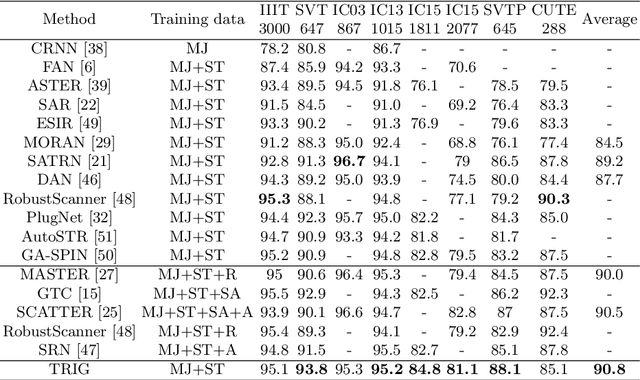
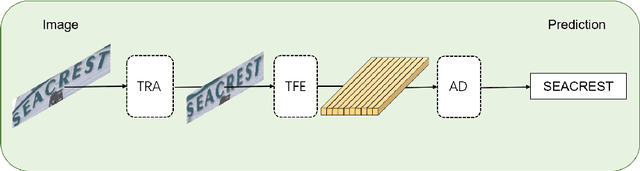
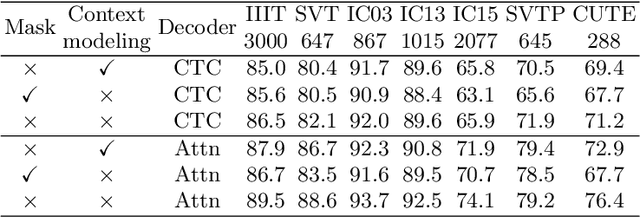
Scene text recognition (STR) is an important bridge between images and text, attracting abundant research attention. While convolutional neural networks (CNNS) have achieved remarkable progress in this task, most of the existing works need an extra module (context modeling module) to help CNN to capture global dependencies to solve the inductive bias and strengthen the relationship between text features. Recently, the transformer has been proposed as a promising network for global context modeling by self-attention mechanism, but one of the main shortcomings, when applied to recognition, is the efficiency. We propose a 1-D split to address the challenges of complexity and replace the CNN with the transformer encoder to reduce the need for a context modeling module. Furthermore, recent methods use a frozen initial embedding to guide the decoder to decode the features to text, leading to a loss of accuracy. We propose to use a learnable initial embedding learned from the transformer encoder to make it adaptive to different input images. Above all, we introduce a novel architecture for text recognition, named TRansformer-based text recognizer with Initial embedding Guidance (TRIG), composed of three stages (transformation, feature extraction, and prediction). Extensive experiments show that our approach can achieve state-of-the-art on text recognition benchmarks.