 Add to Chrome
 Add to Firefox
 Add to Edge
LiteMedCoT-VL: Parameter-Efficient Adaptation for Medical Visual Question Answering
May 10, 2026
The reasoning gap between large and compact vision-language models (VLMs) limits the deployment of medical AI on portable clinical devices. Compact VLMs of 2--4B parameters can run on resource-constrained hardware but lack the multi-step reasoning capacity needed for interpretable clinical decision support. Existing knowledge distillation methods transfer answers without the reasoning process behind them. Medical visual question answering (VQA) serves as a testbed for this problem, as it requires models to integrate visual evidence with clinical knowledge through structured reasoning chains. We introduce LiteMedCoT-VL, a pipeline that transfers chain-of-thought reasoning from a 235B teacher model to 2B student models through LoRA-based fine-tuning on explanation-enriched training data. All inference is conducted without image captions by default, simulating the clinical scenario in which a physician interprets a medical image directly without an accompanying radiology report. On the PMC-VQA benchmark, LiteMedCoT-VL achieves 64.9% accuracy, exceeding the zero-shot Qwen3-VL-4B baseline of 53.9% by 11.0 percentage points and outperforming all published baselines. This result indicates that a 2B model with reasoning distillation can match or exceed models with twice the parameters. Visual grounding analysis shows that the model relies on image content rather than exploiting textual priors. Our code is publicly available at https://anonymous.4open.science/r/LiteMedCoT-VL.

Two-Phase Object-Based Deep Learning for Multi-temporal SAR Image Change Detection
Jan 17, 2020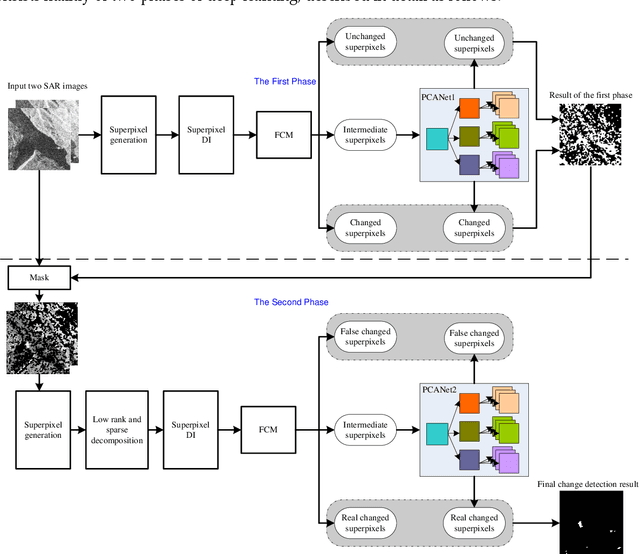
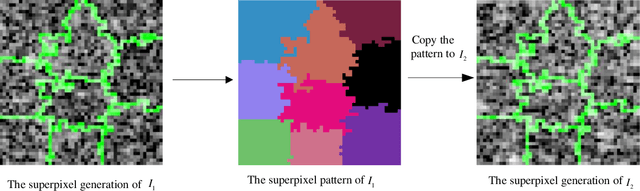
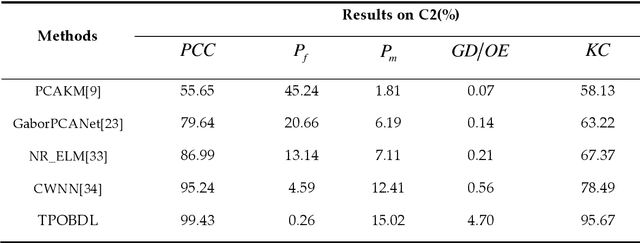
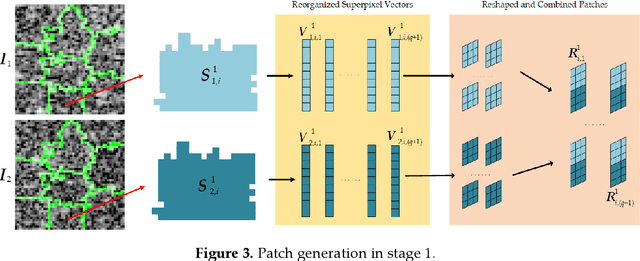
Change detection is one of the fundamental applications of synthetic aperture radar (SAR) images. However, speckle noise presented in SAR images has a much negative effect on change detection. In this research, a novel two-phase object-based deep learning approach is proposed for multi-temporal SAR image change detection. Compared with traditional methods, the proposed approach brings two main innovations. One is to classify all pixels into three categories rather than two categories: unchanged pixels, changed pixels caused by strong speckle (false changes), and changed pixels formed by real terrain variation (real changes). The other is to group neighboring pixels into segmented into superpixel objects (from pixels) such as to exploit local spatial context. Two phases are designed in the methodology: 1) Generate objects based on the simple linear iterative clustering algorithm, and discriminate these objects into changed and unchanged classes using fuzzy c-means (FCM) clustering and a deep PCANet. The prediction of this Phase is the set of changed and unchanged superpixels. 2) Deep learning on the pixel sets over the changed superpixels only, obtained in the first phase, to discriminate real changes from false changes. SLIC is employed again to achieve new superpixels in the second phase. Low rank and sparse decomposition are applied to these new superpixels to suppress speckle noise significantly. A further clustering step is applied to these new superpixels via FCM. A new PCANet is then trained to classify two kinds of changed superpixels to achieve the final change maps. Numerical experiments demonstrate that, compared with benchmark methods, the proposed approach can distinguish real changes from false changes effectively with significantly reduced false alarm rates, and achieve up to 99.71% change detection accuracy using multi-temporal SAR imagery.