 Add to Chrome
 Add to Firefox
 Add to Edge
LiteMedCoT-VL: Parameter-Efficient Adaptation for Medical Visual Question Answering
May 10, 2026
The reasoning gap between large and compact vision-language models (VLMs) limits the deployment of medical AI on portable clinical devices. Compact VLMs of 2--4B parameters can run on resource-constrained hardware but lack the multi-step reasoning capacity needed for interpretable clinical decision support. Existing knowledge distillation methods transfer answers without the reasoning process behind them. Medical visual question answering (VQA) serves as a testbed for this problem, as it requires models to integrate visual evidence with clinical knowledge through structured reasoning chains. We introduce LiteMedCoT-VL, a pipeline that transfers chain-of-thought reasoning from a 235B teacher model to 2B student models through LoRA-based fine-tuning on explanation-enriched training data. All inference is conducted without image captions by default, simulating the clinical scenario in which a physician interprets a medical image directly without an accompanying radiology report. On the PMC-VQA benchmark, LiteMedCoT-VL achieves 64.9% accuracy, exceeding the zero-shot Qwen3-VL-4B baseline of 53.9% by 11.0 percentage points and outperforming all published baselines. This result indicates that a 2B model with reasoning distillation can match or exceed models with twice the parameters. Visual grounding analysis shows that the model relies on image content rather than exploiting textual priors. Our code is publicly available at https://anonymous.4open.science/r/LiteMedCoT-VL.

Can Multimodal LLMs See Materials Clearly? A Multimodal Benchmark on Materials Characterization
Sep 11, 2025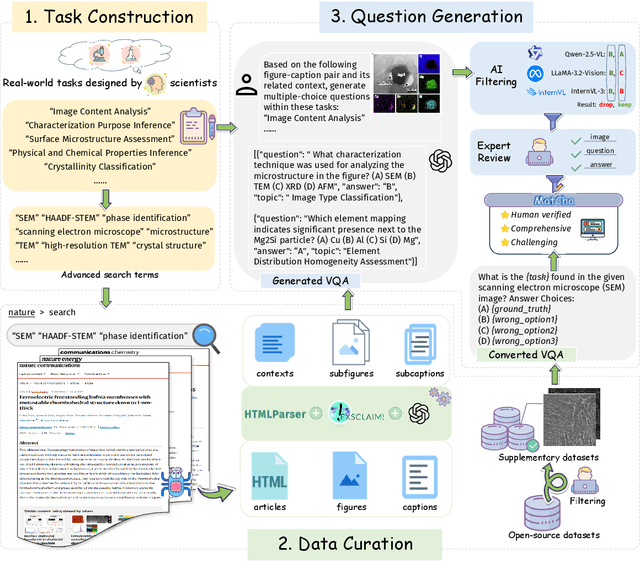
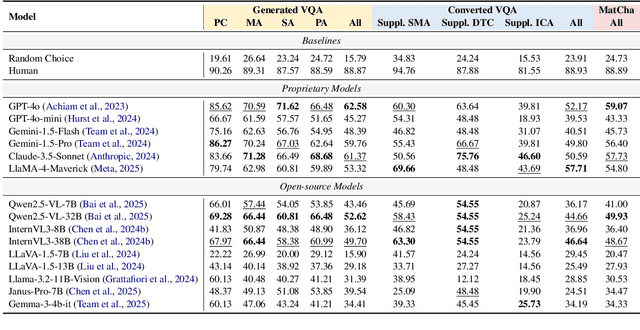
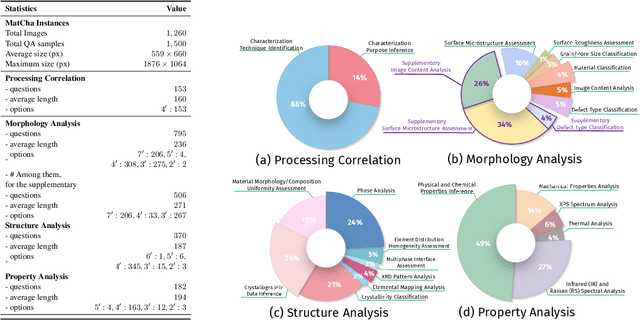
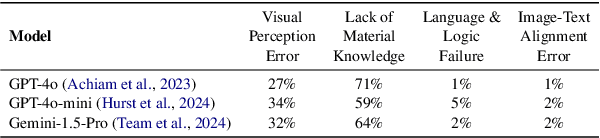
Materials characterization is fundamental to acquiring materials information, revealing the processing-microstructure-property relationships that guide material design and optimization. While multimodal large language models (MLLMs) have recently shown promise in generative and predictive tasks within materials science, their capacity to understand real-world characterization imaging data remains underexplored. To bridge this gap, we present MatCha, the first benchmark for materials characterization image understanding, comprising 1,500 questions that demand expert-level domain expertise. MatCha encompasses four key stages of materials research comprising 21 distinct tasks, each designed to reflect authentic challenges faced by materials scientists. Our evaluation of state-of-the-art MLLMs on MatCha reveals a significant performance gap compared to human experts. These models exhibit degradation when addressing questions requiring higher-level expertise and sophisticated visual perception. Simple few-shot and chain-of-thought prompting struggle to alleviate these limitations. These findings highlight that existing MLLMs still exhibit limited adaptability to real-world materials characterization scenarios. We hope MatCha will facilitate future research in areas such as new material discovery and autonomous scientific agents. MatCha is available at https://github.com/FreedomIntelligence/MatCha.