 Add to Chrome
 Add to Firefox
 Add to Edge
You Only Pass Once: Answering and Abstaining Together in a Single Forward Pass of a Frozen Language Model
Aug 14, 2026
A frozen language model on reasoning tasks has two coupled weaknesses: it under-uses evidence its own residual stream already encodes, and it fails to detect when the input is insufficient to answer, so it confabulates. This paper consolidates two research lines that address these on the same residual stream: a conditional steering probe writes the stream at mid-stack layers and recovers reasoning accuracy from a frozen backbone, and a zero-shot sufficiency direction reads the stream and abstains when information is insufficient. Deployed in one forward pass they interfere: the steering write shifts the state the direction reads, costing up to 8 AUROC points of cross-domain transfer on small models; a separate clean pass doubles inference cost. We keep the direction fixed and train a small network to reconstruct the pre-steering residual from the steered one -- mean-squared error on (steered, clean) pairs, no sufficiency labels -- and read the direction on the reconstruction. The resulting system, YOPO (You Only Pass Once), answers, steers, and abstains in one forward pass of a frozen Qwen2.5 backbone (1.5B/3B/7B). End to end, three-way accuracy more than doubles the frozen baseline (0.375->0.798 on 1.5B alphaNLI) and one pass beats the two-pass reference at every scale (0.798/0.830/0.893 vs 0.753/0.790/0.863) and on ten backbones across six model families. We chart the capacity-transfer frontier quantifying the principle that abstention should not be trained in; a source-side audit catches our own alphaNLI construction leaking a surface artifact, so architectural claims are anchored on native-label replications (SQuAD2, RepLiQA, MuSiQue); and on the standard four-domain suite we contribute, to our knowledge, the first answer-or-abstain benchmark, where our gate tops every in-domain dataset and the label-free direction is the only gate family to survive domain transfer.

MM Algorithms for Distance Covariance based Sufficient Dimension Reduction and Sufficient Variable Selection
Dec 13, 2019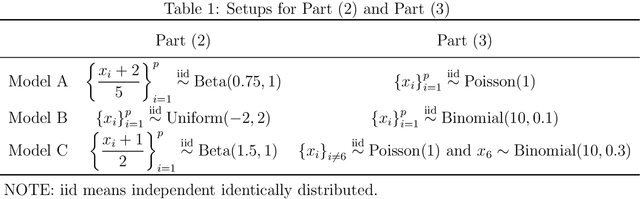
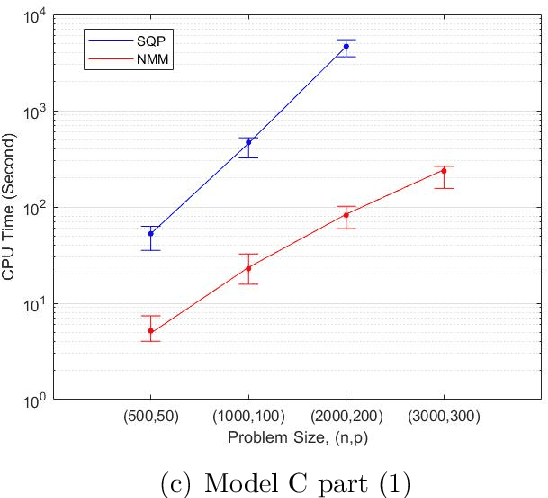
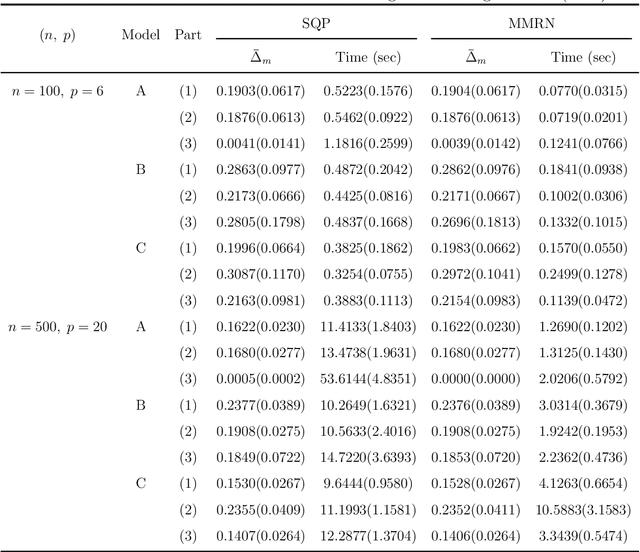
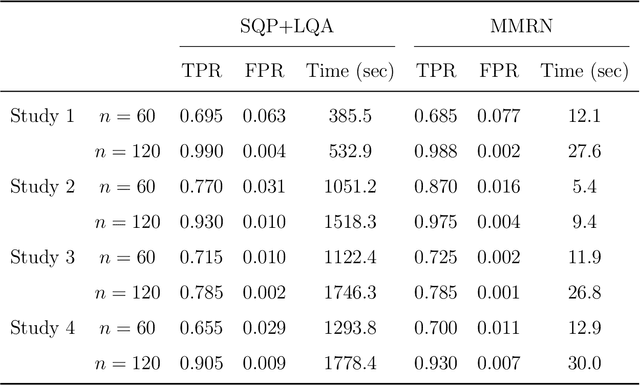
Sufficient dimension reduction (SDR) using distance covariance (DCOV) was recently proposed as an approach to dimension-reduction problems. Compared with other SDR methods, it is model-free without estimating link function and does not require any particular distributions on predictors (see Sheng and Yin, 2013, 2016). However, the DCOV-based SDR method involves optimizing a nonsmooth and nonconvex objective function over the Stiefel manifold. To tackle the numerical challenge, we novelly formulate the original objective function equivalently into a DC (Difference of Convex functions) program and construct an iterative algorithm based on the majorization-minimization (MM) principle. At each step of the MM algorithm, we inexactly solve the quadratic subproblem on the Stiefel manifold by taking one iteration of Riemannian Newton's method. The algorithm can also be readily extended to sufficient variable selection (SVS) using distance covariance. We establish the convergence property of the proposed algorithm under some regularity conditions. Simulation studies show our algorithm drastically improves the computation efficiency and is robust across various settings compared with the existing method. Supplemental materials for this article are available.