 Add to Chrome
 Add to Firefox
 Add to Edge
EEG-JEPA: Structured Latent Prediction for EEG Foundation Models
Jul 31, 2026
Electroencephalography (EEG) foundation models aim to learn reusable representations from large-scale unlabeled recordings. A common pretraining strategy is masked waveform reconstruction, but applying supervision directly to noisy EEG may encourage models to recover predictable background activity, acquisition effects, and artifacts rather than neural structure that transfers across tasks. This raises a central question: what should an EEG foundation model predict to learn transferable representations? We introduce EEG-JEPA a structured latent-prediction framework for EEG foundation modeling. Rather than reconstructing masked voltage samples, a masked context encoder and predictor infer contextual latent states produced by an exponential-moving-average target encoder that observes the complete input. EEG-JEPA organizes target design along three complementary dimensions: target content specifies what representation is predicted, target support specifies where prediction occurs over structured electrode--time regions through Neurotopology-Aware Multi-scale Electrode-Temporal Masking (N-MET), and target depth specifies at which encoder layers supervision is applied. Together, these designs shift EEG pretraining from recovering missing measurements to inferring latent states from structured electrode--time context. We evaluate EEG-JEPA through controlled objective comparisons, frozen multitask transfer, and full fine-tuning. Under the same backbone, pretraining corpus, and training duration, EEG-JEPA improves the 14-task frozen macro balanced accuracy from 40.49% to 50.42% over CBraMod-style masked waveform reconstruction. Multi-source continuation further raises this result to 52.94%, the highest average among the EEG foundation models evaluated on EEG-FM-Bench. Under protocol-matched full fine-tuning, EEG-JEPA also improves the nine-task average balanced accuracy from 68.98% to 70.65%.

Training-Driven Representational Geometry Modularization Predicts Brain Alignment in Language Models
Feb 07, 2026How large language models (LLMs) align with the neural representation and computation of human language is a central question in cognitive science. Using representational geometry as a mechanistic lens, we addressed this by tracking entropy, curvature, and fMRI encoding scores throughout Pythia (70M-1B) training. We identified a geometric modularization where layers self-organize into stable low- and high-complexity clusters. The low-complexity module, characterized by reduced entropy and curvature, consistently better predicted human language network activity. This alignment followed heterogeneous spatial-temporal trajectories: rapid and stable in temporal regions (AntTemp, PostTemp), but delayed and dynamic in frontal areas (IFG, IFGorb). Crucially, reduced curvature remained a robust predictor of model-brain alignment even after controlling for training progress, an effect that strengthened with model scale. These results links training-driven geometric reorganization to temporal-frontal functional specialization, suggesting that representational smoothing facilitates neural-like linguistic processing.
Dynamic-Attention-based EEG State Transition Modeling for Emotion Recognition
Nov 07, 2024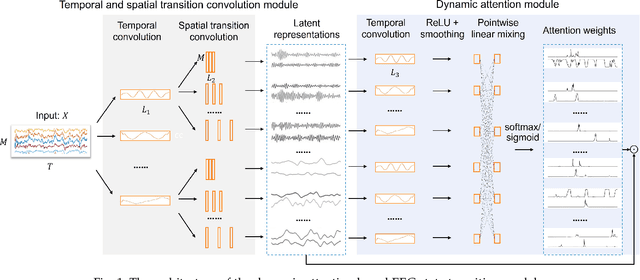
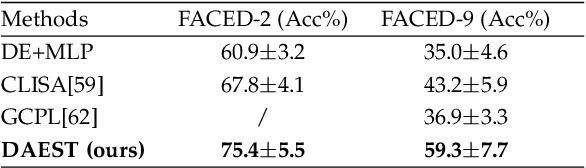
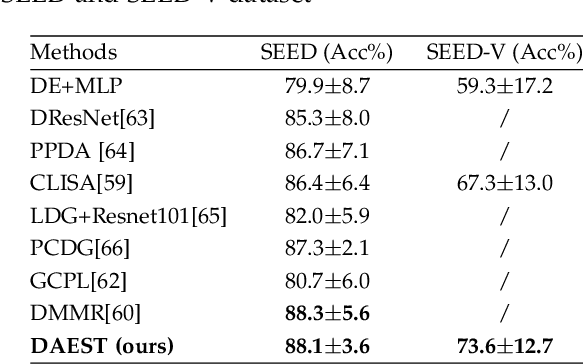
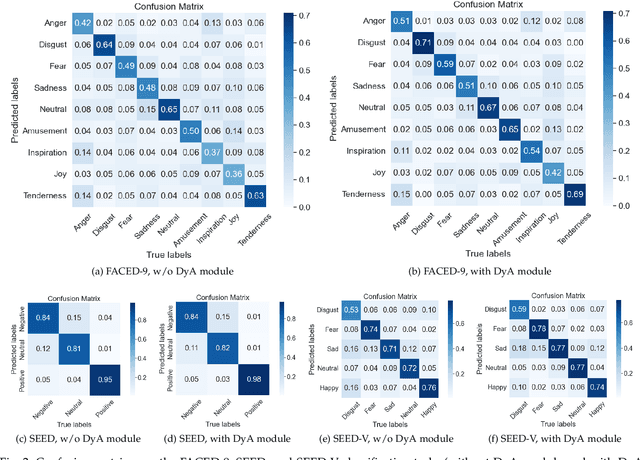
Electroencephalogram (EEG)-based emotion decoding can objectively quantify people's emotional state and has broad application prospects in human-computer interaction and early detection of emotional disorders. Recently emerging deep learning architectures have significantly improved the performance of EEG emotion decoding. However, existing methods still fall short of fully capturing the complex spatiotemporal dynamics of neural signals, which are crucial for representing emotion processing. This study proposes a Dynamic-Attention-based EEG State Transition (DAEST) modeling method to characterize EEG spatiotemporal dynamics. The model extracts spatiotemporal components of EEG that represent multiple parallel neural processes and estimates dynamic attention weights on these components to capture transitions in brain states. The model is optimized within a contrastive learning framework for cross-subject emotion recognition. The proposed method achieved state-of-the-art performance on three publicly available datasets: FACED, SEED, and SEED-V. It achieved 75.4% accuracy in the binary classification of positive and negative emotions and 59.3% in nine-class discrete emotion classification on the FACED dataset, 88.1% in the three-class classification of positive, negative, and neutral emotions on the SEED dataset, and 73.6% in five-class discrete emotion classification on the SEED-V dataset. The learned EEG spatiotemporal patterns and dynamic transition properties offer valuable insights into neural dynamics underlying emotion processing.