 Add to Chrome
 Add to Firefox
 Add to Edge
Physics-Grounded Fluid Video Generation with a Simulation Dataset and Dual-Stream Optical-Flow Supervision
Jul 28, 2026
Video diffusion models generate visually compelling content but routinely violate elementary physics when the subject involves fluids: liquid columns break apart in mid-air, container water levels fail to rise as liquid is poured in, and splashes disperse without regard to momentum or gravity. We attribute this gap to the fact that large-scale video-text corpora contain almost no explicit motion supervision, so models learn to imitate fluid appearance rather than dynamics. We address this with two contributions. First, we build a physics-simulation fluid dataset combining 1,638 MPM-simulated pouring/sloshing videos with 2,320 keyword-filtered real pouring videos mined from stock footage, plus two held-out test sets: a 1,515-video real-video benchmark and an 18-prompt text-to-first-frame generalization benchmark. Second, we introduce a dual-stream image-to-video architecture built on a pretrained diffusion-transformer video generator. It augments the standard RGB decoder with a lightweight Optical-Flow Decoder branch trained with explicit end-point-error and smoothness losses, fused into the RGB stream via zero-initialized convolutions so the pretrained backbone starts undisturbed. Only the two decoders are updated; the encoder, temporal transformer, and text encoder remain frozen. Across two model scales (1.3B and 14B) and two test sets, our method improves VideoPhy-2 Physical-Commonsense and Video-Quality scores over the frozen backbone by up to 8.75 and 4.65 points, outperforms a leading open competitor, and is preferred by human raters in a blind study. A direct optical-flow read-out evaluation further shows an end-point error as low as 0.54 pixels in-distribution, confirming the model has internalized a coherent motion prior rather than merely improving surface appearance.

VividDreamer: Towards High-Fidelity and Efficient Text-to-3D Generation
Jun 21, 2024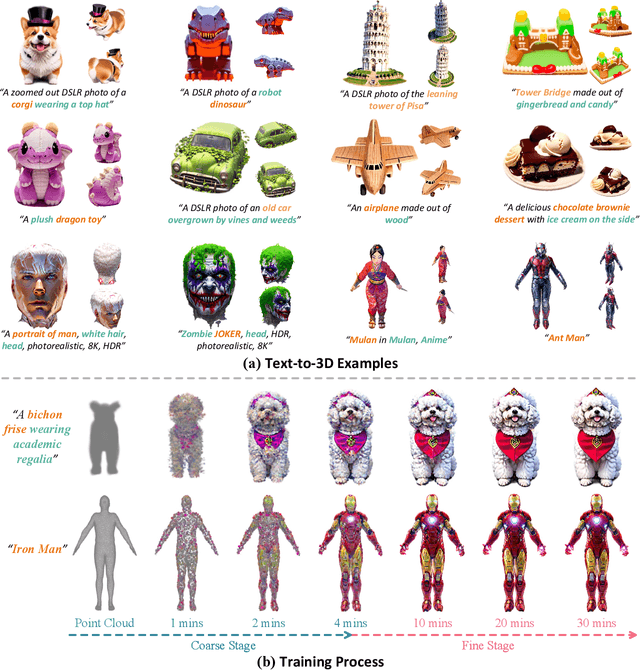


Text-to-3D generation aims to create 3D assets from text-to-image diffusion models. However, existing methods face an inherent bottleneck in generation quality because the widely-used objectives such as Score Distillation Sampling (SDS) inappropriately omit U-Net jacobians for swift generation, leading to significant bias compared to the "true" gradient obtained by full denoising sampling. This bias brings inconsistent updating direction, resulting in implausible 3D generation e.g., color deviation, Janus problem, and semantically inconsistent details). In this work, we propose Pose-dependent Consistency Distillation Sampling (PCDS), a novel yet efficient objective for diffusion-based 3D generation tasks. Specifically, PCDS builds the pose-dependent consistency function within diffusion trajectories, allowing to approximate true gradients through minimal sampling steps (1-3). Compared to SDS, PCDS can acquire a more accurate updating direction with the same sampling time (1 sampling step), while enabling few-step (2-3) sampling to trade compute for higher generation quality. For efficient generation, we propose a coarse-to-fine optimization strategy, which first utilizes 1-step PCDS to create the basic structure of 3D objects, and then gradually increases PCDS steps to generate fine-grained details. Extensive experiments demonstrate that our approach outperforms the state-of-the-art in generation quality and training efficiency, conspicuously alleviating the implausible 3D generation issues caused by the deviated updating direction. Moreover, it can be simply applied to many 3D generative applications to yield impressive 3D assets, please see our project page: https://narcissusex.github.io/VividDreamer.