 Add to Chrome
 Add to Firefox
 Add to Edge
Service-Induced Congestion in Memory-Constrained LLM Serving
Jun 14, 2026
In large language model (LLM) serving, each request accumulates persistent graphics processing unit (GPU) memory during service as its key-value cache grows with every generated token. Under high concurrency, aggregate memory usage therefore increases endogenously over time: the service process itself creates future capacity pressure. When memory capacity is exceeded, systems evict active requests, discarding cached state and restarting them later, which wastes computation and reduces throughput. We develop a discrete-time dynamical model of memory-constrained LLM inference that captures admission, memory growth, and eviction under continuous batching. In the saturated-input regime, the system admits both eviction-free fixed points and limit cycles with evictions. For homogeneous workloads, we show that the eviction-free equilibrium is unstable and that, except for a Lebesgue-measure-zero exact-capture set, the system converges to a unique worst-case limit cycle that is asymptotically stable outside this exceptional set, with throughput losses as large as 50%. For heterogeneous workloads, we prove a stability criterion in the two-class common-input setting and explain how the survival-polynomial mechanism generalizes to multiple classes and heterogeneous-input lengths. Under an input-dominated scaling regime, coprime decoding lengths stabilize the eviction-free equilibrium, while non-coprime lengths create synchronized modes that drive instability. These results characterize when workload heterogeneity desynchronizes completions and helps stabilize memory-constrained serving. More broadly, we identify service-induced congestion as a structural instability mechanism and derive scheduling design principles for sustaining high throughput.

Resource-Constrained Adaptive Inference for Sequential Pricing
Jun 02, 2026Resource-constrained pricing controllers can make fixed-price inference impossible: the controller's resource state may remove the target price neighborhood from the feasible set, even when every realized action has a known positive density. We formalize this support-exclusion failure through a local non-identification result and a realized information clock. We then design a target-aware pricing controller that certifies feasible target bands and logs continuous local densities. Localized debiasing gives studentized intervals whose width is governed by this clock. The resulting regret--information accounting, stated up to pilot re-solving error, shows that cheap exploration can be insufficient for inference: polynomial target mass gives polynomial rates, while a pure $1/t$ target branch does not yield shrinking fixed-target intervals without additional local movement. Experiments show calibration in certified bands and diagnostic abstention when the resource state collapses target support.
On the Reliability Limits of LLM-Based Multi-Agent Planning
Mar 27, 2026This technical note studies the reliability limits of LLM-based multi-agent planning as a delegated decision problem. We model the LLM-based multi-agent architecture as a finite acyclic decision network in which multiple stages process shared model-context information, communicate through language interfaces with limited capacity, and may invoke human review. We show that, without new exogenous signals, any delegated network is decision-theoretically dominated by a centralized Bayes decision maker with access to the same information. In the common-evidence regime, this implies that optimizing over multi-agent directed acyclic graphs under a finite communication budget can be recast as choosing a budget-constrained stochastic experiment on the shared signal. We also characterize the loss induced by communication and information compression. Under proper scoring rules, the gap between the centralized Bayes value and the value after communication admits an expected posterior divergence representation, which reduces to conditional mutual information under logarithmic loss and to expected squared posterior error under the Brier score. These results characterize the fundamental reliability limits of delegated LLM planning. Experiments with LLMs on a controlled problem set further demonstrate these characterizations.
The Value of Information in Resource-Constrained Pricing
Mar 26, 2026Firms that price perishable resources -- airline seats, hotel rooms, seasonal inventory -- now routinely use demand predictions, but these predictions vary widely in quality. Under hard capacity constraints, acting on an inaccurate prediction can irreversibly deplete inventory needed for future periods. We study how prediction uncertainty propagates into dynamic pricing decisions with linear demand, stochastic noise, and finite capacity. A certified demand forecast with known error bound~$ε^0$ specifies where the system should operate: it shifts regret from $O(\sqrt{T})$ to $O(\log T)$ when $ε^0 \lesssim T^{-1/4}$, and we prove this threshold is tight. A misspecified surrogate model -- biased but correlated with true demand -- cannot set prices directly but reduces learning variance by a factor of $(1-ρ^2)$ through control variates. The two mechanisms compose: the forecast determines the regret regime; the surrogate tightens estimation within it. All algorithms rest on a boundary attraction mechanism that stabilizes pricing near degenerate capacity boundaries without requiring non-degeneracy assumptions. Experiments confirm the phase transition threshold, the variance reduction from surrogates, and robustness across problem instances.
Designing Service Systems from Textual Evidence
Mar 11, 2026Designing service systems requires selecting among alternative configurations -- choosing the best chatbot variant, the optimal routing policy, or the most effective quality control procedure. In many service systems, the primary evidence of performance quality is textual -- customer support transcripts, complaint narratives, compliance review reports -- rather than the scalar measurements assumed by classical optimization methods. Large language models (LLMs) can read such textual evidence and produce standardized quality scores, but these automated judges exhibit systematic biases that vary across alternatives and evaluation instances. Human expert review remains accurate but costly. We study how to identify the best service configuration with high confidence while minimizing expensive human audits, given that automated evaluation is cheap but biased. We formalize this as a sequential decision problem where a biased proxy score is observed for every evaluation, and a verified outcome can be acquired selectively at additional cost. We prove that LLM-only selection fails under arm-dependent bias, and that naive selective-audit estimators can be asymptotically biased. We develop an estimator combining proxy scores with inverse-propensity-weighted residuals and construct anytime-valid confidence sequences. Our algorithm, PP-LUCB, jointly decides which alternatives to evaluate and whether to request human audits, concentrating reviews where the LLM judge is least reliable. We prove correctness and establish instance-dependent cost bounds showing near-optimal efficiency. On a customer support ticket classification task, our algorithm correctly identifies the best model in 40/40 trials while achieving 90\% audit cost reduction.
OptiRepair: Closed-Loop Diagnosis and Repair of Supply Chain Optimization Models with LLM Agents
Feb 24, 2026Supply chain optimization models frequently become infeasible because of modeling errors. Diagnosis and repair require scarce OR expertise: analysts must interpret solver diagnostics, trace root causes across echelons, and fix formulations without sacrificing operational soundness. Whether AI agents can perform this task remains untested. We decompose this task into two phases: a domain-agnostic feasibility phase that iteratively repairs any LP using IIS-guided diagnosis, and a domain-specific validation phase that enforces five rationality checks grounded in inventory theory. We test 22 API models from seven families on 976 multi-echelon supply chain problems and train two 8B-parameter models with self-taught reasoning and solver-verified rewards. The trained models reach 81.7% Rational Recovery Rate (RRR) -- the fraction of problems resolved to both feasibility and operational rationality -- versus 42.2% for the best API model and 21.3% on average. The gap concentrates in Phase 1 repair, where API models average 27.6% recovery rate versus 97.2% for trained models. Two gaps separate current AI from reliable model repair: solver interaction, as API models restore only 27.6% of infeasible formulations; and operational rationale, as roughly one in four feasible repairs violate supply chain theory. Each gap requires a different intervention -- targeted training closes the solver interaction gap, while explicit specification as solver-verifiable checks closes the rationality gap. For organizations adopting AI in operational planning, formalizing what 'rational' means in their context is the higher-return investment.
Best Arm Identification with LLM Judges and Limited Human
Jan 29, 2026We study fixed-confidence best-arm identification (BAI) where a cheap but potentially biased proxy (e.g., LLM judge) is available for every sample, while an expensive ground-truth label can only be acquired selectively when using a human for auditing. Unlike classical multi-fidelity BAI, the proxy is biased (arm- and context-dependent) and ground truth is selectively observed. Consequently, standard multi-fidelity methods can mis-select the best arm, and uniform auditing, though accurate, wastes scarce resources and is inefficient. We prove that without bias correction and propensity adjustment, mis-selection probability may not vanish (even with unlimited proxy data). We then develop an estimator for the mean of each arm that combines proxy scores with inverse-propensity-weighted residuals and form anytime-valid confidence sequences for that estimator. Based on the estimator and confidence sequence, we propose an algorithm that adaptively selects and audits arms. The algorithm concentrates audits on unreliable contexts and close arms and we prove that a plug-in Neyman rule achieves near-oracle audit efficiency. Numerical experiments confirm the theoretical guarantees and demonstrate the superior empirical performance of the proposed algorithm.
PPI-SVRG: Unifying Prediction-Powered Inference and Variance Reduction for Semi-Supervised Optimization
Jan 29, 2026We study semi-supervised stochastic optimization when labeled data is scarce but predictions from pre-trained models are available. PPI and SVRG both reduce variance through control variates -- PPI uses predictions, SVRG uses reference gradients. We show they are mathematically equivalent and develop PPI-SVRG, which combines both. Our convergence bound decomposes into the standard SVRG rate plus an error floor from prediction uncertainty. The rate depends only on loss geometry; predictions affect only the neighborhood size. When predictions are perfect, we recover SVRG exactly. When predictions degrade, convergence remains stable but reaches a larger neighborhood. Experiments confirm the theory: PPI-SVRG reduces MSE by 43--52\% under label scarcity on mean estimation benchmarks and improves test accuracy by 2.7--2.9 percentage points on MNIST with only 10\% labeled data.
Solver-in-the-Loop: MDP-Based Benchmarks for Self-Correction and Behavioral Rationality in Operations Research
Jan 28, 2026Operations Research practitioners routinely debug infeasible models through an iterative process: analyzing Irreducible Infeasible Subsystems (\IIS{}), identifying constraint conflicts, and systematically repairing formulations until feasibility is achieved. Yet existing LLM benchmarks evaluate OR as one-shot translation -- given a problem description, generate solver code -- ignoring this diagnostic loop entirely. We introduce two benchmarks that place the \textbf{solver in the evaluation loop}. \textbf{\ORDebug{}} evaluates iterative self-correction through 5,000+ problems spanning 9 error types; each repair action triggers solver re-execution and \IIS{} recomputation, providing deterministic, verifiable feedback. \textbf{\ORBias{}} evaluates behavioral rationality through 2,000 newsvendor instances (1,000 ID + 1,000 OOD), measuring systematic deviations from closed-form optimal policies. Across 26 models and 12,000+ samples, we find that domain-specific RLVR training enables an 8B model to surpass frontier APIs: 95.3\% vs 86.2\% recovery rate (+9.1\%), 62.4\% vs 47.8\% diagnostic accuracy (+14.6\%), and 2.25 vs 3.78 steps to resolution (1.7$\times$ faster). On \ORBias{}, curriculum training achieves the only negative ID$\rightarrow$OOD bias drift among models evaluated (-9.6\%), reducing systematic bias by 48\% (from 20.0\% to 10.4\%). These results demonstrate that process-level evaluation with verifiable oracles enables targeted training that outperforms scale.
Optimizing LLM Inference: Fluid-Guided Online Scheduling with Memory Constraints
Apr 15, 2025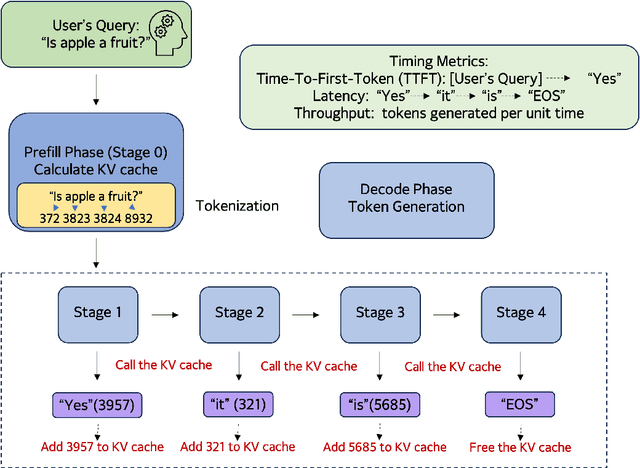
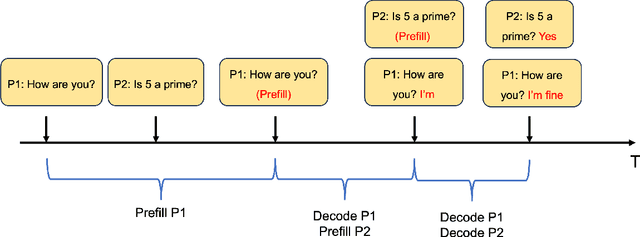
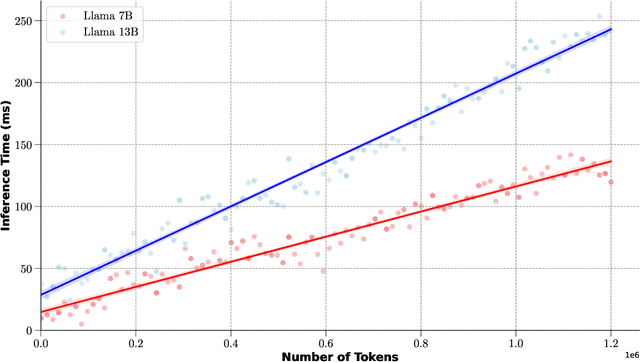
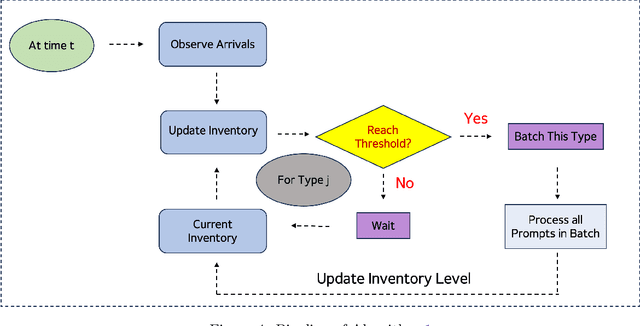
Large Language Models (LLMs) are indispensable in today's applications, but their inference procedure -- generating responses by processing text in segments and using a memory-heavy Key-Value (KV) cache -- demands significant computational resources, particularly under memory constraints. This paper formulates LLM inference optimization as a multi-stage online scheduling problem where sequential prompt arrivals and KV cache growth render conventional scheduling ineffective. We develop a fluid dynamics approximation to provide a tractable benchmark that guides algorithm design. Building on this, we propose the Waiting for Accumulated Inference Threshold (WAIT) algorithm, which uses multiple thresholds to schedule incoming prompts optimally when output lengths are known, and extend it to Nested WAIT for cases with unknown output lengths. Theoretical analysis shows that both algorithms achieve near-optimal performance against the fluid benchmark in heavy traffic conditions, balancing throughput, latency, and Time to First Token (TTFT). Experiments with the Llama-7B model on an A100 GPU using both synthetic and real-world datasets demonstrate improved throughput and reduced latency relative to established baselines like vLLM and Sarathi. This work bridges operations research and machine learning, offering a rigorous framework for the efficient deployment of LLMs under memory constraints.