 Add to Chrome
 Add to Firefox
 Add to Edge
AVO: Agentic Variation Operators for Autonomous Evolutionary Search
Mar 25, 2026
Agentic Variation Operators (AVO) are a new family of evolutionary variation operators that replace the fixed mutation, crossover, and hand-designed heuristics of classical evolutionary search with autonomous coding agents. Rather than confining a language model to candidate generation within a prescribed pipeline, AVO instantiates variation as a self-directed agent loop that can consult the current lineage, a domain-specific knowledge base, and execution feedback to propose, repair, critique, and verify implementation edits. We evaluate AVO on attention, among the most aggressively optimized kernel targets in AI, on NVIDIA Blackwell (B200) GPUs. Over 7 days of continuous autonomous evolution on multi-head attention, AVO discovers kernels that outperform cuDNN by up to 3.5% and FlashAttention-4 by up to 10.5% across the evaluated configurations. The discovered optimizations transfer readily to grouped-query attention, requiring only 30 minutes of additional autonomous adaptation and yielding gains of up to 7.0% over cuDNN and 9.3% over FlashAttention-4. Together, these results show that agentic variation operators move beyond prior LLM-in-the-loop evolutionary pipelines by elevating the agent from candidate generator to variation operator, and can discover performance-critical micro-architectural optimizations that produce kernels surpassing state-of-the-art expert-engineered attention implementations on today's most advanced GPU hardware.

Reducing the Cost of Dropout in Flash-Attention by Hiding RNG with GEMM
Oct 10, 2024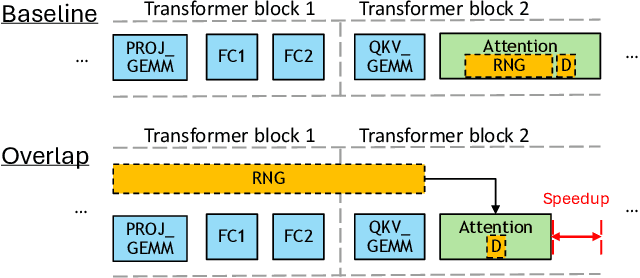
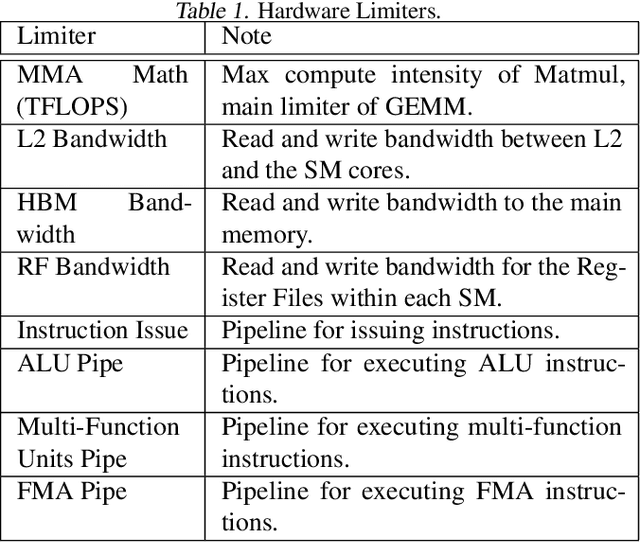
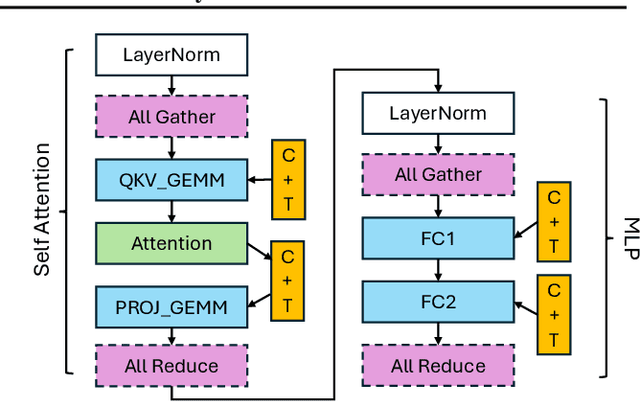
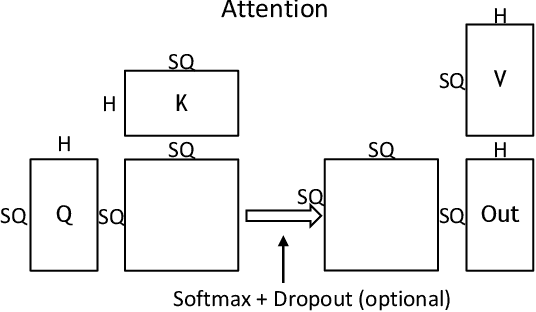
Dropout, a network operator, when enabled is likely to dramatically impact the performance of Flash-Attention, which in turn increases the end-to-end training time of Large-Language-Models (LLMs). The main contributor to such performance degradation is the Random Number Generation (RNG) phase that is traditionally fused into the Flash-Attention kernel. As RNG and Attention have the same hardware bottlenecks, RNG latency can hardly be hidden within the Attention kernel. We propose overlapping RNG with previous GEMM layers in the network to hide RNG runtime and improve end-to-end performance. RNG and GEMM have distinct resource requirements and hardware bottlenecks, so they can run in parallel without compromising each other's performance. Our fine-grained performance model, cross-validated by silicon results, shows 1.14x speedup on one transformer block (including multi-head attention and feed-forward layers) for Llama2, and up to 1.23x speedup when varying workload sizes, on GH100 GPUs with FP8 precision. Further, we extend our theoretical model to different RNG implementations and hardware architectures, and discuss the widely applicable benefits for overlapping RNG with GEMM layers.