 Add to Chrome
 Add to Firefox
 Add to Edge
Self-Supervised Compression and Artifact Correction for Streaming Underwater Imaging Sonar
Nov 17, 2025
Real-time imaging sonar has become an important tool for underwater monitoring in environments where optical sensing is unreliable. Its broader use is constrained by two coupled challenges: highly limited uplink bandwidth and severe sonar-specific artifacts (speckle, motion blur, reverberation, acoustic shadows) that affect up to 98% of frames. We present SCOPE, a self-supervised framework that jointly performs compression and artifact correction without clean-noise pairs or synthetic assumptions. SCOPE combines (i) Adaptive Codebook Compression (ACC), which learns frequency-encoded latent representations tailored to sonar, with (ii) Frequency-Aware Multiscale Segmentation (FAMS), which decomposes frames into low-frequency structure and sparse high-frequency dynamics while suppressing rapidly fluctuating artifacts. A hedging training strategy further guides frequency-aware learning using low-pass proxy pairs generated without labels. Evaluated on months of in-situ ARIS sonar data, SCOPE achieves a structural similarity index (SSIM) of 0.77, representing a 40% improvement over prior self-supervised denoising baselines, at bitrates down to <= 0.0118 bpp. It reduces uplink bandwidth by more than 80% while improving downstream detection. The system runs in real time, with 3.1 ms encoding on an embedded GPU and 97 ms full multi-layer decoding on the server end. SCOPE has been deployed for months in three Pacific Northwest rivers to support real-time salmon enumeration and environmental monitoring in the wild. Results demonstrate that learning frequency-structured latents enables practical, low-bitrate sonar streaming with preserved signal details under real-world deployment conditions.

Exploring Multimodal Foundation AI and Expert-in-the-Loop for Sustainable Management of Wild Salmon Fisheries in Indigenous Rivers
May 10, 2025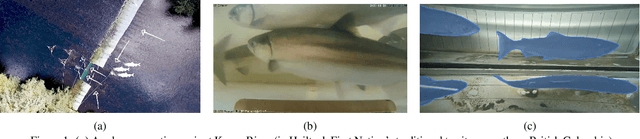
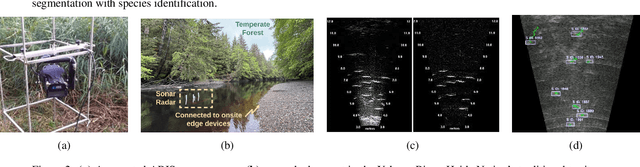
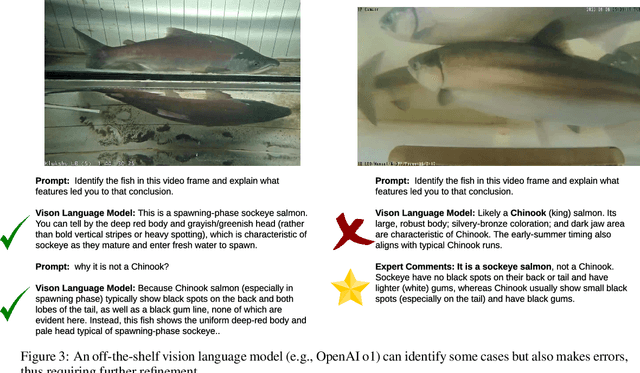
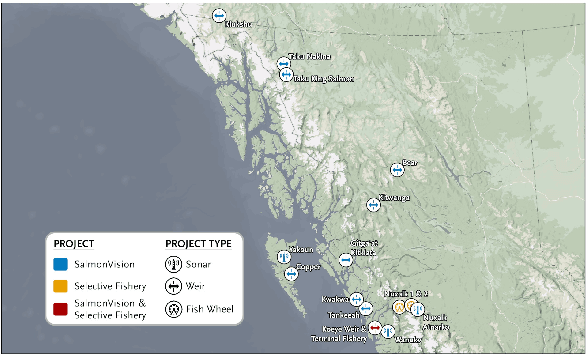
Wild salmon are essential to the ecological, economic, and cultural sustainability of the North Pacific Rim. Yet climate variability, habitat loss, and data limitations in remote ecosystems that lack basic infrastructure support pose significant challenges to effective fisheries management. This project explores the integration of multimodal foundation AI and expert-in-the-loop frameworks to enhance wild salmon monitoring and sustainable fisheries management in Indigenous rivers across Pacific Northwest. By leveraging video and sonar-based monitoring, we develop AI-powered tools for automated species identification, counting, and length measurement, reducing manual effort, expediting delivery of results, and improving decision-making accuracy. Expert validation and active learning frameworks ensure ecological relevance while reducing annotation burdens. To address unique technical and societal challenges, we bring together a cross-domain, interdisciplinary team of university researchers, fisheries biologists, Indigenous stewardship practitioners, government agencies, and conservation organizations. Through these collaborations, our research fosters ethical AI co-development, open data sharing, and culturally informed fisheries management.