 Add to Chrome
 Add to Firefox
 Add to Edge
On the Role of Batch Size in Stochastic Conditional Gradient Methods
Mar 22, 2026
We study the role of batch size in stochastic conditional gradient methods under a $μ$-Kurdyka-Łojasiewicz ($μ$-KL) condition. Focusing on momentum-based stochastic conditional gradient algorithms (e.g., Scion), we derive a new analysis that explicitly captures the interaction between stepsize, batch size, and stochastic noise. Our study reveals a regime-dependent behavior: increasing the batch size initially improves optimization accuracy but, beyond a critical threshold, the benefits saturate and can eventually degrade performance under a fixed token budget. Notably, the theory predicts the magnitude of the optimal stepsize and aligns well with empirical practices observed in large-scale training. Leveraging these insights, we derive principled guidelines for selecting the batch size and stepsize, and propose an adaptive strategy that increases batch size and sequence length during training while preserving convergence guarantees. Experiments on NanoGPT are consistent with the theoretical predictions and illustrate the emergence of the predicted scaling regimes. Overall, our results provide a theoretical framework for understanding batch size scaling in stochastic conditional gradient methods and offer guidance for designing efficient training schedules in large-scale optimization.

Apertus: Democratizing Open and Compliant LLMs for Global Language Environments
Sep 17, 2025
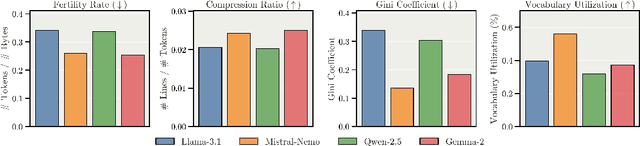

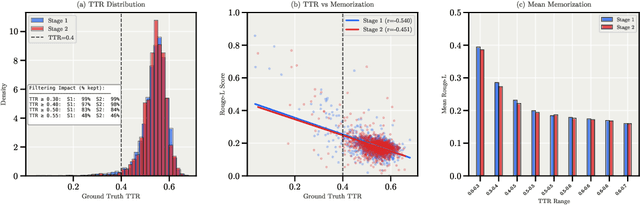
We present Apertus, a fully open suite of large language models (LLMs) designed to address two systemic shortcomings in today's open model ecosystem: data compliance and multilingual representation. Unlike many prior models that release weights without reproducible data pipelines or regard for content-owner rights, Apertus models are pretrained exclusively on openly available data, retroactively respecting robots.txt exclusions and filtering for non-permissive, toxic, and personally identifiable content. To mitigate risks of memorization, we adopt the Goldfish objective during pretraining, strongly suppressing verbatim recall of data while retaining downstream task performance. The Apertus models also expand multilingual coverage, training on 15T tokens from over 1800 languages, with ~40% of pretraining data allocated to non-English content. Released at 8B and 70B scales, Apertus approaches state-of-the-art results among fully open models on multilingual benchmarks, rivalling or surpassing open-weight counterparts. Beyond model weights, we release all scientific artifacts from our development cycle with a permissive license, including data preparation scripts, checkpoints, evaluation suites, and training code, enabling transparent audit and extension.