 Add to Chrome
 Add to Firefox
 Add to Edge
Design, Locomotion, and Control of Amphibious Robots: Recent Advances
Feb 22, 2026
Amphibious robots, operating seamlessly across land and water, are advancing applications in conservation, disaster response, and defense. Their performance depends on locomotion mechanisms, actuation technologies, and sensor-control integration. This review highlights recent progress in these areas, examining movement strategies, material-based actuators, and control systems for autonomy and adaptability. Challenges and opportunities are outlined to guide future research toward more efficient, resilient, and multifunctional amphibious robots.

A Bioinspired Synthetic Nervous System Controller for Pick-and-Place Manipulation
May 18, 2023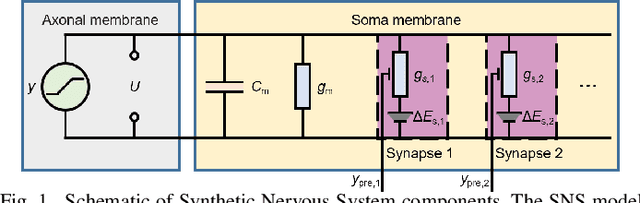
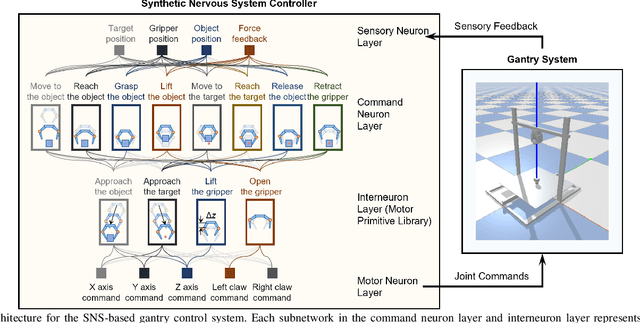
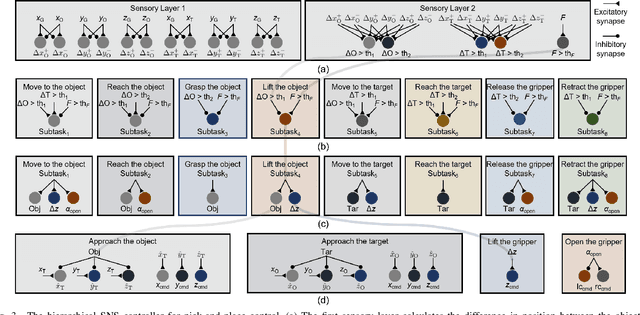
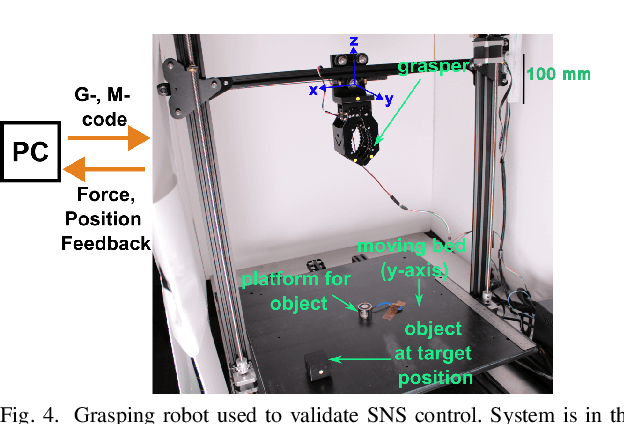
The Synthetic Nervous System (SNS) is a biologically inspired neural network (NN). Due to its capability of capturing complex mechanisms underlying neural computation, an SNS model is a candidate for building compact and interpretable NN controllers for robots. Previous work on SNSs has focused on applying the model to the control of legged robots and the design of functional subnetworks (FSNs) to realize dynamical systems. However, the FSN approach has previously relied on the analytical solution of the governing equations, which is difficult for designing more complex NN controllers. Incorporating plasticity into SNSs and using learning algorithms to tune the parameters offers a promising solution for systematic design in this situation. In this paper, we theoretically analyze the computational advantages of SNSs compared with other classical artificial neural networks. We then use learning algorithms to develop compact subnetworks for implementing addition, subtraction, division, and multiplication. We also combine the learning-based methodology with a bioinspired architecture to design an interpretable SNS for the pick-and-place control of a simulated gantry system. Finally, we show that the SNS controller is successfully transferred to a real-world robotic platform without further tuning of the parameters, verifying the effectiveness of our approach.