 Add to Chrome
 Add to Firefox
 Add to Edge
Automating Information Extraction and Retrieval for Industrial Spare Parts Pooling
Jun 02, 2026
Maintenance organizations in manufacturing try to avoid downtime and unnecessary purchasing by reusing existing assets, but the main obstacle is not a lack of parts but a lack of actionable visibility across sites and partners. Inventories are distributed, described with inconsistent naming conventions, and contain duplicates and partially specified references, so the right part often exists somewhere but remains effectively undiscoverable. The paper proposes PhRAG, a hybrid Retrieval-Augmented Generation for Pooling this fragmented landscape into a Virtual Stock Pool (VSPool) that can be structured and searched as a single resource. Unstructured, heterogeneous spare part descriptions are structured via Named Entity Recognition (NER) into a shared virtual pool dataset and indexed to support robust retrieval even when users express needs in natural language rather than exact technical specifications. The proposed modular pipeline leverages the multitasking nature of generative language models to cover two dimensions that make industrial parts pooling challenging: (i) unstructured technical specifications from diverse data sources (e.g. new partners, catalogs, marketplace listings) are handled through an offline extraction and (ii) request variability at runtime (references, partial references, specifications, price/condition constraints) is handled through a hybrid RAG-based search engine capable of retrieving relevant components and justifying results. The framework demonstrates the potential of generative approaches compared with traditional NER approaches in the presence of data scarcity for technical specifications extraction and overcomes the opacity of standard information retrieval systems by generating justifications for retrieved components. The project's open-source code can be found at https://github.com/roccofelici/vspool.

EBuddy: a workflow orchestrator for industrial human-machine collaboration
Mar 30, 2026This paper presents EBuddy, a voice-guided workflow orchestrator for natural human-machine collaboration in industrial environments. EBuddy targets a recurrent bottleneck in tool-intensive workflows: expert know-how is effective but difficult to scale, and execution quality degrades when procedures are reconstructed ad hoc across operators and sessions. EBuddy operationalizes expert practice as a finite state machine (FSM) driven application that provides an interpretable decision frame at runtime (current state and admissible actions), so that spoken requests are interpreted within state-grounded constraints, while the system executes and monitors the corresponding tool interactions. Through modular workflow artifacts, EBuddy coordinates heterogeneous resources, including GUI-driven software and a collaborative robot, leveraging fully voice-based interaction through automatic speech recognition and intent understanding. An industrial pilot on impeller blade inspection and repair preparation for directed energy deposition (DED), realized by human-robot collaboration, shows substantial reductions in end-to-end process duration across onboarding, 3D scanning and processing, and repair program generation, while preserving repeatability and low operator burden.
Imitation Learning-based Visual Servoing for Tracking Moving Objects
Sep 14, 2023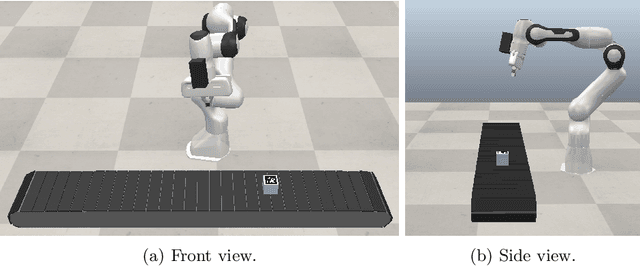
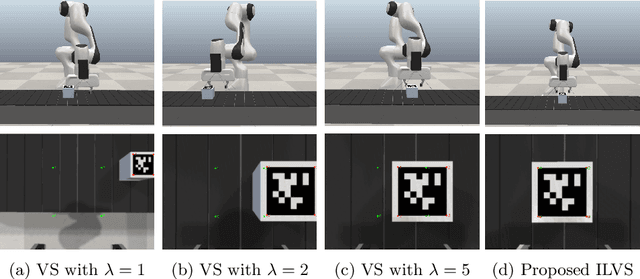
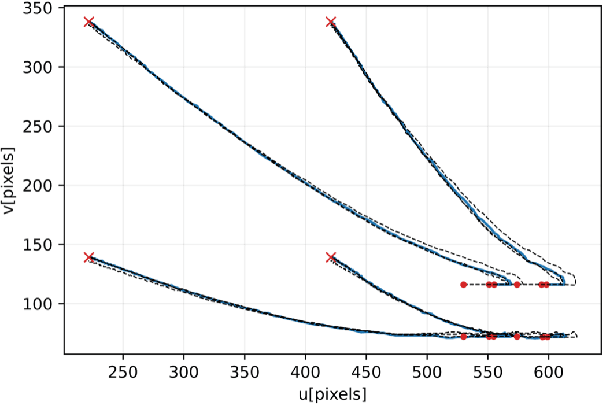
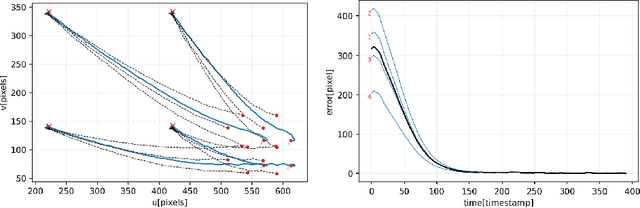
In everyday life collaboration tasks between human operators and robots, the former necessitate simple ways for programming new skills, the latter have to show adaptive capabilities to cope with environmental changes. The joint use of visual servoing and imitation learning allows us to pursue the objective of realizing friendly robotic interfaces that (i) are able to adapt to the environment thanks to the use of visual perception and (ii) avoid explicit programming thanks to the emulation of previous demonstrations. This work aims to exploit imitation learning for the visual servoing paradigm to address the specific problem of tracking moving objects. In particular, we show that it is possible to infer from data the compensation term required for realizing the tracking controller, avoiding the explicit implementation of estimators or observers. The effectiveness of the proposed method has been validated through simulations with a robotic manipulator.