 Add to Chrome
 Add to Firefox
 Add to Edge
ARGUS: Aligning Robot Scene Geometry Under Shifting Views with Large 3D Vision Models
Aug 06, 2026
Large-scale visuomotor policies have demonstrated impressive performance across a wide range of robot manipulation tasks. However, despite this success, manipulation polices often entangle scene geometry with the corresponding viewpoint, learning where objects lie in an image rather than where it lies in the task space. This entanglement inherently limits the corresponding policy's ability to learn from viewpoint-diverse datasets (ex. DROID, BridgeV2) and generalize beyond the viewpoints captured in their training data. In this work, we present ARGUS, an observation pre-processing pipeline that uses large-scale 3D vision models to align image observations from arbitrary camera viewpoints into a canonical viewpoint before passing it to downstream visuomotor policies. Experiments across training datasets with varying levels of viewpoint diversity, from fixed multi-view camera configurations to highly varied camera placements, show that our method consistently outperforms prior approaches across both limited-view and view-diverse training regimes. In efficiency comparisons, ARGUS demonstrates an ability to learn from view-diverse data, converging to high success rates 4-6x faster than previous methods by leveraging a simplified observation space. Overall, our findings show that leveraging large-scale 3D vision models reduces the learning burden on visuomotor policies, enabling more efficient learning from large-scale, viewpoint-diverse robot datasets.

A Training-Free Framework for Precise Mobile Manipulation of Small Everyday Objects
Feb 19, 2025Many everyday mobile manipulation tasks require precise interaction with small objects, such as grasping a knob to open a cabinet or pressing a light switch. In this paper, we develop Servoing with Vision Models (SVM), a closed-loop training-free framework that enables a mobile manipulator to tackle such precise tasks involving the manipulation of small objects. SVM employs an RGB-D wrist camera and uses visual servoing for control. Our novelty lies in the use of state-of-the-art vision models to reliably compute 3D targets from the wrist image for diverse tasks and under occlusion due to the end-effector. To mitigate occlusion artifacts, we employ vision models to out-paint the end-effector thereby significantly enhancing target localization. We demonstrate that aided by out-painting methods, open-vocabulary object detectors can serve as a drop-in module to identify semantic targets (e.g. knobs) and point tracking methods can reliably track interaction sites indicated by user clicks. This training-free method obtains an 85% zero-shot success rate on manipulating unseen objects in novel environments in the real world, outperforming an open-loop control method and an imitation learning baseline trained on 1000+ demonstrations by an absolute success rate of 50%.
Opening Cabinets and Drawers in the Real World using a Commodity Mobile Manipulator
Feb 27, 2024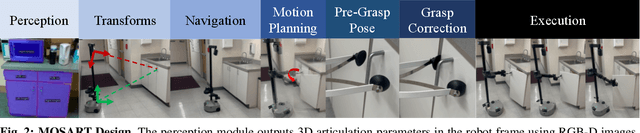
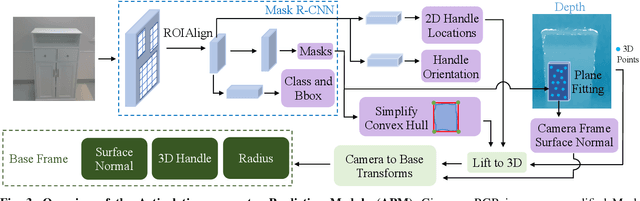
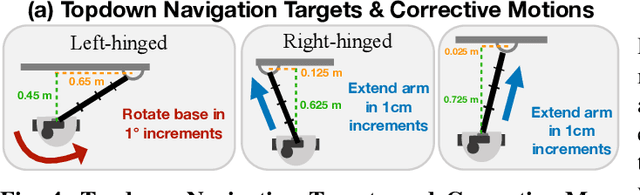

Pulling open cabinets and drawers presents many difficult technical challenges in perception (inferring articulation parameters for objects from onboard sensors), planning (producing motion plans that conform to tight task constraints), and control (making and maintaining contact while applying forces on the environment). In this work, we build an end-to-end system that enables a commodity mobile manipulator (Stretch RE2) to pull open cabinets and drawers in diverse previously unseen real world environments. We conduct 4 days of real world testing of this system spanning 31 different objects from across 13 different real world environments. Our system achieves a success rate of 61% on opening novel cabinets and drawers in unseen environments zero-shot. An analysis of the failure modes suggests that errors in perception are the most significant challenge for our system. We will open source code and models for others to replicate and build upon our system.