 Add to Chrome
 Add to Firefox
 Add to Edge
Hand Visibility Detector: Per-Keypoint Visibility Estimation for Hands
Aug 12, 2026
Hand Pose Estimation (HPE) is a fundamental technology for various applications such as AR/VR and robotics. In these applications, the visibility of each hand joint in the image is crucial for assessing the reliability of estimation results under occlusion. However, most existing HPE methods output joint positions without explicitly indicating their visibility. Although some methods account for occlusion or visibility, visibility estimation has mainly been used as an auxiliary signal for improving pose estimation. To our knowledge, per-joint hand visibility estimation has not been systematically studied as a standalone task. In this work, we propose Hand Visibility Detector, a model for estimating the visibility of individual hand joints, and present the first systematic investigation of visibility estimation as an independent task. We show that leveraging the prior knowledge of HPE models pretrained on large-scale data as a backbone yields high performance in this task. We further demonstrate the utility of Hand Visibility Detector on a downstream task of 3D hand pose annotation via multi-view triangulation of 2D keypoints, showing that visibility-weighted triangulation reduces reprojection error. Our method is released as a ready-to-use package, and the code and demo are available at https://github.com/ryhara/hand_visibility_detector .

MoireMix: A Formula-Based Data Augmentation for Improving Image Classification Robustness
Mar 26, 2026Data augmentation is a key technique for improving the robustness of image classification models. However, many recent approaches rely on diffusion-based synthesis or complex feature mixing strategies, which introduce substantial computational overhead or require external datasets. In this work, we explore a different direction: procedural augmentation based on analytic interference patterns. Unlike conventional augmentation methods that rely on stochastic noise, feature mixing, or generative models, our approach exploits Moire interference to generate structured perturbations spanning a wide range of spatial frequencies. We propose a lightweight augmentation method that procedurally generates Moire textures on-the-fly using a closed-form mathematical formulation. The patterns are synthesized directly in memory with negligible computational cost (0.0026 seconds per image), mixed with training images during training, and immediately discarded, enabling a storage-free augmentation pipeline without external data. Extensive experiments with Vision Transformers demonstrate that the proposed method consistently improves robustness across multiple benchmarks, including ImageNet-C, ImageNet-R, and adversarial benchmarks, outperforming standard augmentation baselines and existing external-data-free augmentation approaches. These results suggest that analytic interference patterns provide a practical and efficient alternative to data-driven generative augmentation methods.
Zero-shot Composed Image Retrieval Considering Query-target Relationship Leveraging Masked Image-text Pairs
Jun 27, 2024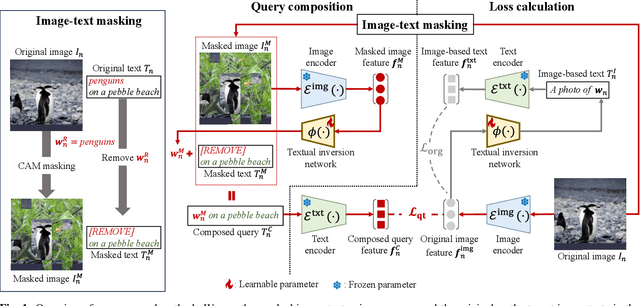

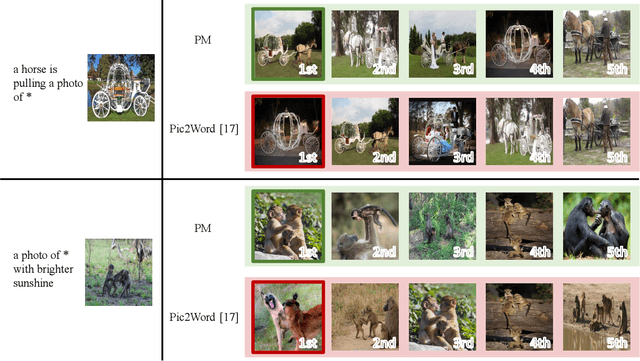
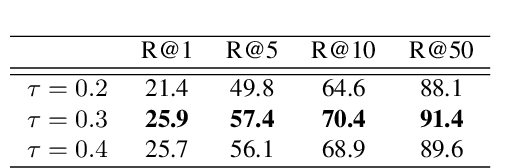
This paper proposes a novel zero-shot composed image retrieval (CIR) method considering the query-target relationship by masked image-text pairs. The objective of CIR is to retrieve the target image using a query image and a query text. Existing methods use a textual inversion network to convert the query image into a pseudo word to compose the image and text and use a pre-trained visual-language model to realize the retrieval. However, they do not consider the query-target relationship to train the textual inversion network to acquire information for retrieval. In this paper, we propose a novel zero-shot CIR method that is trained end-to-end using masked image-text pairs. By exploiting the abundant image-text pairs that are convenient to obtain with a masking strategy for learning the query-target relationship, it is expected that accurate zero-shot CIR using a retrieval-focused textual inversion network can be realized. Experimental results show the effectiveness of the proposed method.
The Effects of Short Video-Sharing Services on Video Copy Detection
Mar 26, 2024The short video-sharing services that allow users to post 10-30 second videos (e.g., YouTube Shorts and TikTok) have attracted a lot of attention in recent years. However, conventional video copy detection (VCD) methods mainly focus on general video-sharing services (e.g., YouTube and Bilibili), and the effects of short video-sharing services on video copy detection are still unclear. Considering that illegally copied videos in short video-sharing services have service-distinctive characteristics, especially in those time lengths, the pros and cons of VCD in those services are required to be analyzed. In this paper, we examine the effects of short video-sharing services on VCD by constructing a dataset that has short video-sharing service characteristics. Our novel dataset is automatically constructed from the publicly available dataset to have reference videos and fixed short-time-length query videos, and such automation procedures assure the reproducibility and data privacy preservation of this paper. From the experimental results focusing on segment-level and video-level situations, we can see that three effects: "Segment-level VCD in short video-sharing services is more difficult than those in general video-sharing services", "Video-level VCD in short video-sharing services is easier than those in general video-sharing services", "The video alignment component mainly suppress the detection performance in short video-sharing services".
Edge-Selective Feature Weaving for Point Cloud Matching
Feb 08, 2022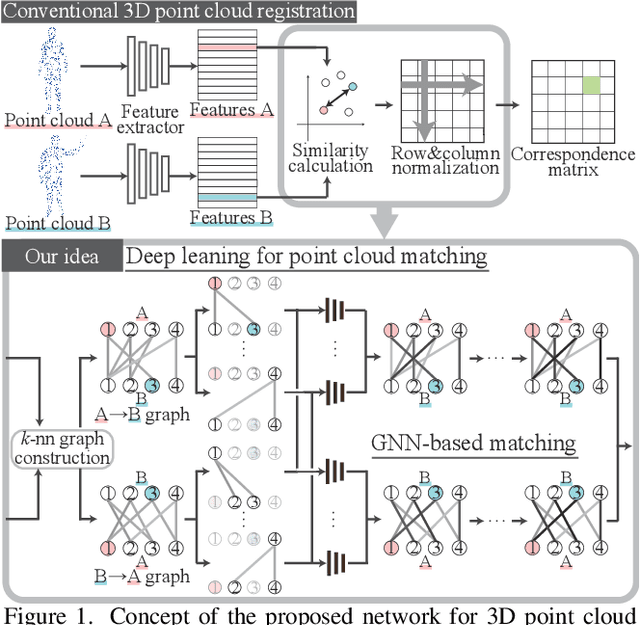
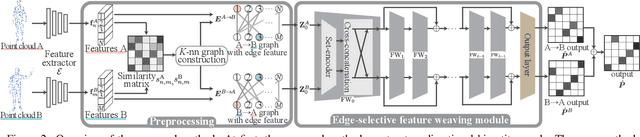
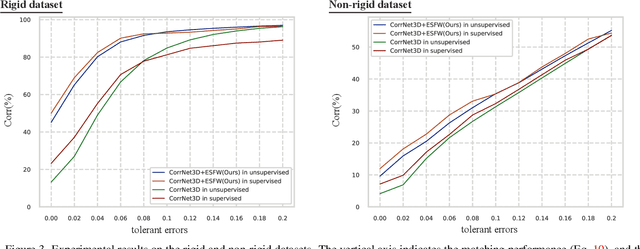
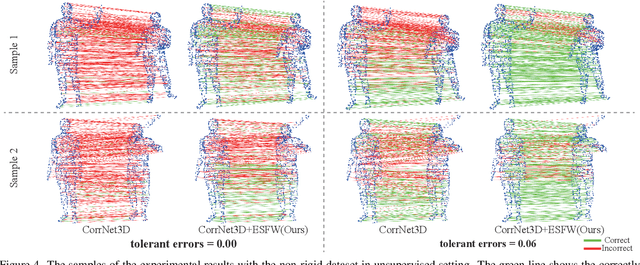
This paper tackles the problem of accurately matching the points of two 3D point clouds. Most conventional methods improve their performance by extracting representative features from each point via deep-learning-based algorithms. On the other hand, the correspondence calculation between the extracted features has not been examined in depth, and non-trainable algorithms (e.g. the Sinkhorn algorithm) are frequently applied. As a result, the extracted features may be forcibly fitted to a non-trainable algorithm. Furthermore, the extracted features frequently contain stochastically unavoidable errors, which degrades the matching accuracy. In this paper, instead of using a non-trainable algorithm, we propose a differentiable matching network that can be jointly optimized with the feature extraction procedure. Our network first constructs graphs with edges connecting the points of each point cloud and then extracts discriminative edge features by using two main components: a shared set-encoder and an edge-selective cross-concatenation. These components enable us to symmetrically consider two point clouds and to extract discriminative edge features, respectively. By using the extracted discriminative edge features, our network can accurately calculate the correspondence between points. Our experimental results show that the proposed network can significantly improve the performance of point cloud matching. Our code is available at https://github.com/yanarin/ESFW